
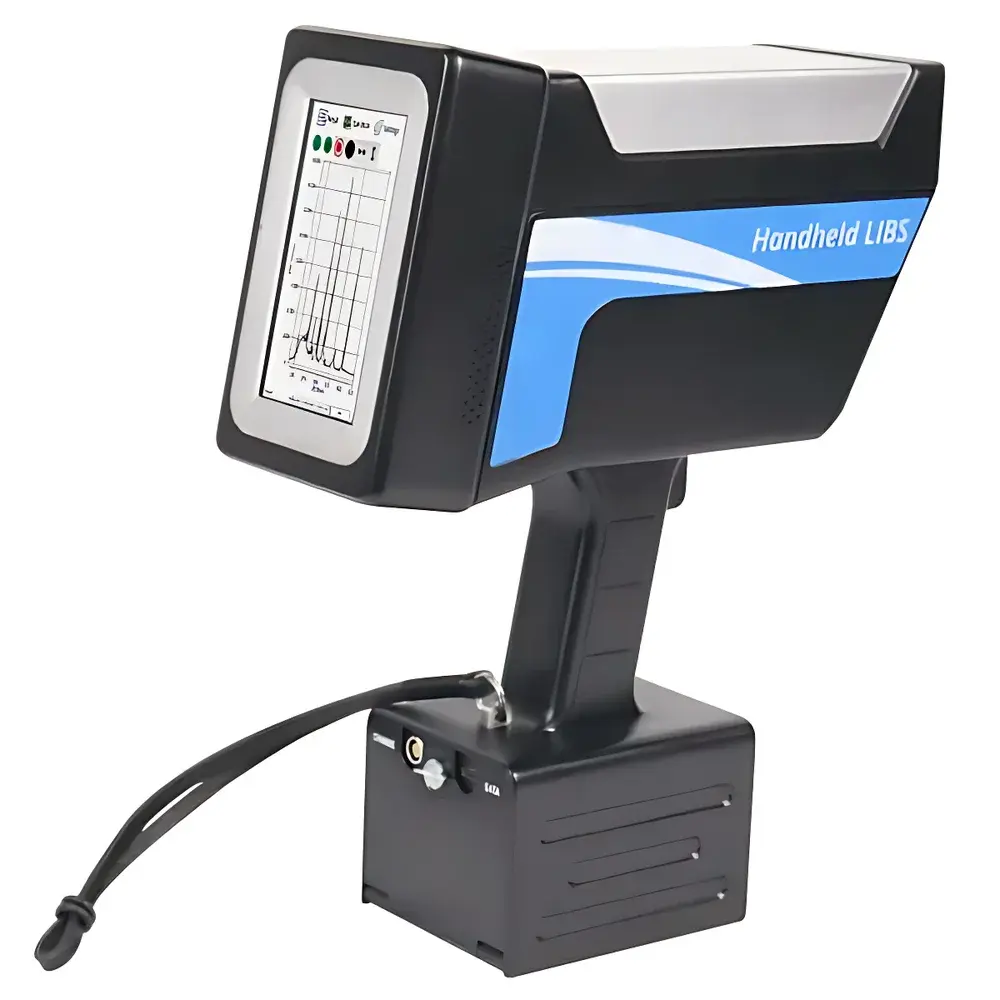
Auniontech LIBS-Handheld Laser-Induced Breakdown Spectrometer
| Brand | Auniontech |
|---|---|
| Origin | Shanghai, China |
| Instrument Type | Handheld |
| Laser Class | Class 3B |
| Wavelength | 1064 nm (Passively Q-Switched Solid-State) |
| Spectral Resolution | < 0.2 nm |
| Spectral Range | 250–415 nm |
| Single-Measurement Duration | ~1 s |
| Detectable Elements | Al, B, Be, Bi, Co, Cr, Cu, Fe, Li, Mg, Mn, Mo, Nb, Ni, Pb, Si, Sn, Ti, V, Zn, Zr (>100 elements) |
| Sample Forms | Solid metals including rods, plates, wires (≥1 mm diameter), foils (~0.02 mm), and bulk fragments (no powders) |
| Base Matrices | Al-, Mg-, Zn-, Cu- (brass/bronze), low-alloy & alloy steels, stainless steels, Ti-, Co-, and Ni-based alloys |
| Display | 4.0″ resistive touchscreen (320 × 480 px) |
| Onboard Storage | 8 GB standard (upgradable to 16 GB) |
| IP Rating | IP54 |
| Operating Temperature | 0–40 °C (recommended: 5–35 °C) |
| Dimensions | 227 × 86 × 234 mm |
| Weight | 2.45 kg |
| Safety | Integrated hardware interlock for laser emission control |
| Electromagnetic Immunity | Industrial-grade EMI resistance |
Overview
The Auniontech LIBS-Handheld Laser-Induced Breakdown Spectrometer is a field-deployable elemental analysis instrument engineered for rapid, in-situ compositional characterization of solid metallic materials. It operates on the fundamental principle of Laser-Induced Breakdown Spectroscopy (LIBS): a focused, nanosecond-class pulsed laser (1064 nm, Class 3B) is directed onto the sample surface, generating a transient microplasma (~10,000–20,000 K). Atoms and ions within the plasma are electronically excited and subsequently emit characteristic atomic line spectra upon relaxation. These emissions are collected via integrated optics and dispersed by a high-resolution Czerny–Turner spectrometer (spectral resolution < 0.2 nm, range 250–415 nm), enabling detection and quantification of elemental signatures across a broad periodic table coverage—including light elements (Li, Be, B) often inaccessible to XRF. Unlike destructive wet chemistry or vacuum-dependent techniques, LIBS requires no sample preparation, minimal surface contact, and delivers single-shot compositional data in approximately one second—making it suitable for high-throughput industrial sorting, alloy verification, and regulatory compliance screening.
Key Features
- True handheld ergonomics: Compact form factor (227 × 86 × 234 mm) and balanced weight (2.45 kg) enable extended use without fatigue; designed for one-handed operation in confined or elevated workspaces.
- Industrial-grade robustness: IP54-rated enclosure ensures operational reliability in dusty, humid, or mildly corrosive environments typical of foundries, scrap yards, and offshore platforms.
- High-fidelity spectral acquisition: Optimized optical path with thermally stabilized spectrometer and low-noise CCD detector ensures consistent signal-to-noise ratio and long-term wavelength calibration stability.
- Real-time elemental identification: Preloaded spectral libraries cover over 100 elements across 11 major alloy families (Al-, Mg-, Ti-, Ni-, Co-, Fe-, Cu-, Zn-, Sn-, Pb-, and Cr-based systems), supporting both qualitative grade matching and semi-quantitative concentration estimation.
- EMI-hardened electronics: Shielded laser driver, spectrometer controller, and touchscreen interface meet IEC 61326-1 requirements for electromagnetic compatibility in electrically noisy industrial settings.
- Laser safety by design: Dual-redundant hardware interlock system physically interrupts laser emission when the measurement window is obstructed or the device is tilted beyond operational angle thresholds—fully compliant with IEC 60825-1:2014.
Sample Compatibility & Compliance
The instrument is validated for direct analysis of conductive and non-conductive solid metal samples—including castings, forgings, extrusions, weld seams, and machined components—with minimal surface conditioning (e.g., removal of heavy oxide layers or coatings recommended for optimal precision). It accommodates irregular geometries such as cylindrical rods (≥1 mm diameter), thin foils (~0.02 mm), and fragmented scrap—eliminating the need for milling, polishing, or pelletization. While not intended for powdered or liquid matrices, its micro-ablation spot size (< 100 µm) preserves sample integrity for subsequent testing. The system adheres to ISO 11583:2012 (LIBS terminology and general principles) and supports traceability workflows aligned with ISO/IEC 17025:2017 for testing laboratories. Data export formats (CSV, XML) facilitate integration into LIMS environments governed by FDA 21 CFR Part 11 and EU Annex 11 requirements for electronic records and signatures.
Software & Data Management
Built-in firmware provides intuitive touchscreen navigation with multilingual UI (English, Chinese, Spanish, German). Spectral acquisition, library matching, and result visualization occur in real time. Each measurement is timestamped, geotagged (via optional external GNSS module), and stored with full metadata—including laser energy, ambient temperature, and operator ID. The onboard 8 GB eMMC storage retains >50,000 spectra; upgradeable to 16 GB for extended campaign logging. Export protocols include USB mass storage, Wi-Fi 802.11n, and Bluetooth 5.0. Desktop software (Windows/macOS) enables advanced post-processing: peak deconvolution, matrix-matched calibration curve generation, PCA-based clustering, and report generation compliant with ASTM E2926-22 (Standard Guide for LIBS Analysis of Metals).
Applications
- Rapid positive material identification (PMI) in petrochemical piping, pressure vessels, and valve assemblies per ASME B31.3 and API RP 578.
- Scrap metal sorting and recycling stream optimization based on elemental composition and alloy grade.
- In-process quality control during additive manufacturing (AM) powder feedstock verification and build layer composition monitoring.
- Field-based verification of aerospace-grade titanium and nickel superalloys against AMS and NADCAP specifications.
- Environmental screening for regulated heavy metals (Pb, Cr, Cd, Hg) in industrial soils and slag under EPA Method 6010D and ISO 17294-2.
- Nuclear facility component assay for cobalt activation products and cladding integrity assessment.
FAQ
Is this instrument suitable for quantitative analysis?
Yes—when calibrated against certified reference materials (CRMs) matched to the target matrix, the system achieves relative standard deviations (RSD) of ≤5% for major and minor constituents (≥0.1 wt%) in homogeneous alloys.
Can it analyze coated or painted surfaces?
The laser pulse can penetrate thin organic coatings (<10 µm); however, thick paints, galvanizing layers, or thermal spray coatings require mechanical abrasion prior to measurement for accurate bulk composition.
What maintenance does the spectrometer require?
No consumables or routine optical alignment is needed. Annual verification of wavelength calibration using internal Ne-Ar lamp reference lines is recommended.
Does it comply with international laser safety standards?
Yes—the integrated interlock, beam shutter, and Class 3B classification conform to IEC 60825-1:2014 and ANSI Z136.1-2022; operator training and controlled access zones are required per local occupational health regulations.
How is data integrity ensured during field use?
All measurements include cryptographic hash signatures, audit trails (user, time, GPS, instrument status), and write-once storage options to satisfy GLP/GMP and ISO 17025 data governance requirements.




