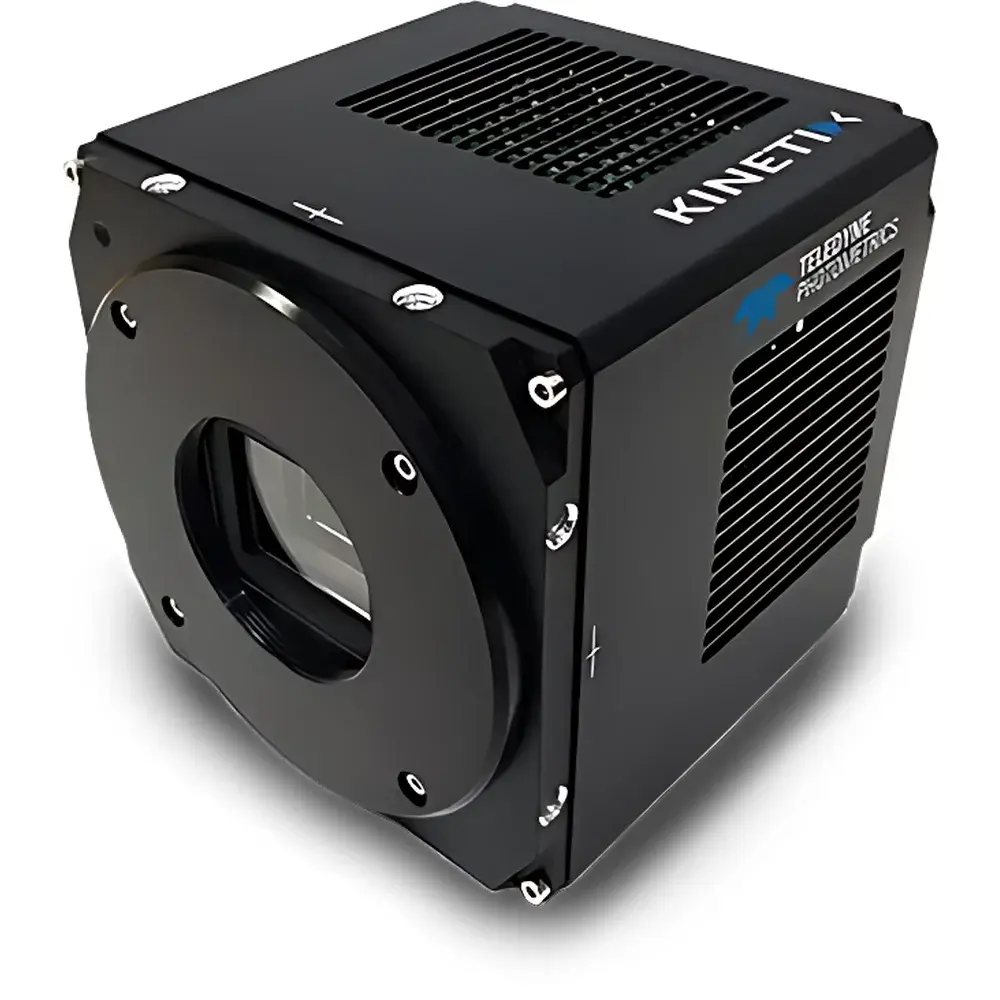
Teledyne Photometrics Kinetix 3200×3200 Back-Illuminated Scientific sCMOS Camera
| Sensor Resolution | 3200 × 3200 |
|---|---|
| Pixel Size | 6.5 µm × 6.5 µm |
| Quantum Efficiency | 95% (peak) |
| Full-Frame Readout Speed | 498 fps |
| Sensor Active Area | 20.8 mm × 20.8 mm |
| Diagonal Field of View | 29.4 mm |
| Read Noise | ≤1.2 e⁻ (at 498 fps, 12-bit) |
| Bit Depth | 8/12/16-bit selectable |
| Interface | PCIe Gen3 x4 and USB 3.2 Gen2 |
| Spectral Response | 200–1700 nm (UV-VIS-NIR) |
| Noise Reduction | Pattern Noise Reduction (PNR) & Correlated Double Sampling (CDS) |
Overview
The Teledyne Photometrics Kinetix is a back-illuminated scientific complementary metal-oxide-semiconductor (sCMOS) camera engineered for high-fidelity, quantitative imaging in demanding low-light applications. Leveraging true back-illumination architecture, the Kinetix achieves near-theoretical quantum efficiency—up to 95% at peak wavelengths—by directing photons directly onto the photosensitive layer without obstruction from wiring or gate structures. This design, combined with optimized microlens and anti-reflection coating stacks, ensures exceptional photon capture across ultraviolet (200–400 nm), visible (400–700 nm), and near-infrared (700–1700 nm) spectral bands. The 3200 × 3200 pixel sensor delivers 10.2 megapixels of spatial resolution with uniform 6.5 µm square pixels—optimized for standard 40× and 60× microscope objectives—while maintaining sub-electron read noise (<1.2 e⁻) at full-frame speeds of 498 frames per second. Its large 20.8 mm × 20.8 mm active area supports wide-field microscopy, light-sheet imaging, and synchrotron beamline diagnostics where both field-of-view scalability and single-photon sensitivity are critical.
Key Features
- Back-illuminated sCMOS architecture: Enables 95% peak quantum efficiency through direct photon absorption in the silicon photodiode layer, minimizing reflection and absorption losses.
- High-speed, high-fidelity acquisition: Sustains 498 fps at full resolution with 50 million pixels/sec throughput—without compromising dynamic range or linearity.
- Large-format sensor with optimized pixel pitch: 20.8 mm × 20.8 mm active area provides 2.4× greater imaging area than conventional 2k × 2k sCMOS sensors, improving experimental throughput in wide-field and multi-position acquisitions.
- Multi-bit depth flexibility: Hardware-selectable 8-, 12-, or 16-bit digitization allows trade-offs between speed, dynamic range, and data volume—fully compatible with quantitative intensity calibration protocols.
- Advanced on-sensor noise suppression: Integrated Pattern Noise Reduction (PNR) and Correlated Double Sampling (CDS) eliminate fixed-pattern noise and reset kTC noise, yielding clean, artifact-free images essential for background-limited applications such as single-molecule localization microscopy (SMLM) and fluorescence correlation spectroscopy (FCS).
Sample Compatibility & Compliance
The Kinetix is designed for integration into regulated and research-grade optical systems requiring traceable performance and long-term stability. Its analog-to-digital conversion chain is calibrated to NIST-traceable standards, and firmware implements non-linear gain compensation to ensure pixel response uniformity across the entire sensor. The camera complies with CE, FCC Class A, and RoHS directives. For laboratories operating under Good Laboratory Practice (GLP) or Good Manufacturing Practice (GMP) frameworks, the Kinetix supports audit-ready metadata logging—including exposure time, temperature, bit depth, and gain settings—within TIFF and HDF5 file headers. While not FDA 21 CFR Part 11-certified out-of-the-box, its deterministic frame timing, hardware-triggered acquisition modes, and deterministic data path make it suitable for validation in ISO 13485-compliant instrumentation when deployed with validated software environments.
Software & Data Management
Kinetix operates natively via Photometrics’ unified SDK (v5.x), supporting Windows and Linux platforms with C/C++, Python (PyPhotometrics), MATLAB, and LabVIEW bindings. The included MetaMorph-compatible driver enables seamless integration into established microscopy platforms including Nikon NIS-Elements, Zeiss ZEN, and Olympus cellSens. All acquired images embed EXIF-like metadata—exposure timestamp (µs resolution), sensor temperature, ROI coordinates, and bit-depth configuration—enabling reproducible post-acquisition analysis. Raw data export supports lossless compression (HDF5 with LZ4) and memory-mapped I/O for real-time streaming into GPU-accelerated processing pipelines. Firmware updates are delivered via signed binary packages with SHA-256 checksum verification to ensure integrity and version control in multi-instrument deployments.
Applications
- Super-resolution microscopy: Supports PALM, STORM, and MINFLUX workflows requiring high localization precision, low background, and precise photon counting over extended acquisition durations.
- Light-sheet fluorescence microscopy (LSFM): Large FOV and high frame rate enable volumetric imaging of cleared tissues and live embryos at cellular resolution without motion blur.
- Electron microscopy correlation (CLEM): UV-enhanced QE facilitates simultaneous fluorescence pre-screening and EM target registration with minimal sample exposure.
- Synchrotron and X-ray imaging: NIR sensitivity and radiation-hardened packaging support indirect detection via scintillator coupling in hard X-ray beamlines.
- Quantitative live-cell assays: Sub-electron noise floor and linear response over 5-decade dynamic range allow absolute quantification of fluorescent protein expression kinetics and FRET efficiency.
FAQ
What is the maximum sustained frame rate at full 3200 × 3200 resolution?
498 fps is achievable using the PCIe Gen3 ×4 interface with appropriate host system configuration (e.g., ≥32 GB RAM, NVMe storage, and dedicated CPU core allocation). USB 3.2 Gen2 supports up to 200 fps at full resolution.
Does the Kinetix support hardware triggering and external synchronization?
Yes—dedicated TTL-compatible trigger input/output ports support master-slave configurations, pulse-width modulation, and frame-blanking for laser-gated imaging.
How is sensor temperature stabilized during long acquisitions?
The camera incorporates a thermoelectric cooler (TEC) with closed-loop PID control, maintaining sensor temperature within ±0.1°C of setpoint (range: −25°C to +20°C ambient).
Can the Kinetix be used with custom optics outside standard microscope mounts?
Yes—the C-mount interface is standard; optional F-mount and M42 adapters are available. Mechanical drawings and flange focal distance specifications are provided in the technical documentation package.
Is dark current characterization data provided with each unit?
Each camera ships with a factory-measured dark current map (per-pixel median value at multiple temperatures and exposure times), accessible via SDK for real-time dark frame subtraction.