
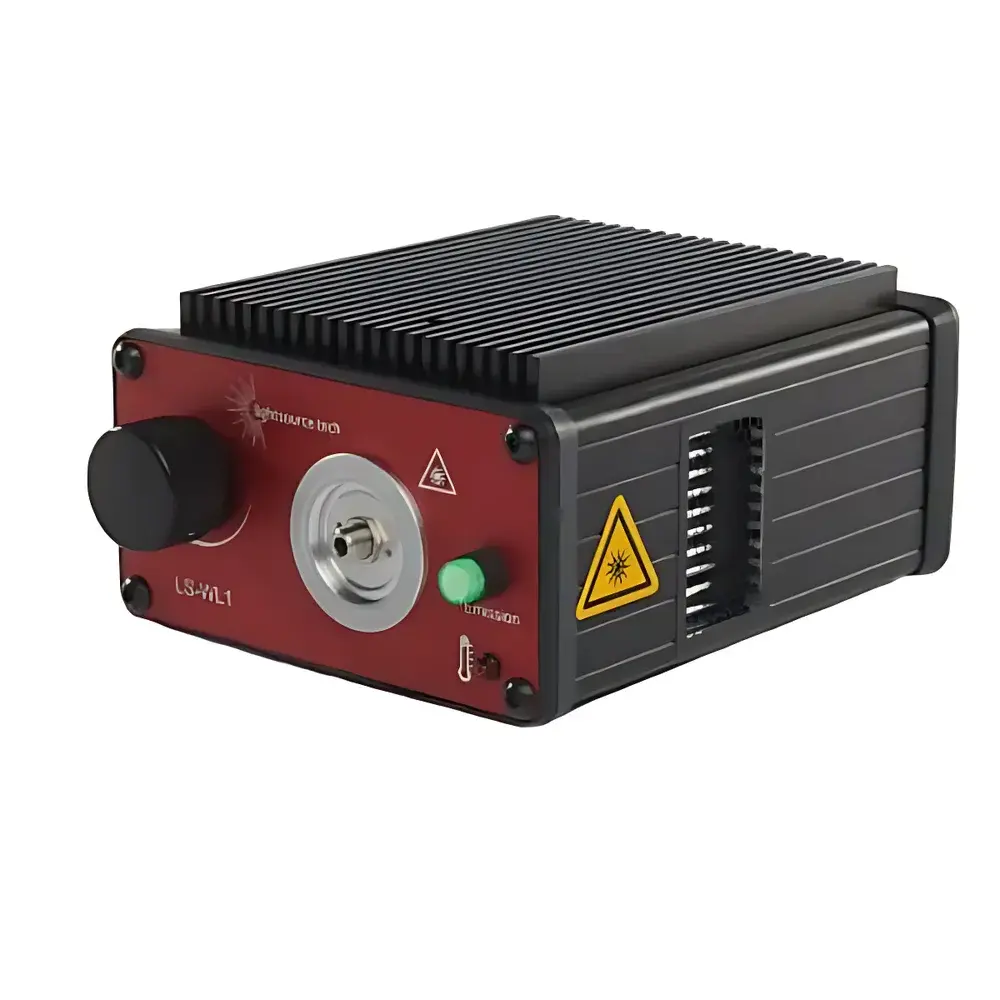
Auniontech LS-WL Laser-Pumped White Light Source (470–700 nm)
| Brand | Auniontech |
|---|---|
| Origin | Shanghai, China |
| Manufacturer Type | Authorized Distributor |
| Product Category | Domestic |
| Model | LS-WL Tunable Broadband White Light Source |
| Output Power | ≥440 mW (into 600 µm multimode fiber, NA 0.5) |
| Wavelength Range | 450–700 nm |
| Trigger Frequency | Up to 200 kHz (TTL, SMA) |
| Pulse Width & Delay | User-Programmable |
| Fiber Coupling | SMA adapter, 50 µm–1 mm multimode fiber |
| Control Interface | USB/RS-232 (Mini-B), ASCII command set |
| Power Supply | 12 V DC, 2.5 A (~20 W max) |
| Dimensions | 125 × 110 × 60 mm³ |
| Weight | 450 g |
| Lifetime | >10,000 h |
| Thermal Management | Dual high-performance fans + integrated temperature sensor with programmable shutdown (default range: 10–30 °C) |
| Compliance | CE-marked, RoHS-compliant |
Overview
The Auniontech LS-WL is a compact, laser-pumped broadband white light source engineered for high-brightness, spatially coherent point illumination across the visible spectrum (450–700 nm). Unlike conventional LED or halogen-based broadband sources, the LS-WL employs two precisely aligned laser diodes focused onto an integrated ceramic phosphor converter chip—enabling efficient spectral down-conversion and yielding exceptional radiance from a sub-millimeter emission core. This architecture delivers a stable, diffraction-limited point source ideal for applications demanding high photon flux density, temporal synchronization, and long-term intensity stability. The device operates on the principle of laser-excited photoluminescence in a thermally robust phosphor matrix, offering superior brightness (>440 mW into 600 µm fiber, NA 0.5), narrow spatial coherence, and minimal thermal drift—making it suitable for quantitative optical metrology, time-resolved imaging, and interferometric systems requiring consistent illumination over extended operational periods.
Key Features
- High-radiance output: ≥440 mW coupled into multimode fiber (600 µm core, NA 0.5); scalable up to ~500 mW depending on fiber geometry and coupling efficiency
- Sub-millimeter emission core (<1 mm) delivering brightness orders of magnitude higher than standard LEDs—enabling high numerical aperture collection and reduced étendue mismatch
- Programmable pulsed operation: TTL-triggered stroboscopic mode up to 200 kHz; fully adjustable pulse width and delay via ASCII commands for precise synchronization with high-speed cameras, lock-in amplifiers, or gated detectors
- Compact, fan-cooled thermal architecture: dual high-efficiency fans and real-time temperature monitoring with user-configurable thermal shutdown threshold (default: 10–30 °C)
- Flexible integration: SMA-fiber-coupled output compatible with standard optical breadboards, microscope ports, spectrometer inputs, and custom optomechanical assemblies
- Lightweight design (450 g) and low power consumption (~20 W at full output) support portable, benchtop, and embedded system deployment
- Proven long-term reliability: >10,000 hours rated lifetime under continuous operation; validated in peer-reviewed interferometric studies requiring strict photometric stability
Sample Compatibility & Compliance
The LS-WL is optimized for use with standard silica-based multimode fibers (50 µm to 1 mm core diameter, NA 0.22–0.5), enabling seamless integration into existing optical setups without alignment recalibration. Its output spectrum exhibits smooth continuity across 450–700 nm—free of discrete laser lines—making it appropriate for fluorescence excitation (e.g., FITC, TRITC), reflectance spectroscopy, and white-light interferometry. The unit complies with CE Directive 2014/30/EU (EMC) and 2011/65/EU (RoHS), and its electrical interface meets IEC 61000-4-2/4-3 immunity standards. While not certified to ISO/IEC 17025 or GLP/GMP out-of-the-box, its deterministic output control, audit-ready ASCII command logging, and stable intensity profile support traceable calibration workflows in regulated environments—including ISO 13694 (optical radiation safety) and ASTM E308 (colorimetry) compliant configurations when paired with NIST-traceable photodetectors.
Software & Data Management
Control is implemented via a lightweight ASCII command protocol over USB-to-RS232 (Mini-B connector), eliminating dependency on proprietary drivers or runtime libraries. Commands support real-time adjustment of output intensity (1–100%), trigger parameters (frequency, width, delay), and thermal thresholds. An open-source Python API and LabVIEW VI library are available for rapid integration into automated test benches, machine vision pipelines, or custom DAQ platforms. The GUI application—compatible with Windows, macOS, and Linux—supports multi-unit control, script-based sequence execution, and timestamped parameter logging. All communication is stateless and non-blocking, ensuring deterministic timing for hard-real-time applications. No cloud connectivity or telemetry is embedded; data remains local and fully auditable—aligning with ITAR-free and FDA 21 CFR Part 11–compatible validation requirements when deployed with appropriate electronic record controls.
Applications
- Quantitative optical metrology: White-light interferometry, coherence scanning interferometry (CSI), and low-coherence interferometry (LCI) requiring stable, broadband point sources with minimal speckle and high temporal coherence length
- Machine vision & industrial inspection: High-speed stroboscopic illumination synchronized to line-scan or area-scan cameras for defect detection on moving substrates (e.g., semiconductor wafers, printed circuit boards)
- Biomedical imaging: Fluorescence microscopy excitation, endomicroscopy probe illumination, and OCT reference arm illumination where spectral continuity and intensity stability are critical
- Spectroscopic calibration: Broadband reference source for CCD/CMOS spectrometer flat-field correction, wavelength calibration, and stray-light characterization
- Optical component testing: Non-contact surface profiling of aspheric lenses, diffractive optical elements (DOEs), and micro-optics using structured illumination or fringe projection
- Environmental sensing: Portable LIDAR seed illumination, underwater optical communication testbeds, and atmospheric scattering simulation
FAQ
What is the spectral shape of the LS-WL output?
The LS-WL emits a smooth, continuous spectrum from 450 nm to 700 nm with no dominant laser peaks—resulting from broadband photoluminescence in the ceramic phosphor. Spectral flatness is ±15% RMS across the band when measured with a calibrated spectrometer.
Can the LS-WL be operated in continuous-wave (CW) mode?
Yes—intensity is continuously adjustable from 1% to 100% in CW mode. Pulsed and CW modes are mutually exclusive and selected via command.
Is fiber coupling efficiency dependent on core diameter?
Yes—output power scales approximately linearly with core area for fixed NA. Maximum power (≥440 mW) is specified for 600 µm fiber (NA 0.5); coupling into smaller cores reduces total throughput but increases radiance.
Does the LS-WL require external cooling or water circulation?
No—integrated dual-fan active cooling and thermal feedback ensure safe operation up to ambient temperatures of 35 °C without auxiliary heat sinking.
How is intensity stability quantified over time?
Under constant drive current and ambient conditions, intensity drift is <±0.3% over 8 hours and <±1.2% over 1,000 hours—verified per IEC 61223-3-5 Annex D protocols for medical optical devices.




