
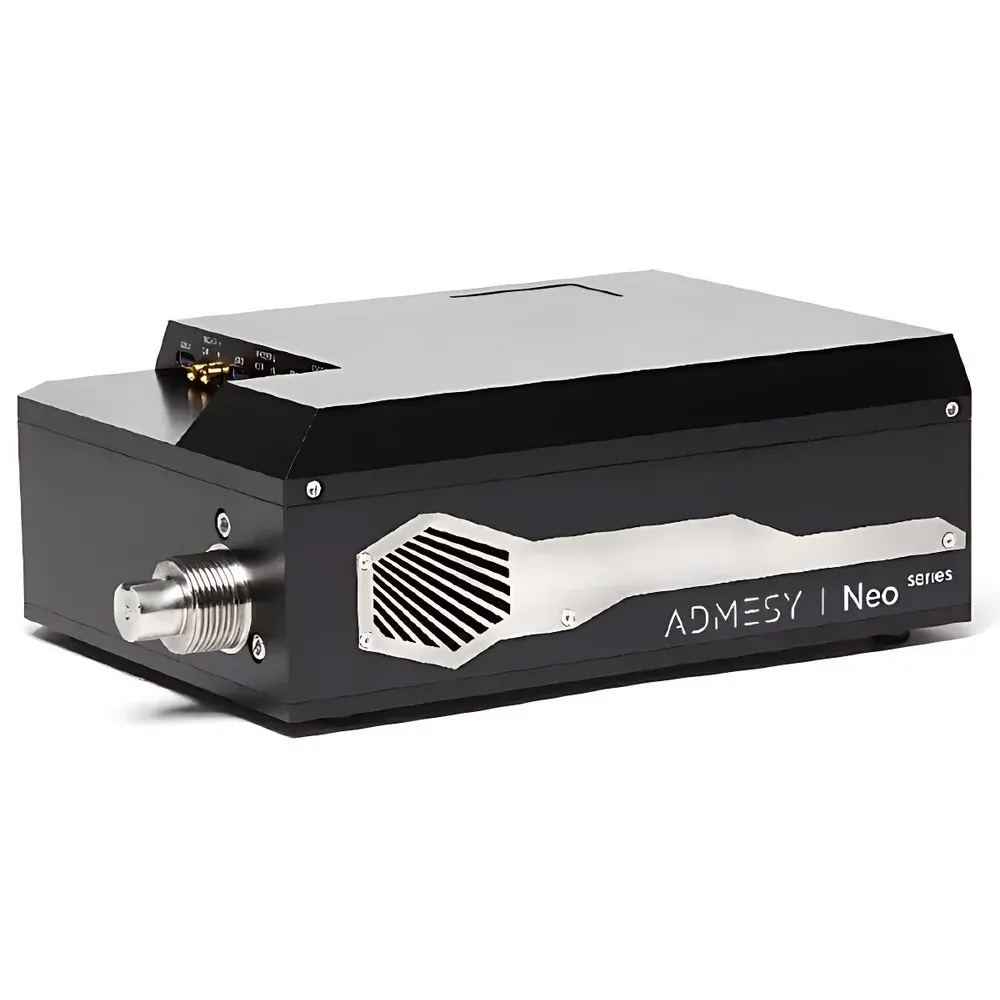
Auniontech NEO High-Performance Cooled CCD Spectrometer
| Brand | Auniontech |
|---|---|
| Origin | Netherlands |
| Manufacturer Type | Authorized Distributor |
| Origin Category | Imported |
| Model | NEO |
| Pricing | Upon Request |
| Spectral Range | 250–1100 nm (configurable broadband or tunable variants) |
| Detector | Thermoelectrically Cooled CCD (–10 °C) |
| Optical Resolution | Up to ~0.1 nm (dependent on grating and slit configuration) |
| Stray Light | < 0.01% |
| Linearity Error | < 1% (internally compensated) |
| Dark Current Compensation | Near-zero across full integration time range |
| Interface | USB 3.0 (USBTMC/SCPI), RS232, Ethernet, TTL trigger I/O |
| Active Accessory Control | Up to 3 devices (e.g., LED sources, filter wheels) |
| Fiber Coupling | Industrial-grade FC/PC or SMA (via adapter) |
| Housing | IP54-rated ruggedized enclosure for industrial deployment |
| Compliance | CE, RoHS, ISO/IEC 17025-compatible calibration traceability |
Overview
The Auniontech NEO High-Performance Cooled CCD Spectrometer is an engineered solution for precision optical spectral analysis in demanding laboratory, industrial QA/QC, and R&D environments. Based on a fixed-grating, crossed-Czerny–Turner optical architecture, the NEO delivers high-fidelity spectral data across the ultraviolet–visible–near-infrared (UV-VIS-NIR) domain—from 250 nm to 1100 nm—using a thermoelectrically cooled back-illuminated CCD detector operating at –10 °C. This active cooling significantly suppresses dark current and thermal noise, enabling extended integration times (up to several seconds) without signal degradation. The spectrometer’s high-throughput optical design maximizes photon collection efficiency while maintaining low stray light (< 0.01%), ensuring accurate quantification of absorbance, transmittance, reflectance, and radiant flux. Its modular platform supports both direct optical coupling (e.g., via cosine correctors or integrating spheres) and robust fiber-optic interfacing—facilitating seamless integration into inline process monitoring systems, LED binning stations, thin-film metrology setups, and photobiological safety testing workflows.
Key Features
- Thermoelectrically cooled CCD detector stabilized at –10 °C for ultra-low noise and high dynamic range (typical SNR > 1000:1 at saturation)
- Configurable spectral coverage: broadband variant (~850 nm dispersion) or tunable variant (~580 nm dispersion), supporting custom grating and slit options
- Integrated mechanical shutter for precise dark reference acquisition and automated background subtraction
- Real-time auto-ranging and internal wavelength calibration (NIST-traceable Hg/Ne lamp support optional)
- Onboard spectral processing: automatic calculation of absorbance, %T, irradiance, colorimetric values (CIE XYZ, CCT, CRI), and peak detection—reducing host CPU load
- Multi-interface connectivity: USB 3.0 (USBTMC compliant with SCPI command set), RS232, Gigabit Ethernet, and programmable TTL trigger I/O for synchronized multi-device operation
- Ruggedized aluminum housing rated IP54, optimized for vibration resistance and thermal stability in production-floor environments
- Dedicated accessory control interface supporting up to three active peripherals—including LED light sources, motorized filter wheels, and shutter drivers—via integrated 5 V/500 mA power and digital control lines
Sample Compatibility & Compliance
The NEO spectrometer accommodates diverse sample geometries and measurement modalities through standardized optical interfaces. With optional cosine correction optics, it meets IEC 62471 and CIE S 026 requirements for radiometric and photometric measurements of LEDs and solid-state lighting (SSL). When coupled to an integrating sphere (e.g., Labsphere or Avantes models), it complies with ASTM E308 for colorimetric analysis and ISO 13406-2 for display luminance uniformity assessment. For thin-film characterization, the system supports variable-angle reflectance and transmission measurements when paired with motorized goniometers. All factory calibrations are performed under ISO/IEC 17025-accredited conditions, with documentation available for GLP/GMP-regulated environments. Firmware and driver software adhere to FDA 21 CFR Part 11 principles for electronic records and signatures where audit trails and user access controls are implemented.
Software & Data Management
The NEO operates natively with Auniontech’s SpectraSuite Pro—a cross-platform application (Windows/macOS/Linux) supporting real-time spectrum acquisition, batch processing, and report generation in PDF, CSV, and XML formats. The SDK (C/C++, Python, MATLAB, LabVIEW) provides full SCPI command access for custom automation in manufacturing execution systems (MES) or LIMS integration. Raw spectral data retains full 16-bit depth and timestamp metadata, enabling post-acquisition recalibration and spectral deconvolution. Internal memory buffers allow gap-free acquisition at up to 100 spectra/sec (USB 3.0 mode), with onboard averaging and smoothing filters applied in real time. Audit logs record all parameter changes, calibration events, and user actions—supporting traceability requirements per ISO 9001 and ISO 13485 quality management systems.
Applications
- LED and OLED spectral characterization: CCT, CRI, TM-30 metrics, binning, and aging studies
- Thin-film interference analysis: thickness mapping, refractive index extraction, and coating uniformity verification
- Pharmaceutical and chemical QC: UV-Vis quantification of active ingredients, dissolution testing, and excipient identification
- Environmental monitoring: water quality (COD, nitrate, turbidity), air pollutant detection (NO₂, SO₂ absorption bands)
- Material science: semiconductor bandgap determination, quantum dot emission profiling, and photovoltaic EQE measurement
- Biomedical optics: tissue oxygenation monitoring (NIR spectroscopy), fluorescence lifetime screening, and laser safety compliance testing
FAQ
What spectral resolution can the NEO achieve?
Resolution is configuration-dependent: typical FWHM values range from 0.1 nm to 2.5 nm, determined by grating groove density, entrance slit width (10–200 µm), and detector pixel binning.
Is the NEO compatible with third-party integrating spheres?
Yes—standard 1/4″ or 1/2″ fiber ports accept SMA905 or FC/PC connectors; mechanical adapters enable direct coupling to spheres from Labsphere, SphereOptics, or StellarNet.
Can the NEO perform absolute irradiance measurements?
When calibrated against a NIST-traceable tungsten halogen or deuterium lamp, the NEO provides traceable irradiance (W/m²/nm) with uncertainty ≤ ±3% (k=2) across 350–1050 nm.
Does the firmware support remote firmware updates?
Yes—over-the-air updates via Ethernet or USB are supported, with version rollback capability and SHA-256 signature verification for integrity assurance.
What is the maximum recommended fiber length for stable signal transmission?
For optimal SNR and minimal modal noise, multimode silica fibers up to 5 m (core diameter ≥ 400 µm, NA 0.22) are recommended; longer lengths require attenuation correction during calibration.




