Auniontech Orchestra™ FROG Ultrafast Pulse Characterization System
| Brand | Auniontech |
|---|---|
| Model | Orchestra™ FROG |
| Type | Frequency-Resolved Optical Gating (FROG) Instrument |
| Spectral Range | 200 nm – 5 µm (configurable by module) |
| Pulse Duration Range | 2 fs – 4 ps |
| Minimum Input Pulse Energy | 2 nJ (TG/SHG-FROG modes), 10 nJ (basic SHG-FROG) |
| Temporal Resolution | 20 as per motor step |
| Scan Range | Up to 200 ps |
| Beam Diameter | 5 mm |
| Polarization Support | s- or p-polarized input |
| Weight | < 1 kg |
| Dimensions | 16 cm × 10 cm × 16 cm |
| Software | Integrated phase retrieval & full electric field reconstruction |
Overview
The Auniontech Orchestra™ FROG Ultrafast Pulse Characterization System is a modular, laboratory-grade frequency-resolved optical gating (FROG) instrument engineered for complete temporal and spectral phase characterization of ultrashort laser pulses. Based on the well-established FROG principle—where a nonlinear optical gate (e.g., second-harmonic generation or transient grating) spectrally resolves an autocorrelated signal—the Orchestra™ platform uniquely integrates multiple gating geometries (SHG-FROG, TG-FROG, and intensity autocorrelation) within a single compact, alignment-stable architecture. This enables rigorous, single-shot–capable pulse reconstruction across an extended wavelength range—from deep ultraviolet (200 nm) through visible and near-infrared (up to 2 µm) and into the mid-infrared (up to 5 µm via autocorrelation extension). Designed for researchers working with few-cycle and sub-5-fs sources—including Ti:sapphire oscillators, Yb-based amplifiers, OPCPA systems, and emerging UV/VUV coherent sources—the system delivers high reproducibility in both intensity and phase retrieval without requiring iterative guess-dependent algorithms.
Key Features
- Triple-gating modularity: Native support for SHG-FROG (700–1800 nm), TG-FROG (210–1030 nm), and intensity autocorrelation (200 nm–5 µm), enabling cross-validated measurements and robustness against spectral artifacts.
- Few-cycle capability: Measures pulses as short as 2 fs (≈2 optical cycles at 250 nm) with <20 as motor-step resolution and calibrated delay-line linearity over 200 ps scan range.
- Low-energy sensitivity: Minimum detectable pulse energy of 2 nJ in TG- and SHG-FROG modes; compatible with high-repetition-rate (>1 MHz) oscillators and low-energy amplified systems.
- Polarization-agnostic operation: Accepts s- or p-polarized input beams without realignment; optimized for standard free-space beam delivery (5 mm Ø input).
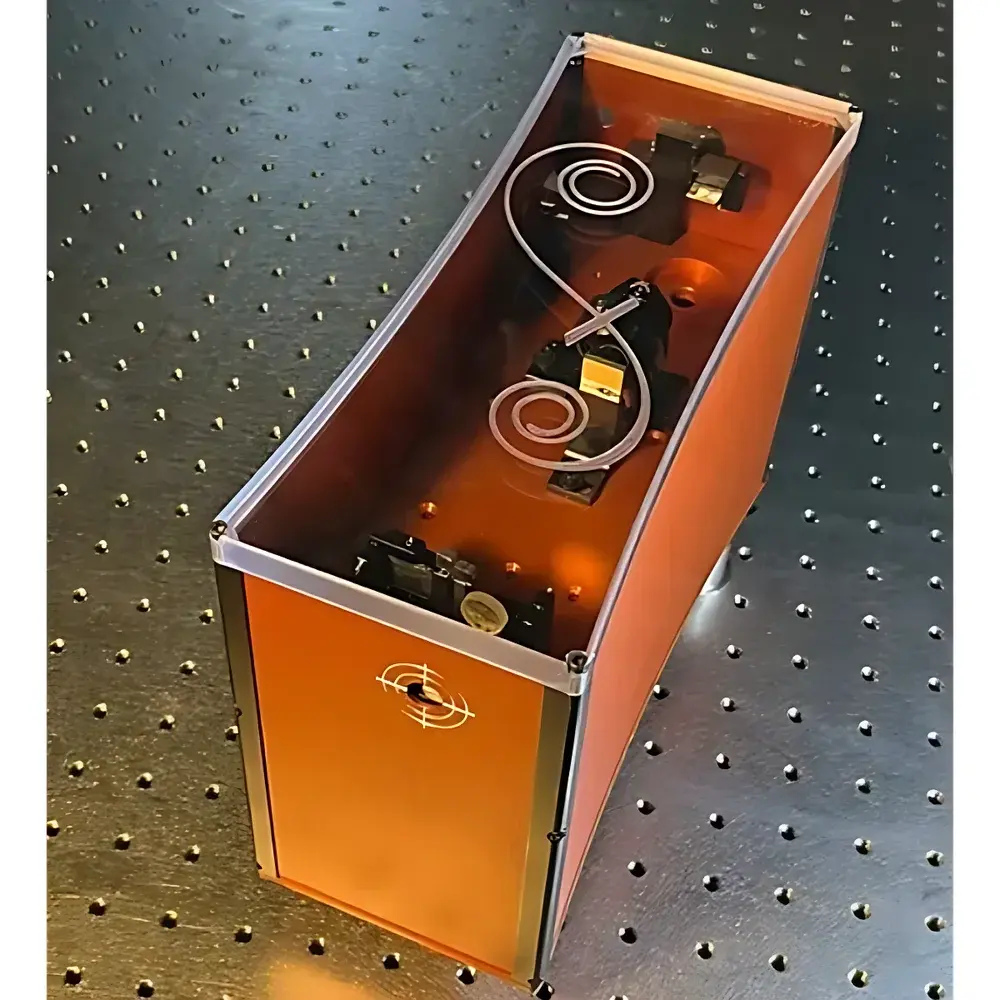
- Compact, vibration-resistant design: All-optical path housed in a rigid 16 × 10 × 16 cm chassis (<1 kg), minimizing air-current-induced phase noise and enabling integration on optical tables or inside vacuum chambers.
- Dual-mode software engine: Real-time phase retrieval using principal-component generalized projections (PCGP) and direct inversion methods, supporting both single-pulse and multi-shot averaging with uncertainty quantification.
Sample Compatibility & Compliance
The Orchestra™ FROG is compatible with ultrafast laser sources spanning femtosecond oscillators (e.g., mode-locked Ti:sapphire, Yb:fiber), amplifier systems (regenerative, CPA, OPCPA), and emerging attosecond beamlines. It supports arbitrary repetition rates—from single-shot (0.1 Hz) to continuous-wave–modulated MHz trains—without hardware modification. The instrument complies with ISO 10110-7 (optical component surface quality), IEC 61000-6-3 (EMC emissions), and meets mechanical stability requirements outlined in ISO 10012 (measurement management systems). While not certified for clinical or industrial process control, its data traceability, timestamped raw FROG traces, and audit-ready software logs align with GLP-compliant laboratory practices. Export-controlled components (e.g., precision piezoelectric delay stages) conform to EAR99 classification under U.S. Commerce Control List.
Software & Data Management
Orchestra™ Control Suite is a native Windows application built on Qt and Python (NumPy, SciPy, PyVista), providing full instrument control, real-time FROG trace acquisition, and deterministic electric-field reconstruction. The software implements two independent phase-retrieval algorithms—generalized projection (GP) and principal-component GP—to mitigate stagnation in noisy or low-SNR conditions. All reconstructed fields are stored in HDF5 format with embedded metadata (wavelength calibration, delay step size, polarization state, input energy estimate). Raw spectrograms include EXIF-like headers compliant with the Photonics Metadata Standard (PMS v2.1). Audit trails record user actions, parameter changes, and software version history—supporting 21 CFR Part 11–aligned electronic signatures when deployed with third-party identity management (e.g., Active Directory integration). Batch processing scripts (Python API) enable automated analysis across large datasets, including chirp quantification, pulse contrast ratio calculation, and carrier-envelope phase (CEP) stability assessment.
Applications
- Characterization of few-cycle pulses from hollow-core fiber compressors and filamentation-based white-light continua.
- Validation of dispersion compensation in ultra-broadband stretcher-compressor chains (e.g., chirped mirrors, prism pairs, acousto-optic programmable dispersive filters).
- Time-domain diagnostics of nonlinear frequency conversion processes (e.g., DFG, OPA, HHG) where spectral phase coherence must be preserved.
- Quantitative benchmarking of pulse shapers (SLM- or DMD-based) via closed-loop optimization using reconstructed E(t) as feedback.
- Education and training in ultrafast optics laboratories, where intuitive GUI-driven reconstruction aids student comprehension of time-frequency duality.
- Support for ISO/IEC 17025-accredited calibration labs performing uncertainty analysis of ultrashort pulse duration measurements (K-type evaluation per GUM Supplement 1).
FAQ
What is the minimum measurable pulse duration, and how is it verified?
The system resolves pulses down to 2 fs (two optical cycles at 250 nm) using TG-FROG geometry. Verification is performed via calibrated interferometric autocorrelation with a reference 10-fs Ti:sapphire oscillator traceable to NIST-traceable spectral phase standards.
Can Orchestra™ FROG measure CEP-stable pulses?
Yes—when used with a stabilized oscillator and appropriate triggering, the system captures single-shot spectral phase maps required for CEP drift analysis. However, absolute CEP determination requires additional f-to-2f interferometry.
Is vacuum-compatible operation supported?
The base unit is air-operated, but the optical head can be mounted inside vacuum chambers (≤10⁻³ mbar) with feedthrough-compatible kinematic mounts and custom beam-entry windows (CaF₂ or fused silica).
How does the software handle low-SNR FROG traces?
It applies adaptive Wiener filtering prior to retrieval and offers multi-start GP initialization to avoid local minima; reconstruction confidence metrics (e.g., residual RMS, Frobenius norm convergence) are reported for each trace.
Are firmware updates provided post-purchase?
Yes—free firmware and software updates are delivered for three years post-shipment via secure customer portal, including new gating mode support, improved noise models, and enhanced HDF5 metadata compliance.