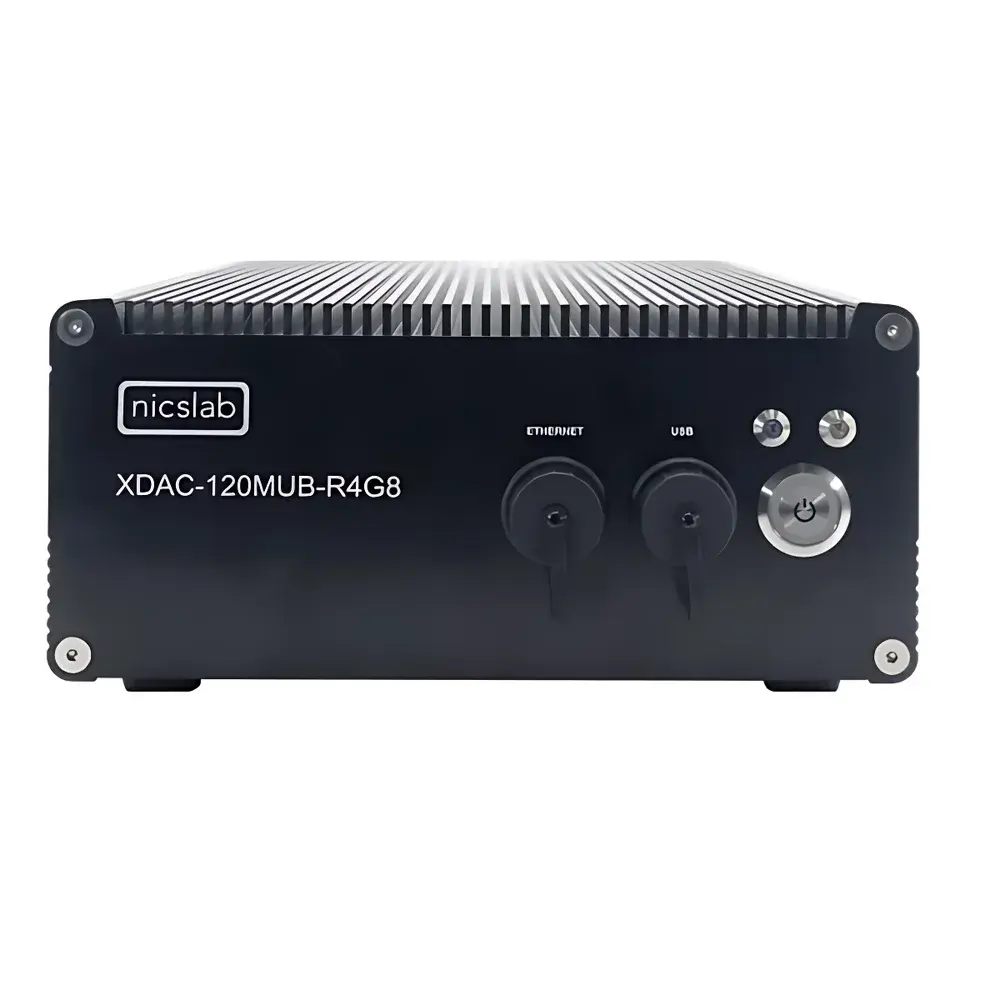
Auniontech PHO-EXTEND Series Expandable Photonic Integrated Circuit Controller
| Brand | Auniontech |
|---|---|
| Origin | Shanghai, China |
| Model | PHO-EXTEND Series |
| Channel Density | Up to 120 channels per chassis |
| Interface | USB 2.0, Gigabit Ethernet, GPIO |
| DAC Resolution | 16-bit |
| Output Modes | Unipolar, Bipolar, Differential |
| Voltage Range (Standard) | ±16 V, 0–34 V, ±18 V |
| Current Range (Standard) | ±500 mA, 0–300 mA, ±500 mA |
| Software Support | SCPI (Python, C#, MATLAB, LabVIEW), CSV-based sequence programming, GUI with real-time monitoring |
| Processor | Quad-Core 64-bit ARM Cortex-A53 (ARM v8) |
| Compliance | GLP/GMP-ready audit trail logging (Premium firmware), ISO/IEC 17025 traceable calibration support (optional) |
Overview
The Auniontech PHO-EXTEND Series Expandable Photonic Integrated Circuit Controller is a modular, high-channel-density source-measurement unit (SMU) platform engineered for precision analog control and characterization of photonic integrated circuits (PICs). Unlike conventional pressure controllers—whose classification in the input metadata appears to be a mis-categorization—the PHO-EXTEND operates on fundamental principles of programmable voltage/current sourcing and sub-millisecond sensing, enabling closed-loop biasing, thermal tuning, and phase modulation across heterogeneous photonic components including Mach-Zehnder interferometers (MZIs), microring resonators, semiconductor optical amplifiers (SOAs), and electro-optic modulators. Its architecture leverages low-noise 16-bit digital-to-analog conversion, galvanically isolated output stages, and deterministic real-time scheduling to meet the stringent stability and repeatability requirements of quantum photonics, coherent optical interconnects, and programmable photonic processors deployed in data centers and research laboratories.
Key Features
- Modular scalability: Single 19-inch rack-mount chassis supports up to 120 independently configurable SMU channels via hot-swappable module slots.
- Multi-mode analog output: Each channel supports unipolar (0–34 V / 0–300 mA), bipolar (±16 V / ±500 mA), and differential (±18 V / ±500 mA) sourcing with software-selectable range spans—including premium-grade sub-ranges (e.g., ±2.5 V, ±5 V, 0–200 mA) for enhanced resolution in low-power PIC biasing.
- Dual-interface connectivity: Native Gigabit Ethernet for deterministic LAN-based control and synchronization; USB 2.0 for local configuration and debugging—both fully SCPI-compliant.
- Real-time I/O integration: 16-channel general-purpose digital I/O (GPIO) with programmable timing, supporting TTL-level trigger exchange, status monitoring, and hardware handshake protocols for synchronized multi-instrument experiments.
- Embedded quad-core ARM processor: On-board 64-bit Cortex-A53 (ARM v8) enables local execution of Python scripts, CSV-driven waveform sequencing, and background logging without host dependency.
- Intuitive cross-platform GUI: Feature-rich desktop application with live waveform visualization, parameter mapping trees, and export-ready data formatting (CSV, HDF5).
Sample Compatibility & Compliance
The PHO-EXTEND controller interfaces directly with silicon photonics (SiPh), indium phosphide (InP), and lithium niobate (LiNbO₃) PICs requiring DC or quasi-static analog biasing. It accommodates standard probe station configurations (e.g., Cascade Summit 12000, FormFactor MPI) and integrates seamlessly into automated wafer-level test systems. Firmware versions with Premium license enable GLP/GMP-aligned functionality—including user-accessible audit trails, electronic signature enforcement, and timestamped parameter change logs—supporting compliance with FDA 21 CFR Part 11 and ISO/IEC 17025 documentation requirements. Calibration certificates traceable to NIM (National Institute of Metrology, China) are available upon request.
Software & Data Management
Auniontech provides native drivers and SDKs for Python, C#, MATLAB, and LabVIEW, all implementing full SCPI command sets (IEEE 488.2 compliant). The Premium software tier adds advanced capabilities: type-safe parameter input with resolution-aware validation, persistent settings storage with versioned backup, real-time CSV streaming with customizable headers, and sequence programming via editable templates. All logged data includes embedded metadata (channel ID, timestamp, firmware revision, user tag), ensuring reproducibility in peer-reviewed publications and regulatory submissions. Remote access is secured via TLS 1.2 and role-based authentication.
Applications
- Photonic IC characterization: IV curve tracing, resonance wavelength tuning, extinction ratio optimization, and thermal crosstalk mapping.
- Datacenter optics: Bias control of co-packaged optical transceivers and tunable wavelength-selective switches (WSS).
- Optical neural networks: Analog weight programming across large-scale MZI mesh architectures with <100 ppm linearity error.
- Quantum photonics: Stabilized current sourcing for superconducting nanowire single-photon detectors (SNSPDs) and voltage-controlled phase shifters in boson sampling circuits.
- LIDAR beam steering: Synchronized multi-channel drive for optical phased arrays (OPAs) with sub-microsecond update latency.
- Atomic physics: Precision current control for distributed feedback (DFB) laser diodes and electro-optic frequency combs in cold atom trapping setups.
FAQ
Is the PHO-EXTEND suitable for cryogenic PIC testing?
Yes—standard modules operate from 0 °C to 50 °C ambient; optional low-temperature variants (–40 °C to +70 °C) are qualified for use with dilution refrigerator feedthroughs and vacuum-compatible mounting.
Can multiple chassis be synchronized with sub-microsecond jitter?
Yes—via IEEE 1588 Precision Time Protocol (PTP) over Gigabit Ethernet, achieving ≤200 ns inter-chassis skew under controlled network conditions.
Does the system support external clock referencing for time-domain photonic measurements?
Yes—dedicated 10 MHz reference input/output BNC connectors enable phase-coherent locking to arbitrary waveform generators or RF synthesizers.
Are calibration reports included with shipment?
Base units ship with factory calibration verification report; NIST-traceable calibration certificates (per ISO/IEC 17025) are available as an add-on service.
How is firmware updated, and is rollback supported?
Firmware updates are performed via signed .bin files through the GUI or CLI; full version history and safe rollback to any prior release are retained in non-volatile memory.