
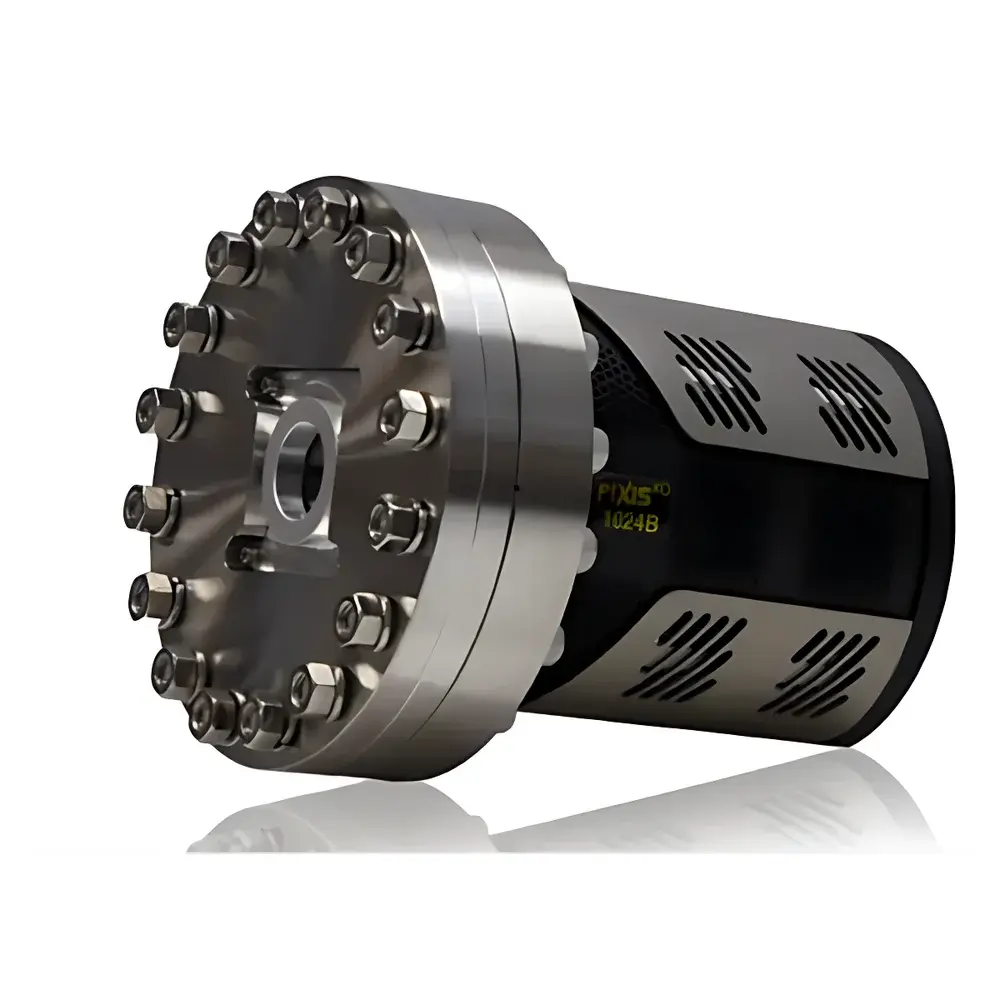
Auniontech PIXIS-XO EUV/Soft X-Ray Camera
| Brand | Auniontech |
|---|---|
| Origin | Shanghai, China |
| Manufacturer Type | Authorized Distributor |
| Product Category | Domestic |
| Model | PIXIS-XO |
| Pricing | Available Upon Request |
| Cooling | Thermoelectric (Air or Liquid) |
| Operating Temperature | +5°C to +30°C (Non-Condensing) |
| Vacuum Compatibility | ≤10⁻⁸ Torr |
| Interface | USB 2.0 |
| Sensor Type | Back-Illuminated CCD, Anti-Reflection Coating-Free |
| Energy Range | 30 eV – 20 keV |
| Flange | Rotatable ConFlat (CF) |
| Readout Architecture | Dual-Amplifier |
| Software Support | LightField (with LabVIEW® & MATLAB® Integration), PICAM SDK |
| Calibration | IntelliCal Auto Wavelength & Intensity Calibration |
Overview
The Auniontech PIXIS-XO EUV/Soft X-Ray Camera is a high-sensitivity, thermoelectrically cooled scientific imaging detector engineered for quantitative photon counting and spatially resolved spectral acquisition in extreme ultraviolet (EUV) and soft X-ray regimes. Based on a back-illuminated, anti-reflection coating-free CCD architecture, the PIXIS-XO enables direct detection of photons across an exceptionally broad energy range—from 30 eV (λ ≈ 41.3 nm) to 20 keV (λ ≈ 0.062 nm)—without reliance on scintillator conversion layers. This direct-detection design preserves intrinsic spatial resolution, quantum efficiency, and energy linearity, making it suitable for applications demanding high fidelity in both imaging and spectroscopic modalities. Its hermetically sealed, ultra-high vacuum (UHV)-compatible housing—featuring a rotatable ConFlat (CF) flange—ensures mechanical stability and alignment flexibility under operational vacuum conditions down to 10⁻⁸ Torr. The camera is optimized for integration into synchrotron beamlines, laser-plasma EUV sources, tabletop HHG setups, and laboratory-scale X-ray microscopy systems.
Key Features
- Back-illuminated CCD sensor with no anti-reflection coating: maximizes quantum efficiency across the 30 eV–20 keV band, especially critical below 1 keV where conventional front-illuminated sensors exhibit strong absorption losses.
- Rotatable ConFlat (CF) vacuum flange: allows precise angular alignment of the sensor plane relative to incident beam geometry—essential for optimizing image focus, spectral dispersion axis registration, and minimizing astigmatism in grating-based spectrometers.
- Dual-amplifier readout architecture: supports selectable gain modes to balance read noise (sub-3 e⁻ RMS typical), dynamic range (>16-bit effective), and linearity (<0.5% deviation over full well capacity), enabling both low-flux single-photon counting and high-intensity continuum imaging.
- Thermoelectric cooling (air or liquid): maintains stable sensor temperature between +5°C and +30°C, suppressing dark current to <0.001 e⁻/pixel/s at −20°C operating setpoint—critical for long-exposure EUV imaging and spectral accumulation.
- UHV-rated mechanical design: all internal materials conform to ASTM E595 outgassing specifications; CF flange meets ISO-KF/CF standard dimensional tolerances for repeatable vacuum sealing and bake-out compatibility up to 150°C.
Sample Compatibility & Compliance
The PIXIS-XO is compatible with vacuum-compatible samples and optical components mounted directly on UHV chambers or beamline endstations. It does not require windowed interfaces or intermediate phosphor screens, eliminating transmission losses and spatial blurring associated with indirect detection schemes. The system complies with electromagnetic compatibility (EMC) requirements per IEC 61326-1 for laboratory instrumentation and meets RoHS Directive 2011/65/EU material restrictions. For regulated environments—including GLP-compliant analytical labs and preclinical imaging facilities—the LightField software platform supports audit-trail logging, user-access controls, and electronic signature workflows aligned with FDA 21 CFR Part 11 principles when deployed with validated configuration.
Software & Data Management
Control and data acquisition are fully enabled via two interoperable software frameworks: LightField and PICAM SDK. LightField provides a graphical interface with real-time image preview, region-of-interest (ROI) histogramming, spectral centroid tracking, and embedded mathematical operations (e.g., flat-field correction, background subtraction, spectral deconvolution). Its native drivers support bidirectional hardware synchronization with spectrometers and delay generators, and offer seamless API-level integration with LabVIEW® and MATLAB® through dedicated toolkits. Alternatively, the PICAM SDK delivers low-level C/C++ and Python bindings for custom acquisition pipelines, ensuring deterministic timing and minimal latency—ideal for pump-probe experiments or feedback-controlled beamline diagnostics. All raw frames are saved in vendor-neutral TIFF or HDF5 formats with embedded metadata (exposure time, sensor temperature, gain mode, timestamp, calibration coefficients).
Applications
- EUV lithography mask inspection and metrology
- Soft X-ray microscopy of biological specimens (e.g., cryo-tomography, water-window imaging)
- Laser-produced plasma diagnostics (electron temperature, ion charge state distribution)
- High-harmonic generation (HHG) beam characterization and attosecond pulse reconstruction
- Synchrotron-based X-ray absorption fine structure (XAFS) and resonant inelastic scattering (RIXS)
- Time-resolved photoemission spectroscopy (TR-PES) detectors in UHV ARPES systems
- Space-borne solar EUV monitor calibration and ground-test validation
FAQ
Is the PIXIS-XO suitable for use in ultra-high vacuum environments?
Yes—the camera features a fully UHV-compatible stainless-steel housing with a rotatable ConFlat flange rated for continuous operation at pressures ≤10⁻⁸ Torr and bake-out temperatures up to 150°C.
Does the camera require a vacuum window for EUV detection?
No—it is designed for direct vacuum coupling; no entrance window is used, eliminating transmission losses and carbon contamination risks common with MgF₂ or SiN membranes.
Can the PIXIS-XO be synchronized with external triggers such as lasers or choppers?
Yes—hardware trigger input/output ports support TTL-level start/stop, exposure gating, and frame-locked acquisition with sub-microsecond jitter.
What calibration standards are supported?
IntelliCal automated wavelength and intensity calibration is included, traceable to NIST-certified emission lines (e.g., Al Kα, Cu Kα, Ne I lines); users may also import custom calibration tables in CSV or XML format.
Is remote operation supported over networked infrastructure?
While the native interface uses USB 2.0, LightField supports remote desktop access and third-party middleware (e.g., EPICS IOC wrappers) for integration into distributed control systems common in large-scale light sources.





