
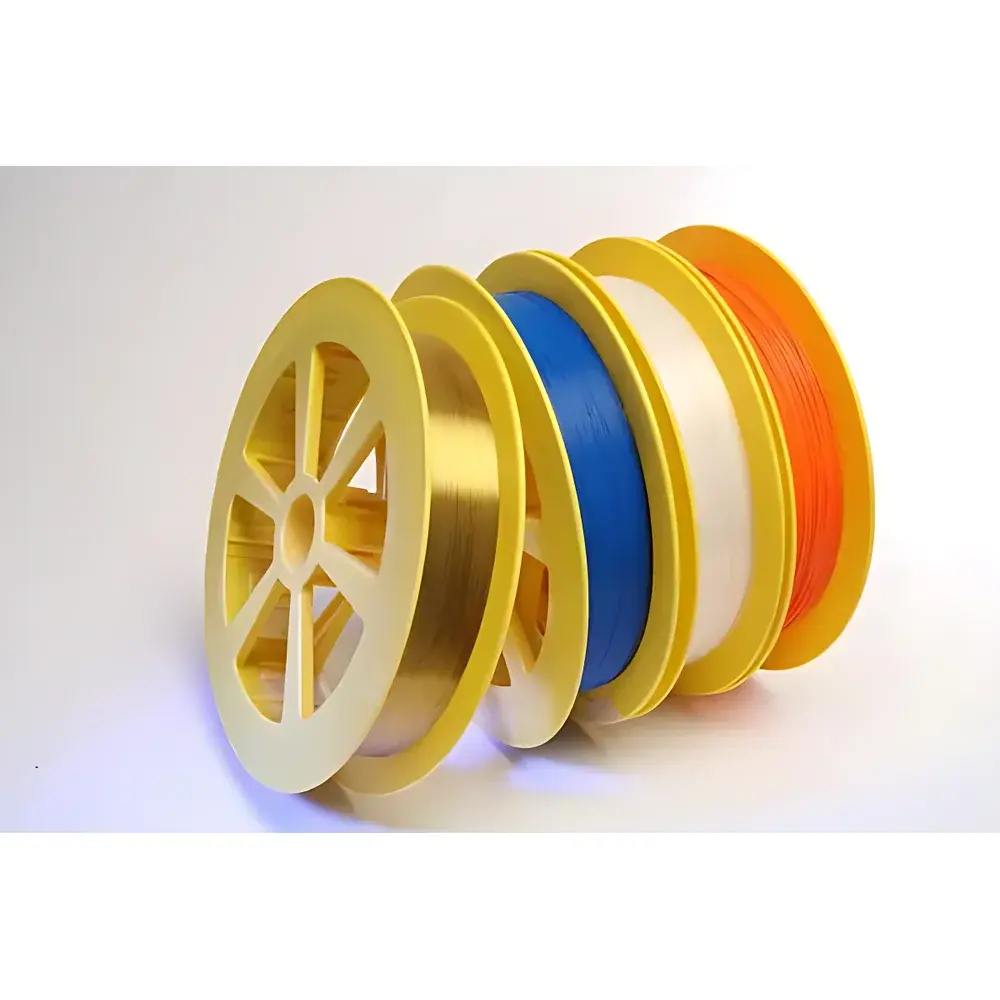
Auniontech Polyimide-Coated High-Temperature Single-Mode Optical Fiber
| Brand | Auniontech |
|---|---|
| Model | PI-Coated SM9/125/155 |
| Core Material | Germanium-Doped Fused Silica |
| Cladding Material | Fluorine-Doped Silica |
| Coating Material | Polyimide (PI) |
| Operating Temperature Range | −65 °C to +300 °C (continuous), up to +400 °C (short-term) |
| Numerical Aperture (NA) | 0.12–0.15 |
| Mode Field Diameter (MFD) | 9.2±0.4 µm @1310 nm, 10.4±0.8 µm @1550 nm |
| Attenuation | <0.7 dB/km @1310 nm, <0.7 dB/km @1550 nm |
| Cladding Diameter | 125±1 µm |
| Coating Diameter | 155±5 µm |
| Core–Cladding Concentricity | ≤0.6 µm |
| Cladding Non-Circularity | ≤0.1% |
| Proof Test Strength | 100 kpsi |
| Compliance | ITU-T G.652.D, IEC 60793-2-50, MIL-PRF-27973 Class 1B |
Overview
Auniontech Polyimide-Coated High-Temperature Single-Mode Optical Fiber is engineered for stable optical transmission under extreme thermal, radiative, and chemically aggressive conditions. Based on a germanium-doped fused silica core and fluorine-doped silica cladding, this fiber delivers low propagation loss (<0.7 dB/km at both 1310 nm and 1550 nm) while maintaining single-mode guidance across the O-, E-, S-, C-, and L-bands. Its defining feature is the polyimide (PI) primary coating — a high-performance thermosetting polymer applied directly over the glass surface. Unlike conventional acrylate or silicone coatings, polyimide exhibits exceptional thermal stability, low outgassing in vacuum, near-zero moisture absorption, and dimensional compatibility with fused silica (CTE ≈ 3–5 ppm/°C). This enables reliable long-term operation from cryogenic temperatures (−65 °C) to sustained 300 °C exposure, with short-term survivability up to 400 °C — critical for distributed temperature sensing (DTS), downhole telemetry, aerospace avionics interconnects, and nuclear instrumentation.
Key Features
- Continuous operating temperature range of −65 °C to +300 °C; peak tolerance of +400 °C for ≤1 hour
- Polyimide coating with ultra-low outgassing (<1 × 10⁻⁸ g/(cm²·s) in high vacuum), meeting NASA ASTM E595 requirements
- High mechanical robustness: proof-tested to 100 kpsi (690 MPa), supporting tensioned installations in rotating machinery or embedded structural monitoring
- Chemical resistance to hydrocarbons, halogenated solvents, strong acids (e.g., HNO₃, H₂SO₄), and aqueous environments — validated per ISO 15184 and IEC 61300-2-22
- Bio-inert and ethylene oxide (EtO)/gamma-radiation sterilizable — compliant with ISO 10993-5 for non-cytotoxicity and USP Class VI testing
- Low hydrogen darkening coefficient (<5 × 10⁻³⁰ cm³/J) and radiation-induced attenuation <0.1 dB/km after 10⁶ rad(Si) exposure
Sample Compatibility & Compliance
This fiber is fully compatible with standard single-mode fusion splicing platforms (e.g., Fujikura FSM-100P, Vytran GPX-3400) using optimized arc parameters for polyimide ablation and low-loss joint formation. It meets the geometric and optical specifications defined in ITU-T G.652.D for dispersion-unshifted single-mode fiber and conforms to IEC 60793-2-50 Category A1a.1. For regulated applications, the fiber supports traceable calibration documentation and batch-specific test reports including spectral attenuation, mode field diameter, and chromatic dispersion. In nuclear and medical contexts, it satisfies relevant portions of ASME NQA-1, FDA 21 CFR Part 11 (when integrated into validated systems), and EN 62366-1 usability engineering requirements for implant-adjacent diagnostic interfaces.
Software & Data Management
While the fiber itself is a passive component, its integration into optical time-domain reflectometry (OTDR), Brillouin optical time-domain analysis (BOTDA), or interferometric sensing systems requires precise parameter input in vendor software (e.g., Luna ODiSI, OFS DTS Manager, or Yokogawa AQ7280). Auniontech provides standardized .csv and .xml configuration files containing MFD vs. wavelength, group index dispersion tables, and coating refractive index profiles — enabling accurate modeling in Lumerical MODE, RSoft BeamPROP, or OptiSystem. All delivery reels include QR-coded traceability labels linking to manufacturing lot data, tensile test logs, and accelerated aging reports (per Telcordia GR-20-CORE).
Applications
- Downhole Monitoring: Distributed temperature and strain profiling in oil/gas wellbores (API RP 14E, ISO 13628-6 compliant)
- Aerospace Structural Health Monitoring: Embedded fiber networks in turbine blades, wing skins, and composite fuselages exposed to thermal cycling and EMI
- Nuclear Facility Instrumentation: Radiation-hardened links for reactor core temperature mapping and spent fuel pool monitoring
- Medical Device Interconnects: Laser delivery and sensing fibers in MRI-compatible surgical tools and endoscopic OCT probes
- High-Energy Physics Experiments: Signal transmission in particle detector readout systems operating under vacuum and cryogenic conditions
- Industrial Process Control: Real-time thermal profiling in kilns, smelters, and chemical reactors where conventional cables fail
FAQ
Can this fiber be cleaved and connectorized using standard single-mode tooling?
Yes — cleaving with high-precision scribe-and-break tools (e.g., Fujikura CT-50) and polishing with 3 µm diamond film yields acceptable end-face geometry (radius of curvature >10 mm, apex offset <50 nm). However, polyimide removal prior to termination requires controlled plasma ashing or laser ablation; mechanical stripping is not recommended.
Is the fiber compatible with 1064 nm or 1550 nm pulsed laser delivery?
Yes — with peak power handling exceeding 1 MW/cm² for nanosecond pulses at 1064 nm (tested per ISO 21254-1), provided beam coupling remains within the fundamental mode and bend radii exceed 30 mm.
Does the polyimide coating support long-term adhesion to epoxies or metal ferrules?
Polyimide exhibits poor wetting with conventional epoxies; we recommend oxygen plasma pretreatment followed by use of high-temperature phenolic or cyanate ester adhesives (e.g., Tra-Con TC-1000) cured at ≥180 °C.
What is the shelf life under ambient storage conditions?
When stored sealed in nitrogen-purged foil bags at 23 °C ±5 °C and RH <40%, the fiber retains full specification compliance for ≥24 months from date of manufacture.




