
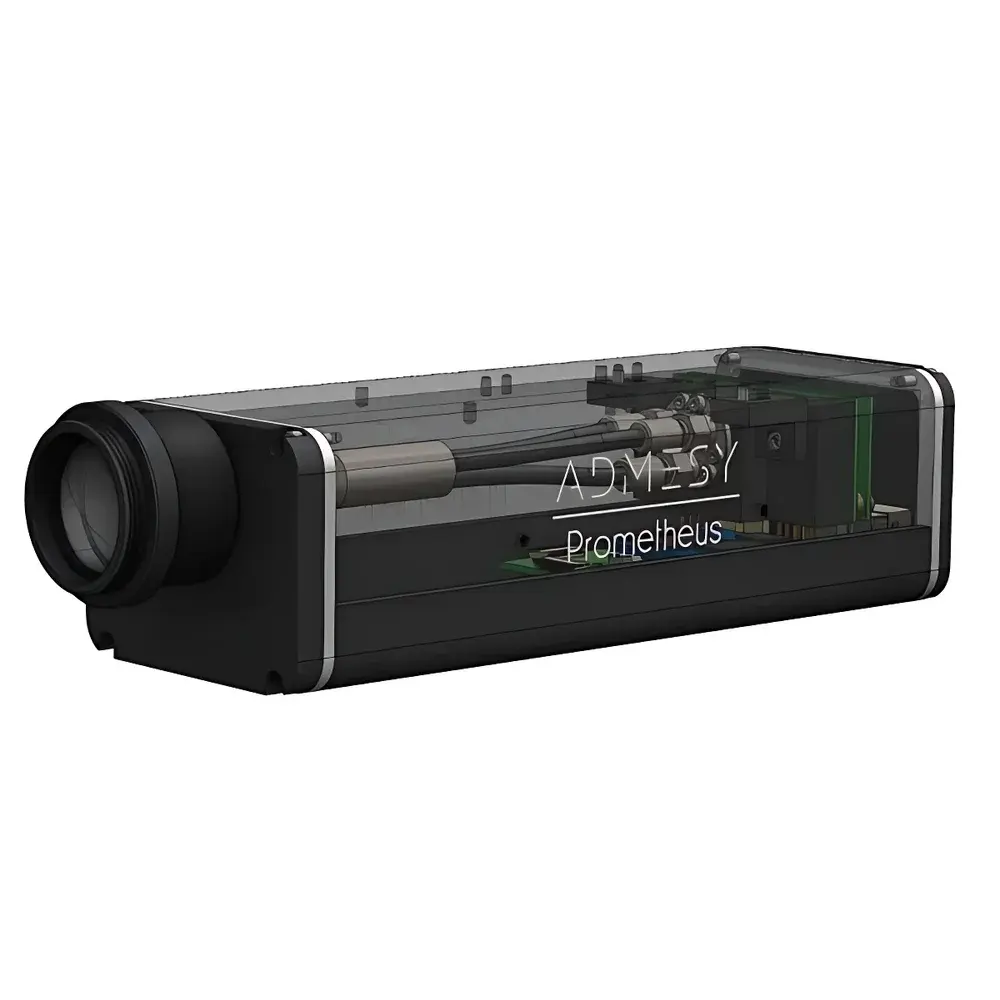
Auniontech PROMETHEUS 10mm Lens Colorimeter
| Brand | Auniontech |
|---|---|
| Origin | Netherlands |
| Model | PROMETHEUS |
| Optical Aperture | 10 mm |
| Luminance Measurement Speed | 2500 samples/sec (Y channel) |
| Dynamic Range | >10⁶:1 (typical) |
| Spectral Sensitivity | Matched to CIE 1931 photopic luminosity function (V(λ)) |
| Interface | USB-TMC compliant |
| OS Compatibility | Windows, Linux (x86_64, i686, ARM), macOS |
| Software Integration | NI-VISA, LabVIEW, LabWindows/CVI, Visual Studio via VISA API |
| Internal Processing | MCU-based JEITA flicker calculation engine |
| Mechanical Shutter | Integrated |
| Auto-ranging | Yes |
| Noise Floor | <0.01 cd/m² (equivalent) |
| Spot Size Options | 2.1–27 mm (interchangeable optics) |
| Fiber-coupled Version Available | Yes |
| Filter Accuracy | Δu'v' < 0.002 (CIE 1976 u'v' chromaticity space, typical) |
Overview
The Auniontech PROMETHEUS 10mm Lens Colorimeter is a precision optical measurement instrument engineered for high-fidelity colorimetric and photometric characterization of emissive displays, lighting sources, and optical components. Based on tristimulus colorimetry principles aligned with the CIE 1931 2° standard observer, the device employs a rigorously calibrated set of interference filters and silicon photodiodes to replicate human spectral sensitivity (V(λ)) with metrological traceability. Its 10 mm entrance lens configuration enables optimized light collection efficiency for medium-field-of-view measurements—ideal for panel-level uniformity mapping, OLED/LCD luminance uniformity verification, and LED backlight validation. Unlike spectroradiometers, the PROMETHEUS achieves real-time performance through dedicated analog signal conditioning and on-board microcontroller unit (MCU)-driven computation, delivering deterministic latency and repeatable results under variable ambient conditions.
Key Features
- High-accuracy CIE 1931-compliant color measurement with filter-matched spectral response (Δu’v’ < 0.002 typical in CIE 1976 u'v' space)
- Ultra-high-speed photometric sampling: up to 2500 Y (luminance) measurements per second, enabling precise flicker analysis per JEITA CP-1501 and IEC TR 62778
- Extended dynamic range (>10⁶:1) supported by low-noise transimpedance amplifiers and auto-ranging circuitry—capable of resolving sub-0.01 cd/m² signals without external attenuation
- Integrated mechanical shutter for dark-current compensation and zero-reference calibration during automated test sequences
- USB-TMC (Test & Measurement Class) compliance ensures plug-and-play interoperability with industry-standard instrumentation control frameworks
- Cross-platform driver support validated on Windows (x64), Linux (x86_64, i686, ARM architectures), and macOS via NI-VISA and open-source libusbtmc libraries
- Modular optical design: interchangeable lens assemblies support spot sizes from 2.1 mm to 27 mm; fiber-coupled variants available for remote or confined-space integration
Sample Compatibility & Compliance
The PROMETHEUS 10mm Lens Colorimeter is suitable for measuring self-luminous sources including OLED, microLED, LCD with local dimming, and general illumination LEDs. It meets requirements for display quality assurance workflows defined in ISO 13406-2, IEC 62341-6-3 (OLED display testing), and VESA DisplayHDR™ conformance protocols. Its spectral responsivity is traceably aligned to NIST-traceable standards, and measurement uncertainty budgets conform to ISO/IEC 17025–accredited laboratory practices when used with certified calibration references. The instrument supports GLP/GMP-aligned data integrity through timestamped, non-modifiable binary output formats and optional audit-log generation in host-controlled environments.
Software & Data Management
The PROMETHEUS operates as a SCPI-commandable USB instrument. Native integration is provided via National Instruments’ VISA library, enabling seamless deployment in LabVIEW-based automated optical inspection (AOI) systems, LabWindows/CVI test executive applications, and custom C#/C++ applications built on Visual Studio. Raw measurement data—including XYZ tristimulus values, CIE xyY coordinates, correlated color temperature (CCT), and dominant wavelength—is streamed in IEEE 754 double-precision format. Optional firmware extensions support JEITA-defined flicker metrics (flicker percentage, flicker index) and temporal luminance profiling synchronized to external triggers. All communication adheres to USBTMC-USB488 specification v1.0, ensuring compatibility with IVI-COM drivers and enterprise-grade test management systems.
Applications
- Display manufacturing: pixel-level luminance and chromaticity uniformity mapping across TFT-LCD, AMOLED, and QD-OLED panels
- R&D validation of HDR content rendering, including peak brightness verification and black-level stability assessment
- Flicker characterization of AC-driven lighting systems per IEEE 1789-2015 guidelines
- Calibration transfer between reference instruments and production-line colorimeters
- Optical component evaluation: transmittance/reflectance ratio consistency of diffusers, color filters, and AR coatings
- Automated visual inspection system integration in semiconductor packaging and micro-optics assembly lines
FAQ
Does the PROMETHEUS support absolute radiometric calibration?
Yes—when paired with an NIST-traceable calibration standard (e.g., tungsten-halogen source with known spectral irradiance), the instrument can be configured for absolute photometric units (cd/m², lux) and colorimetric units (CIE x,y, u’v’, CCT) with documented uncertainty budgets.
Can multiple PROMETHEUS units be synchronized for multi-angle measurements?
Yes—external trigger input/output ports enable hardware-synchronized acquisition across up to 8 units, supporting angular BRDF/BTDF characterization setups.
Is firmware upgrade capability available in-field?
Yes—USB-based DFU (Device Firmware Upgrade) mode allows secure, signed firmware updates without requiring specialized programming hardware.
What is the recommended recalibration interval?
A 12-month calibration cycle is advised under continuous operation; shorter intervals are recommended for high-precision metrology labs operating under ISO/IEC 17025 accreditation.
Are custom optical configurations available beyond the standard 10 mm lens?
Yes—Auniontech offers OEM optical path redesign services, including telecentric adapters, UV-enhanced coatings, and narrow-band spectral filtering upon request.




