
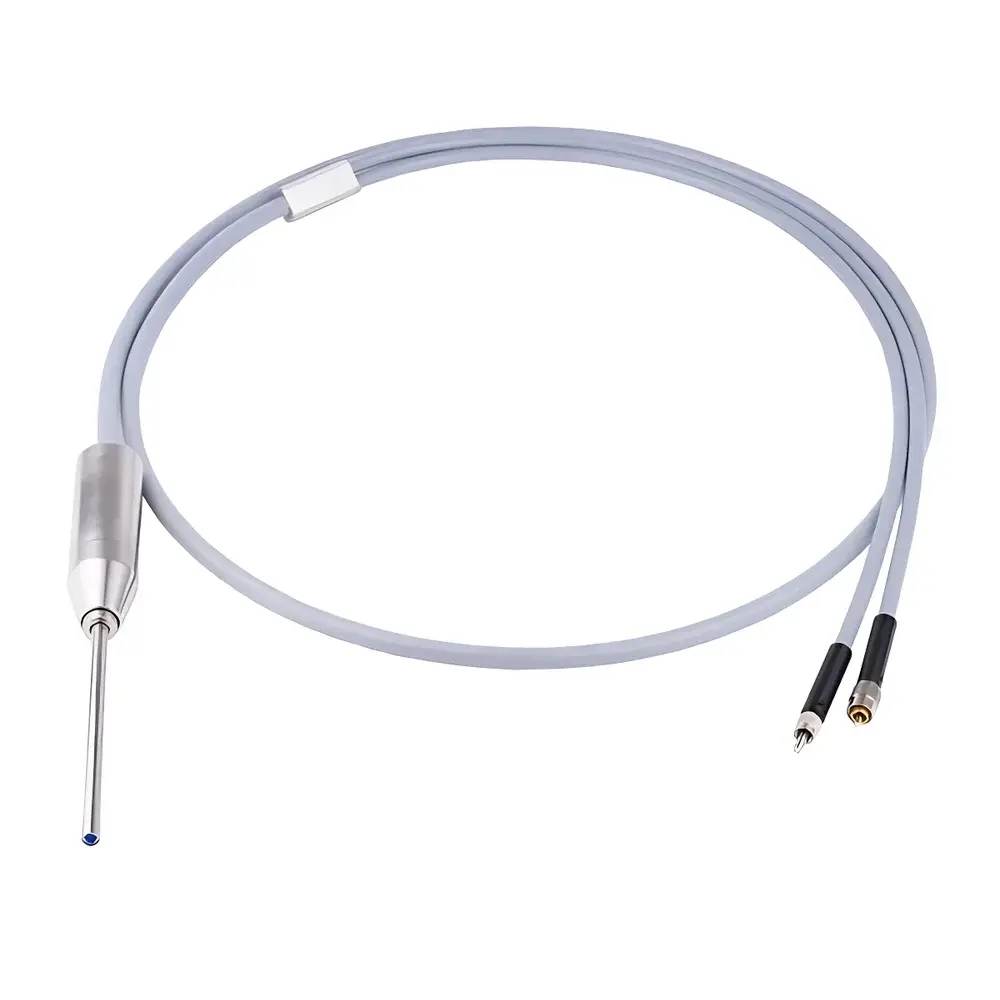
Auniontech Raman Fiber Probe (630–785 nm Multimode Excitation)
| Brand | Auniontech |
|---|---|
| Wavelength Range | 630–785 nm (multimode) |
| Excitation Options | Multimode (630–785 nm) or Single-Wavelength (532 nm / 785 nm) |
| Optical Architecture | Bifurcated Fiber Bundle (Laser Input + Spectrometer Output) |
| Spectral Coverage | FP Mode (800–1800 cm⁻¹) and High-Wavenumber Mode (2800–3800 cm⁻¹) |
| Compatibility | Universal Interface for Standard SMA-905 Fiber-Coupled Raman Spectrometers |
| Environmental Rating | Industrial-grade housing with IP65-rated sealing (optional) |
| Component Type | OEM Optical Instrument Component |
| Origin | Imported |
| Distributor Status | Authorized Distributor |
Overview
The Auniontech Raman Fiber Probe is a precision-engineered optical interface component designed to bridge excitation lasers and fiber-coupled Raman spectrometers in both laboratory and industrial settings. Based on the principle of spontaneous inelastic scattering of monochromatic light—where incident photons interact with molecular vibrational modes to generate characteristic Stokes and anti-Stokes shifts—the probe enables non-destructive, label-free chemical identification and structural analysis. Its bifurcated fiber architecture separates the excitation path (laser delivery) from the collection path (Raman signal return), minimizing background interference and optimizing signal-to-noise ratio. Engineered for high optical throughput and mechanical stability, the probe supports configurable wavelength excitation across the visible to near-infrared range (630–785 nm), making it compatible with common diode-pumped solid-state (DPSS) and laser diode sources used in benchtop and process-integrated Raman systems.
Key Features
- Bifurcated fiber design with independent laser input and spectrometer output arms, each terminated with SMA-905 connectors for universal compatibility
- Optimized for multimode excitation (630–785 nm), with optional single-wavelength variants (532 nm and 785 nm) available for application-specific optimization
- High numerical aperture (NA) fused silica fibers ensure efficient coupling of both excitation energy and weak Raman-scattered photons
- Industrial-grade stainless-steel or anodized aluminum housing with optional IP65 environmental protection for operation in humid, dusty, or temperature-variable conditions
- Minimal fluorescence induction and low autofluorescence fiber coating, critical for biological and pharmaceutical sample analysis
- Thermally stable optical alignment maintained over extended measurement cycles, supporting long-term reproducibility in PAT and QC environments
Sample Compatibility & Compliance
The probe accommodates a broad range of sample geometries—including liquids in flow cells, solids in reflective holders, powders in vials, and gases in multipass cells—via interchangeable sampling tips (e.g., immersion probes, contact probes, and standoff configurations). It complies with standard optical safety classifications (IEC 60825-1) when used with Class 3B or Class 4 lasers. For regulated industries, the probe’s passive optical design supports integration into GMP-compliant analytical workflows; its traceable calibration and documentation package aligns with GLP requirements. While the probe itself does not carry CE or FDA 510(k) certification, it is routinely deployed in ISO 13485-certified biopharmaceutical facilities and ASTM E1840-22–validated PAT platforms.
Software & Data Management
As a hardware-level optical interface, the probe requires no embedded firmware or driver software. It functions transparently within existing Raman data acquisition ecosystems—including Ocean Insight, Wasatch Photonics, B&W Tek, and Horiba software suites—enabling full spectral acquisition, real-time baseline correction, and multivariate chemometric modeling (e.g., PCA, PLS regression). When integrated into automated process control systems, the probe supports timestamped spectral logging compliant with 21 CFR Part 11 audit trails via external DAQ synchronization. Raw intensity data retains native wavenumber calibration fidelity, ensuring interoperability with third-party spectral libraries (e.g., KnowItAll®, Bio-Rad KnowItAll® Raman Library).
Applications
- Real-time reaction monitoring in continuous manufacturing reactors, including crystallization, hydrogenation, and polymerization processes
- Process Analytical Technology (PAT) implementation per ICH Q8(R2) and FDA guidance, enabling quality-by-design (QbD) frameworks
- Raw material identification and counterfeit detection in pharmaceutical supply chains using spectral fingerprint matching
- In situ characterization of battery electrode materials during electrochemical cycling
- Bioprocess monitoring of monoclonal antibody titers, glycosylation profiles, and cell culture viability in upstream bioreactors
- Field-deployable forensic analysis of illicit substances and explosives precursors under ambient lighting conditions
FAQ
Can this probe be used with a 1064 nm laser system?
No—this specific model is optimized for 630–785 nm excitation. Auniontech offers a separate NIR-optimized probe variant for 1064 nm applications.
Is fiber length customizable?
Yes—standard lengths are 1 m and 2 m, but custom lengths up to 5 m are available with NA-matched fiber splicing and insertion loss validation.
Does the probe include spectral calibration standards?
Calibration is performed at the system level (laser + spectrometer + probe); NIST-traceable polystyrene or cyclohexane reference spectra are recommended for end-user verification.
What is the maximum laser power the probe can handle?
Rated for continuous-wave operation up to 500 mW at 785 nm; pulsed laser compatibility depends on peak power density and must be evaluated case-by-case.
Can the probe be sterilized for aseptic bioprocessing use?
The standard housing is not autoclavable; however, a stainless-steel, CIP/SIP-compatible version with sealed optics is available upon request.




