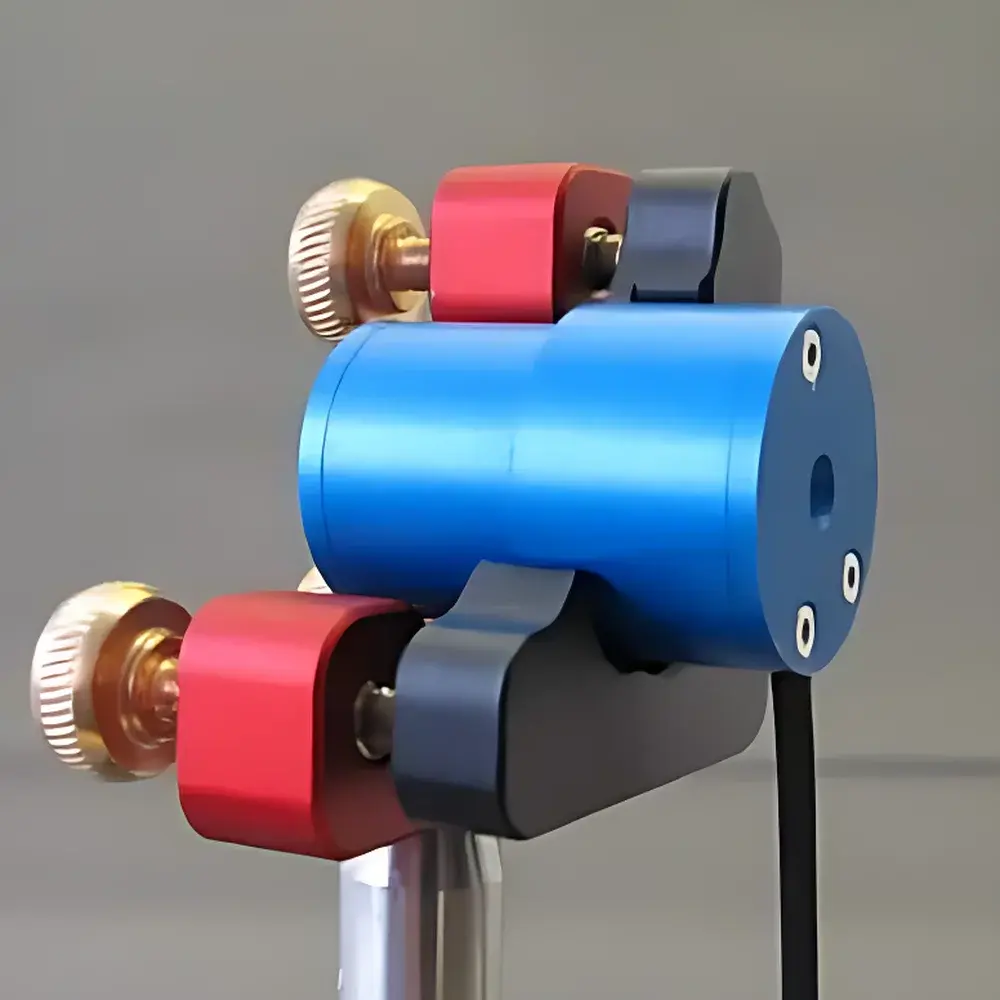
Auniontech Resonant Phase Modulator for PDH Laser Frequency Stabilization
| Brand | Auniontech |
|---|---|
| Model | Resonant Electro-Optic Phase Modulator (EOM) with Pockels Cell |
| Operating Frequency Range | 3–25 MHz (custom frequencies available) |
| Wavelength Ranges | 400–700 nm, 650–1000 nm, 1000–1500 nm (AR-coated variants) |
| Mounting | Standard 1-inch optical post mount compatible |
| Compliance | Designed for GLP-compliant laser stabilization setups |
| Software Integration | Compatible with standard RF signal generators and lock-in amplifiers |
| Drive Requirement | External RF amplifier optional (configurable per modulation depth requirement) |
Overview
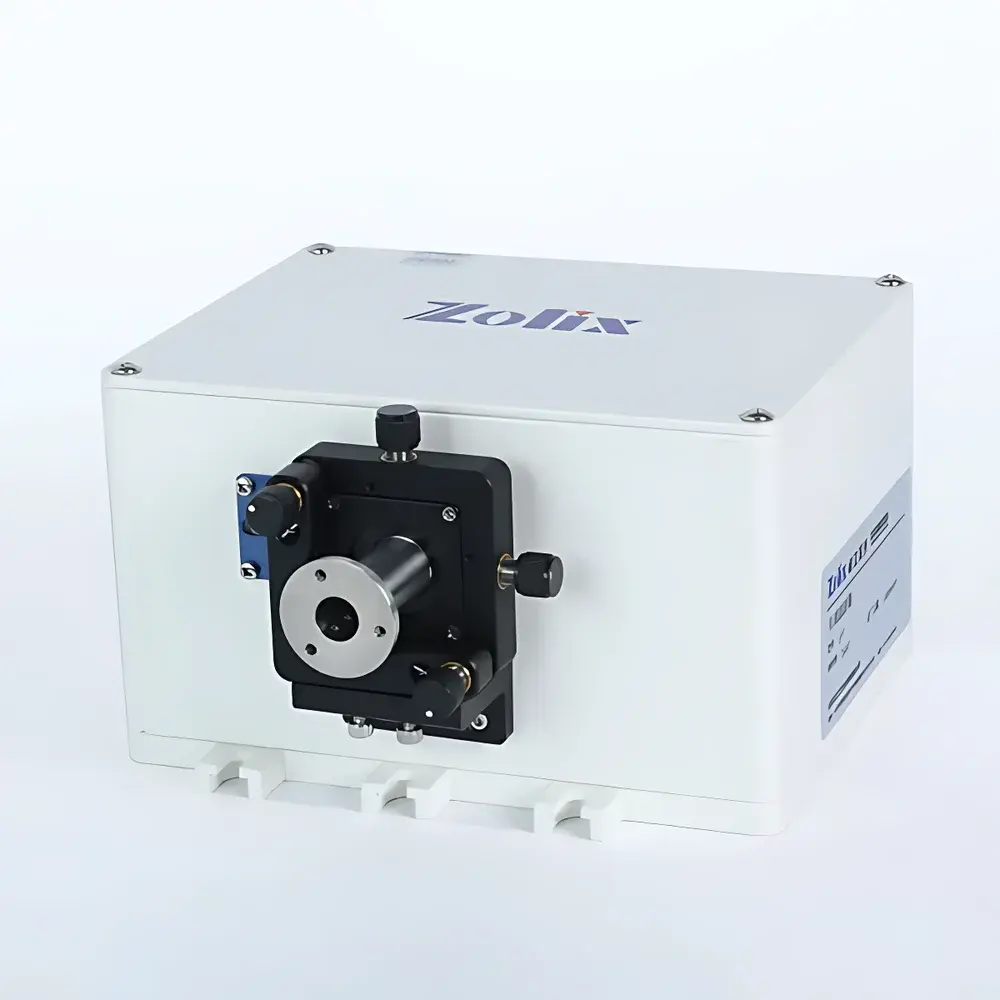
The Auniontech Resonant Phase Modulator is an electro-optic phase modulator engineered specifically for Pound-Drever-Hall (PDH) laser frequency stabilization. It operates on the principle of the linear electro-optic (Pockels) effect in a resonant cavity-enhanced crystal configuration, enabling high-efficiency phase modulation at discrete radio-frequency (RF) harmonics—primarily 6.25 MHz, 12.5 MHz, and 25 MHz—optimized for low-noise error signal generation in ultra-stable optical locking applications. Unlike broadband phase modulators, this resonant design achieves >10× higher modulation efficiency at its designated frequencies due to impedance-matched RF cavity resonance, minimizing drive power requirements while maintaining sub-radian phase stability over thermal and mechanical drift. It is intended for integration into high-finesse optical cavities, atomic spectroscopy systems, and quantum optics experiments where long-term frequency stability (<100 mHz linewidth), high common-mode rejection, and minimal amplitude modulation (AM) sideband contamination are critical.
Key Features
- Resonant electro-optic architecture with Q-factor-optimized RF circuitry for enhanced modulation efficiency at 6.25 MHz, 12.5 MHz, and 25 MHz
- Low-insertion-loss design across three AR-coated wavelength bands: 400–700 nm (visible), 650–1000 nm (NIR), and 1000–1500 nm (telecom)
- Integrated Pockels cell based on high-dielectric-strength, low-birefringence DKDP or RTP crystal (material selected per wavelength band)
- Mechanically robust housing with kinematic 1-inch post-mount interface for precise alignment and vibration-insensitive optical train integration
- DC bias port for fine-tuning of operating point; RF input via SMA connector with 50 Ω impedance match
- Thermally stabilized crystal mount (passive) to minimize resonance drift <0.5 kHz/°C over 15–35 °C ambient range
Sample Compatibility & Compliance
This modulator is compatible with single-frequency continuous-wave (CW) lasers including external-cavity diode lasers (ECDLs), fiber lasers, and non-planar ring oscillators (NPROs). Its optical clear aperture (≥3 mm) supports Gaussian beam diameters up to 2 mm (1/e²), ensuring minimal wavefront distortion. The device conforms to optical safety Class 1 requirements when used within specified input power limits (<500 mW for visible/NIR, <1 W for telecom bands). While not certified to IEC 61000-4-x EMC standards as a standalone unit, it meets functional electromagnetic compatibility when integrated with shielded RF cabling and grounded laboratory enclosures—common practice in metrology-grade laser labs. For GLP/GMP traceability, serial-numbered calibration reports (phase shift vs. RF voltage at reference frequency) are available upon request.
Software & Data Management
The modulator itself is hardware-only and requires external control infrastructure. It interfaces seamlessly with industry-standard instrumentation: RF signal generators (Keysight, Rohde & Schwarz), lock-in amplifiers (Zurich Instruments HF2LI, Stanford Research SR830), and digital PID controllers (e.g., Toptica DigiLock, SRS SIM960). When paired with FPGA-based real-time controllers (e.g., Red Pitaya, Moku:Lab), it supports closed-loop bandwidths up to 100 kHz. All measurement data—including demodulated error signals, actuator feedback, and cavity transmission logs—can be exported via TCP/IP or USB CDC protocols for post-processing in Python (NumPy/SciPy), MATLAB, or LabVIEW environments. Audit trails for PDH loop parameters (gain, offset, filter coefficients) are maintainable under FDA 21 CFR Part 11-compliant software configurations when deployed with validated acquisition platforms.
Applications
- Laser frequency stabilization to ultra-high-finesse Fabry–Pérot cavities for gravitational-wave interferometry (e.g., LIGO, Virgo, KAGRA)
- Atomic and molecular spectroscopy: Doppler-free saturated absorption, Lamb dip spectroscopy, and optical clock transitions (e.g., Sr, Yb, Al⁺)
- Quantum information processing: Sideband cooling, Raman transitions, and cavity QED experiments requiring phase-coherent modulation
- Optical frequency comb stabilization via f–2f self-referencing or carrier-envelope offset (CEO) control loops
- High-resolution photoacoustic sensing and cavity-enhanced absorption spectroscopy (CEAS) systems
FAQ
What is the typical half-wave voltage (Vπ) at 12.5 MHz for the 780 nm variant?
Vπ is frequency- and wavelength-dependent; typical values range from 120–180 Vpp depending on crystal orientation and coating stack. Exact values are provided in the calibration certificate for each unit.
Can this modulator be used for amplitude modulation?
No—it is optimized exclusively for pure phase modulation. AM content remains below –35 dB relative to the carrier under nominal operating conditions.
Is thermal tuning required during operation?
No active thermal control is needed. Passive thermal design ensures resonance frequency drift <±10 kHz over 8-hour continuous operation at stable lab temperature.
Does Auniontech supply matched RF drivers?
Yes—optional broadband or resonant RF amplifiers (10–30 dB gain, 50 Ω output) are available with impedance-matched output stages and harmonic filtering to suppress spurious sidebands.
How is polarization extinction ratio (PER) maintained across wavelength bands?
Each AR-coating variant includes stress-compensated mounting and anti-reflection layers designed to preserve PER >25 dB across the specified band, verified by Mueller matrix characterization pre-shipment.