
Auniontech SEN-3D-CAM-3D True 3D Vector Magnetic Field Camera
| Brand | Auniontech |
|---|---|
| Origin | Shanghai, China |
| Manufacturer Type | Authorized Distributor |
| Product Category | Domestic |
| Model | SEN-3D-CAM-3D |
| Measurement Principle | Senis 3D Hall Sensor Array |
| Spatial Resolution | 100 µm |
| Pixel Count | 128 × 128 (16,384 pixels) |
| Sensitive Volume per Pixel | 27 µm × 9 µm × 4 µm |
| Image Acquisition Rate | 1 frame/s |
| Calibration Ranges | ±100 mT / ±500 mT |
| Absolute Accuracy | <1% of full scale |
| Repeatability | <0.2% of full scale |
| Temperature Calibration Range | 20–30 °C |
| Minimum Working Distance | 300 µm |
| Operating Temperature | 10–50 °C |
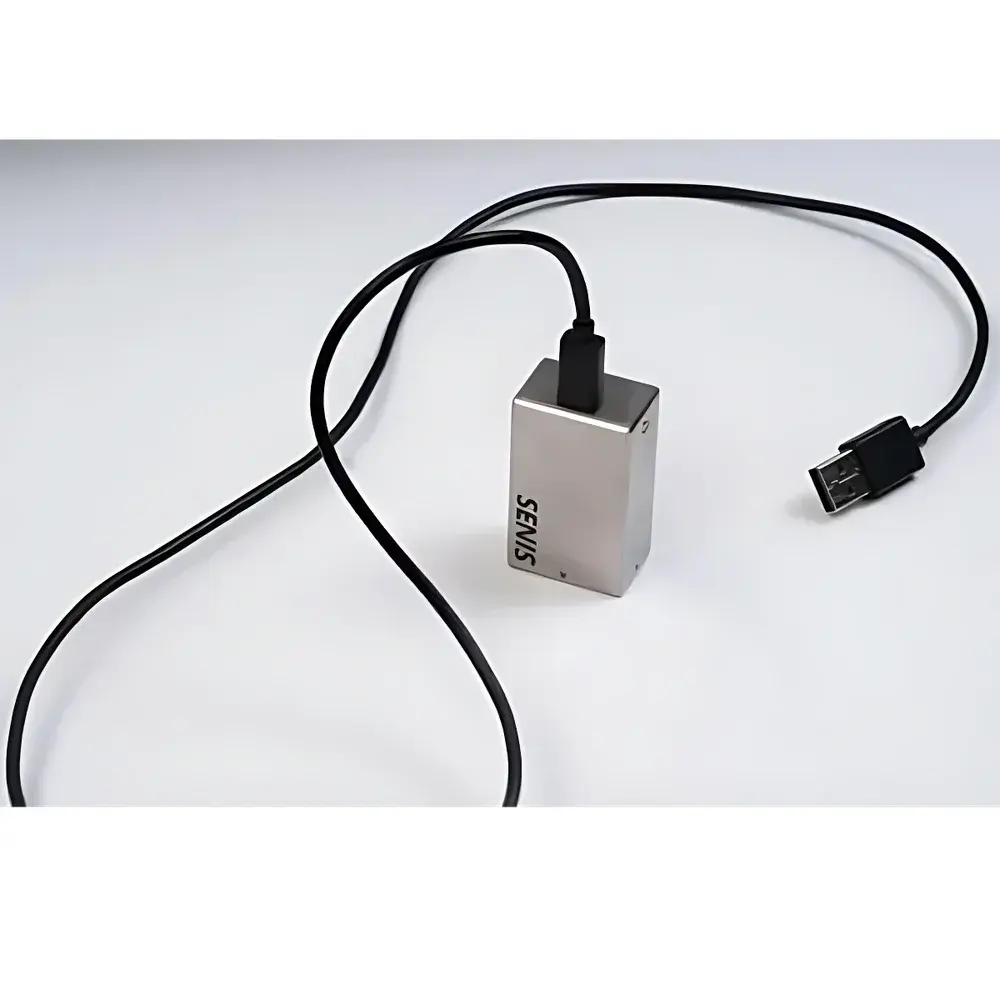
| Interface | USB 3.0 (RNDIS), 5 V powered |
| Digital Resolution | 12-bit |
| Non-orthogonality Error | <0.5° |
| Housing | Rugged lightweight aluminum enclosure |
| Weight | ~100 g |
| Optional Software | Senis 2D Vision Commander v1.3 (Windows 7+) |
Overview
The Auniontech SEN-3D-CAM-3D is a true vector magnetic field imaging system engineered for high-fidelity, real-time 3D magnetic field mapping. Unlike conventional single-axis or sequential multi-axis probes, it employs Senis’ proprietary monolithic 3D Hall sensor array architecture—capable of simultaneously acquiring fully calibrated Bx, By, and Bz components at every pixel. This enables direct acquisition of spatially resolved, quantitative magnetic vector fields without mechanical scanning or interpolation. The instrument operates on the principle of integrated planar and vertical Hall effect sensing within a single silicon die, delivering inherently orthogonal, temperature-stabilized measurements traceable to NIST-traceable calibration protocols. Designed for both laboratory research and industrial process environments, the SEN-3D-CAM-3D supports non-contact, sub-millimeter standoff operation with minimal perturbation to the measured field—making it suitable for characterizing permanent magnets, magnetic assemblies, current-carrying conductors, and electromagnetic actuators under static or quasi-static conditions.
Key Features
- True simultaneous 3D vector field acquisition across 128 × 128 active pixels (16,384 measurement points)
- High spatial resolution of 100 µm with micro-scale sensitive volume per pixel (27 µm × 9 µm × 4 µm)
- Calibrated absolute accuracy better than ±1% of full scale across dual ranges (±100 mT and ±500 mT)
- Repeatability <0.2% of full scale, validated under controlled thermal conditions (20–30 °C)
- Real-time image streaming at 1 Hz via USB 3.0 (RNDIS protocol), enabling integration into automated test benches
- Fanless, lightweight aluminum housing (~100 g) with standardized mounting interfaces for optical table or inline production integration
- No external power supply required—bus-powered via 5 V USB-C interface
- Non-orthogonality error <0.5° between magnetic axes, compensated in firmware during factory calibration
Sample Compatibility & Compliance
The SEN-3D-CAM-3D is compatible with a broad range of magnetic sources, including sintered NdFeB and SmCo permanent magnets, bonded ferrite arrays, printed circuit board traces carrying DC or low-frequency AC currents (<1 kHz), and electromagnetic coil systems. Its minimum working distance of 300 µm ensures compatibility with encapsulated or coated magnet surfaces without risk of sensor damage. All calibration data are generated in accordance with ISO/IEC 17025-accredited procedures; traceability documentation is provided with each unit. While not certified for use in safety-critical or medical device manufacturing environments, the system meets general-purpose laboratory instrumentation requirements under IEC 61326-1 (EMC) and IEC 61010-1 (safety). For regulated QA/QC workflows, raw binary data output supports post-acquisition validation against internal SOPs and GLP-aligned reporting templates.
Software & Data Management
Data acquisition is handled natively through a vendor-provided Windows driver stack compliant with USB CDC/RNDIS standards, enabling plug-and-play operation without third-party runtime dependencies. The optional Senis 2D Vision Commander v1.3 software provides advanced visualization tools—including vector field overlays, cross-sectional line scans, gradient magnitude computation, and B-field divergence analysis. All exported datasets retain full metadata (timestamp, calibration ID, temperature, exposure settings) in HDF5 format for long-term archival and interoperability with MATLAB, Python (NumPy/H5Py), and LabVIEW environments. Audit trails for calibration updates and user-defined processing steps are logged automatically when enabled—supporting basic 21 CFR Part 11 compliance for non-GMP applications. No cloud connectivity or telemetry is implemented; all data remain local unless explicitly exported by the user.
Applications
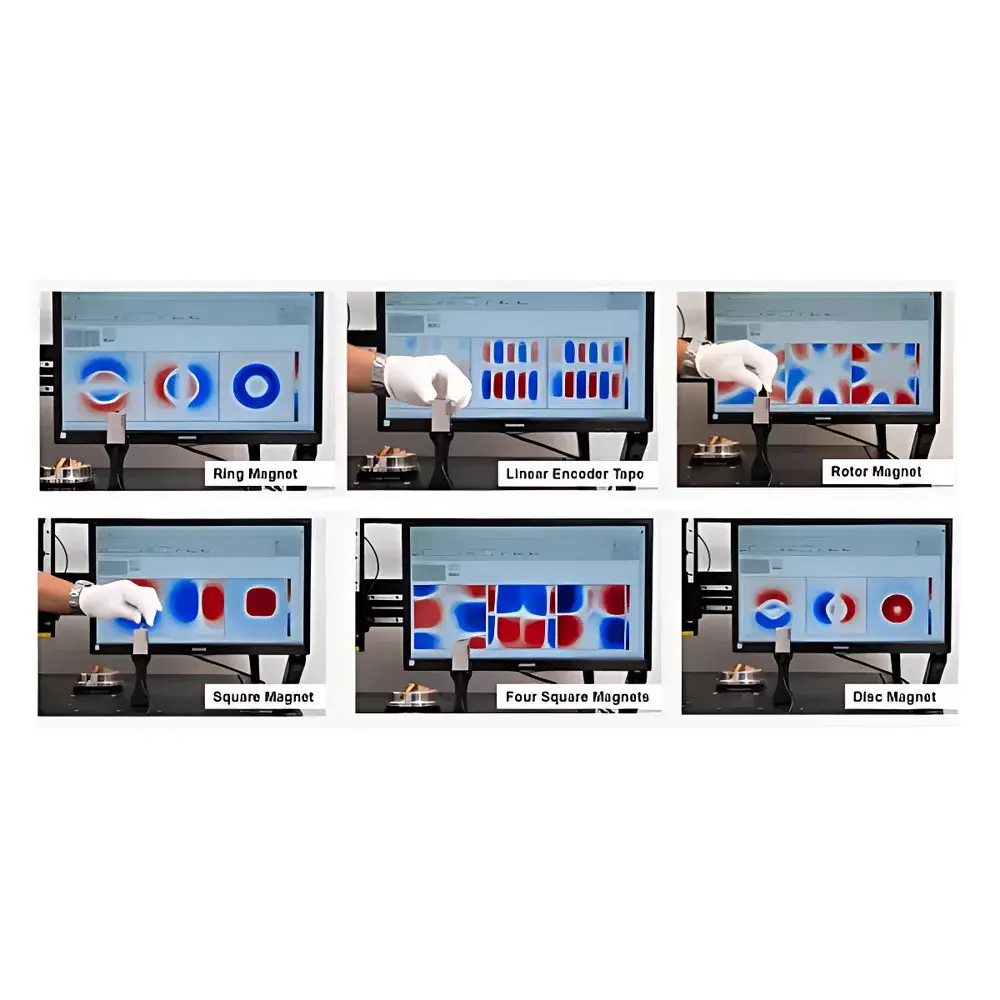
- Quantitative characterization of magnetization uniformity and edge effects in sintered and injection-molded permanent magnets
- In-line quality control of multipole rotor assemblies prior to motor integration
- Verification of magnetic shielding effectiveness in enclosures and sensor housings
- Mapping stray fields around MRI shimming coils and gradient assemblies
- Validation of finite-element magnetic simulations (e.g., COMSOL, ANSYS Maxwell) against empirical field distributions
- Development and failure analysis of magnetic encoders, reed switches, and Hall-effect position sensors
- Education and demonstration of vector field topology, including curl-free and divergence-free regions
FAQ
Is the SEN-3D-CAM-3D suitable for measuring time-varying magnetic fields?
It is optimized for static and quasi-static fields (bandwidth limited by frame rate: ≤1 Hz). For dynamic fields above 10 Hz, dedicated search-coil or fluxgate-based systems are recommended.
Can the camera be used in vacuum or inert gas environments?
The standard housing is rated for ambient air operation only; custom hermetic variants require engineering consultation and are not part of the base configuration.
Does the system support custom calibration for non-standard field ranges?
Factory calibration covers ±100 mT and ±500 mT ranges. Extended-range calibration beyond ±500 mT is not supported due to sensor saturation limits.
How is temperature drift compensated during extended measurements?
Internal temperature monitoring is performed continuously, and gain/offset corrections are applied using polynomial coefficients derived from multi-point thermal calibration (20–30 °C). Operation outside this range degrades specified accuracy.
Is SDK access available for third-party software integration?
Yes—a documented C/C++ API and Python bindings are provided under NDA upon request, supporting low-level register access and asynchronous frame polling.



