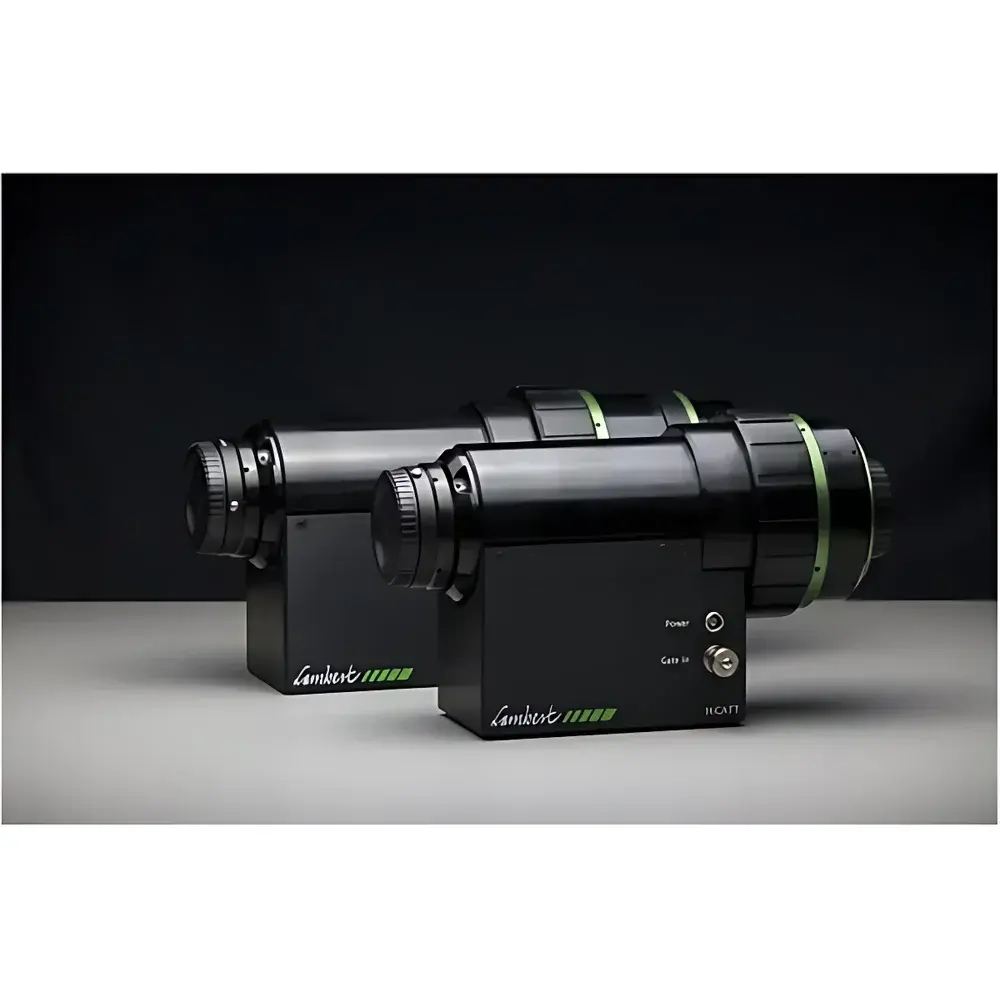
Auniontech TRiCATT Compact Lens-Coupled Image Intensifier
| Brand | Auniontech |
|---|---|
| Model | TRiCATT |
| Type | Lens-Coupled Image Intensifier |
| Generation | Gen II / Gen III |
| Phosphor | P43 |
| Minimum Gating Width | <3 ns (FWHM) |
| Timing Jitter | <100 ps |
| Maximum Gating Repetition Rate | 300 kHz (standard), up to 2.5 MHz (optional) |
| Modulation Bandwidth | DC–120 MHz |
| Input/Output Mount | C-mount, F-mount |
| Relay Optics | 1:1 or 1.7:1 fixed-ratio or variable-aperture configurations |
| Compatible Sensor Sizes | 1/2″, 2/3″, 1″ format CCD/CMOS sensors |
| Max Frame Rate Support | 500 fps (with compatible camera) |
| Overexposure Protection | User-definable photocathode current limit + optional mechanical shutter |
| Compliance | RoHS-compliant construction |
Overview
The Auniontech TRiCATT is a high-performance, compact lens-coupled image intensifier engineered for ultra-low-light, time-resolved imaging and spectroscopy applications requiring sub-nanosecond temporal resolution and high spatial fidelity. Operating on the principle of photoelectron multiplication—where incident photons strike a photocathode to emit electrons, which are then accelerated through a microchannel plate (MCP) for gain amplification before striking a phosphor screen—the TRiCATT delivers photon-limited sensitivity across UV–VIS–NIR spectral bands (185–900 nm). Its core architecture supports both gated and analog modulation modes, enabling precise synchronization with pulsed lasers, RF triggers, or external timing sources. Unlike fiber-optic-coupled ICCDs, the TRiCATT’s lens-coupled design preserves native sensor resolution without pixelation loss, while offering superior flexibility in optical path integration—particularly critical in confocal microscopy, time-gated Raman setups, and plasma diagnostics where space-constrained beam routing is essential.
Key Features
- Sub-3 ns full-width-at-half-maximum (FWHM) gating capability with <100 ps timing jitter, enabling picosecond-scale temporal slicing of transient luminescence or scattering events.
- Gen II and Gen III photocathode options (S-20, GaAs, or multialkali) optimized for quantum efficiency >25% at 550 nm and extended NIR response up to 900 nm.
- Modulation bandwidth up to 120 MHz, supporting continuous-wave (CW) lock-in detection and frequency-domain FLIM without aliasing artifacts.
- Integrated control unit featuring programmable MCP voltage (gain control), photocathode bias modulation, real-time output luminance monitoring, and automatic shutdown upon overcurrent conditions.
- C-mount and F-mount compatibility ensures seamless integration with industry-standard scientific cameras—including sCMOS, EMCCD, and high-speed CMOS platforms—without optical re-engineering.
- Relay optics with 1:1 or 1.7:1 magnification ratios and optional variable aperture allow optimization of signal-to-noise ratio (SNR) versus field-of-view (FOV) trade-offs for specific detector formats.
Sample Compatibility & Compliance
The TRiCATT is compatible with any C-mount or F-mount camera equipped with 1/2″, 2/3″, or 1″ format image sensors, including models from Andor, Hamamatsu, Basler, and PCO. Its mechanical and electrical interfaces adhere to DIN 45026 and IEEE 1394b timing standards for deterministic trigger latency. The device complies with IEC 61000-6-3 (EMC emission limits) and IEC 61000-6-2 (immunity requirements), ensuring stable operation in multi-instrument laboratory environments. While not certified as a medical device, its performance characteristics align with ASTM E1544-22 (Standard Practice for Characterizing Gated Imaging Systems) and ISO 15529:2021 (Optics and photonics — Image intensifiers — Test methods), supporting traceable validation in GLP and GMP-adjacent research workflows.
Software & Data Management
TRiCATT operation is managed via a USB-connected control interface supporting ASCII command protocol (SCPI-compliant), enabling direct integration into LabVIEW, MATLAB, Python (PyVISA), or custom C++ acquisition frameworks. Firmware updates and parameter logging are performed through Auniontech’s TRiControl software suite, which includes built-in oscilloscope-style waveform visualization for gate timing verification, gain calibration curves, and thermal drift compensation profiles. Audit trails—including timestamped gain settings, exposure durations, and photocurrent thresholds—are exportable in CSV/JSON format to satisfy 21 CFR Part 11 data integrity requirements when deployed in regulated analytical labs.
Applications
- Time-resolved fluorescence lifetime imaging (FLIM) and Förster resonance energy transfer (FRET) quantification in live-cell microscopy.
- Laser-induced fluorescence (LIF) and particle image velocimetry (PIV) in turbulent combustion diagnostics and aerodynamic flow analysis.
- Diffuse optical tomography (DOT) and time-gated bioluminescence imaging for preclinical small-animal studies.
- Ultrafast Raman spectroscopy with sub-10 ps laser excitation and nanosecond rejection windows.
- X-ray scintillator readout for synchrotron beamline detectors and radiation-hardened imaging systems.
- Plasma emission spectroscopy with gated spectral acquisition synchronized to RF discharge pulses.
FAQ
What sensor sizes does the TRiCATT support?
The TRiCATT supports standard sensor formats: 1/2″, 2/3″, and 1″ optical formats, with relay optics optimized for minimal vignetting and MTF preservation.
Can the TRiCATT be used for continuous-wave (CW) lock-in detection?
Yes—its analog modulation input accepts DC-coupled sine wave or square wave signals up to 120 MHz, enabling phase-sensitive detection without external chopper synchronization.
Is fiber-optic coupling available for the TRiCATT?
No—the TRiCATT is strictly lens-coupled. For fiber-coupled alternatives, Auniontech offers the TRiCAM series, which integrates a fiber-tapered Gen III intensifier directly onto back-illuminated sCMOS sensors.
Does the control unit provide TTL-compatible trigger outputs?
Yes—the control unit features two optically isolated TTL outputs: one synchronized to gate onset and another to MCP voltage ramp completion, facilitating multi-device timing coordination.
How is gain stability maintained during extended acquisitions?
The control unit continuously monitors anode current and applies closed-loop feedback to MCP voltage, compensating for thermal drift and photocathode fatigue over hour-scale experiments.