
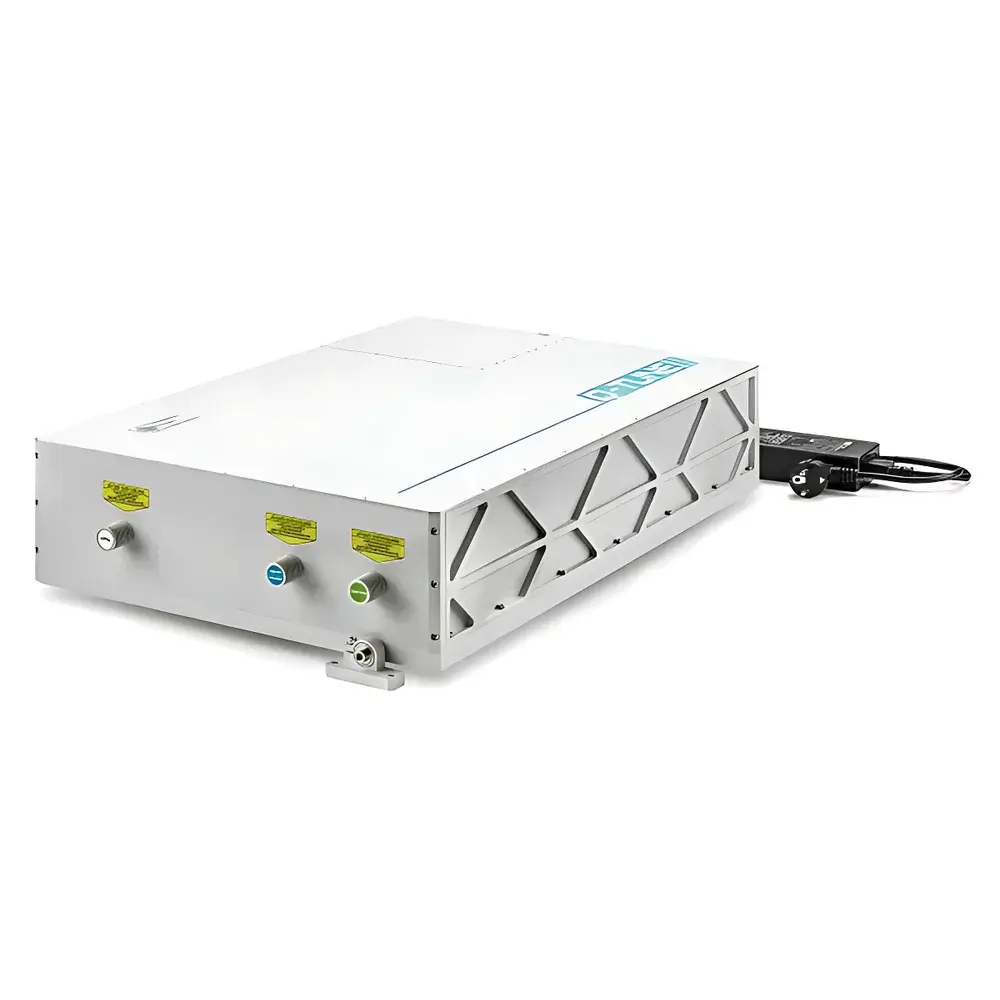
Auniontech Q-TUNE-C10-E10-C100 Tunable Nanosecond Optical Parametric Oscillator (OPO) Laser System
| Brand | Auniontech |
|---|---|
| Model | Q-TUNE-C10-E10-C100 |
| Wavelength Range (OPO) | 410–2300 nm |
| Wavelength Range (SHG) | 210–410 nm |
| Pulse Width | <5 ns |
| Repetition Rate | 10 Hz / 100 Hz (configurable) |
| Pulse Energy (OPO) | >1 mJ (410–2300 nm), up to 5 mJ (visible) |
| Pulse Energy (Fundamental) | up to 50 mJ |
| Pulse Energy (SHG) | up to 20 mJ |
| Pulse Energy (THG) | up to 20 mJ |
| Spectral Linewidth (OPO) | <76 cm⁻¹ |
| Spectral Linewidth (SHG) | ~12 cm⁻¹ |
| Pump Source | Diode-pumped solid-state laser, crystal-free architecture |
| Beam Quality | Near-diffraction-limited (M² < 1.3) |
| Trigger Modes | Internal & External TTL |
| Control Interface | Ethernet + USB, RESTful API, Web-based GUI, Mobile-compatible |
| Cooling | Air-cooled only |
| Dimensions (Laser Head) | ≤350 × 200 × 120 mm |
| Weight (Laser Head) | <12 kg |
Overview
The Auniontech Q-TUNE-C10-E10-C100 is a fully integrated, air-cooled tunable nanosecond laser system based on optical parametric oscillation (OPO) technology. Engineered for precision spectroscopic and metrological applications, it delivers coherent, narrowband pulsed output across an exceptionally broad spectral range—from 210 nm in the deep ultraviolet (via second-harmonic generation) to 2300 nm in the short-wave infrared—without requiring water cooling, external high-voltage supplies, or optical realignment. The system employs a diode-pumped, crystal-free solid-state pump laser architecture, eliminating thermal lensing and mechanical drift associated with conventional flashlamp- or crystal-pumped OPOs. This design ensures long-term amplitude stability (<±3% RMS over 8 hours), high spatial coherence (M² < 1.3), and pulse-to-pulse reproducibility essential for quantitative time-resolved measurements. Its compact monolithic housing integrates all optoelectronic subsystems—including pump laser, OPO cavity, harmonic generators, beam delivery optics, and thermal management—into a single passively cooled unit weighing under 12 kg.
Key Features
- Ultra-broad spectral coverage: 410–2300 nm via OPO; extended to 210–410 nm using built-in SHG stage
- Sub-5 ns pulse width with <76 cm⁻¹ linewidth (OPO) and ~12 cm⁻¹ (SHG), suitable for high-resolution transient absorption and Raman excitation
- Configurable repetition rates: 10 Hz or 100 Hz operation with pulse energy scaling optimized per wavelength band
- High pulse energy: Up to 5 mJ in visible (500–700 nm), 50 mJ fundamental output, 20 mJ at SHG/THG—enabling nonlinear signal generation in low-conversion-efficiency media
- True plug-and-play operation: Microprocessor-controlled self-alignment, automatic wavelength calibration, and real-time thermal compensation
- Fully remote operability: Web-based GUI accessible via Ethernet; RESTful API for Python, LabVIEW, MATLAB, and custom DAQ integration; smartphone-compatible control interface
- No consumables or routine maintenance: Pump diodes rated for >2 billion shots; no alignment screws, no water lines, no external chillers
Sample Compatibility & Compliance
The Q-TUNE-C10-E10-C100 is compatible with standard optical tables, vacuum chambers (with optional Brewster-angle windows), and fiber-coupled spectrometers (e.g., Andor Shamrock, Ocean Insight QE Pro). Its stable TEM₀₀ output supports coupling into single-mode fibers (SMF-28, FC/APC) and high-NA objectives used in confocal microscopy. All electronic subsystems comply with IEC 61000-6-3 (EMI emission) and IEC 61000-6-2 (immunity) standards. Laser safety classification meets IEC 60825-1:2014 Class 4 requirements; interlock-ready design supports integration into ISO 13857-compliant enclosures. Firmware implements audit-trail logging and user-access-level controls aligned with GLP and GMP documentation workflows. While not FDA 21 CFR Part 11-certified out-of-box, the API architecture enables traceable command logging and electronic signature implementation for regulated environments.
Software & Data Management
System control is managed through a browser-hosted web application supporting Chrome, Edge, and Safari. The interface provides real-time monitoring of pulse energy (via internal photodiode), wavelength position (encoder feedback), temperature stabilization status, and diode current/voltage. All parameters—including tuning curve, pulse energy map vs. wavelength, and trigger delay offsets—are stored in JSON-formatted configuration files. The RESTful API exposes endpoints for wavelength setpoint, repetition rate, SHG/THG activation, external trigger enable/disable, and synchronous data acquisition triggers. Timestamped measurement logs (CSV) include UTC timestamps, environmental sensor readings (internal ambient temperature/humidity), and firmware version identifiers—facilitating traceability in multi-instrument experiments. Third-party software packages such as Igor Pro, OriginLab, and Python’s requests library can directly orchestrate multi-step spectral scans or pump-probe delay series.
Applications
- Time-resolved laser-induced fluorescence spectroscopy (LIFS): Nanosecond-scale decay kinetics analysis in combustion diagnostics, plasma chemistry, and biological fluorophore characterization
- Nonlinear optical spectroscopy: Coherent anti-Stokes Raman scattering (CARS), sum-frequency generation (SFG), and two-photon absorption mapping in thin-film and interface studies
- Confocal and multiphoton microscopy: Wavelength-tunable excitation for spectral unmixing, lifetime imaging (FLIM), and optogenetic stimulation protocols
- Optical metrology: Calibration of spectrometer response functions, grating efficiency mapping, and absolute radiometric reference source validation
- Photoacoustic imaging (PAI): High-energy, narrow-linewidth pulses enabling depth-resolved absorption contrast in tissue phantoms and small-animal models
- Gas-phase absorption spectroscopy: High-resolution rovibrational line probing in atmospheric simulation cells and combustion exhaust analysis
FAQ
Is the Q-TUNE compatible with third-party spectrometers and detectors?
Yes—the system provides TTL-synchronized trigger outputs and analog pulse energy monitoring signals compatible with standard DAQ systems (National Instruments, Keysight, Spectrum Instrumentation). Fiber-coupled output options support direct integration with Ocean Insight, Avantes, or Hamamatsu spectrometers.
Can the laser be operated in external cavity mode for narrower linewidth?
No—the Q-TUNE uses a fixed-cavity OPO design optimized for broadband tunability and pulse energy. For sub-1 cm⁻¹ resolution, users should pair it with external grating compressors or injection-seeded amplifiers—not part of the base system.
What is the typical warm-up time before stable output is achieved?
Less than 15 minutes from cold start. Internal thermal stabilization maintains wavelength drift <±0.2 nm over 4 hours at constant ambient temperature (20–25°C).
Does the system support automated wavelength scanning across its full range?
Yes—via the web GUI or API, users can define linear or logarithmic scan profiles with programmable dwell time, step size, and energy normalization per wavelength point.
Is there a calibration certificate included with shipment?
Each unit ships with a factory wavelength calibration report (traceable to NIST SRM 2035), pulse energy linearity verification (±2.5% uncertainty), and M² measurement report. Optional ISO/IEC 17025-accredited calibration is available upon request.




