
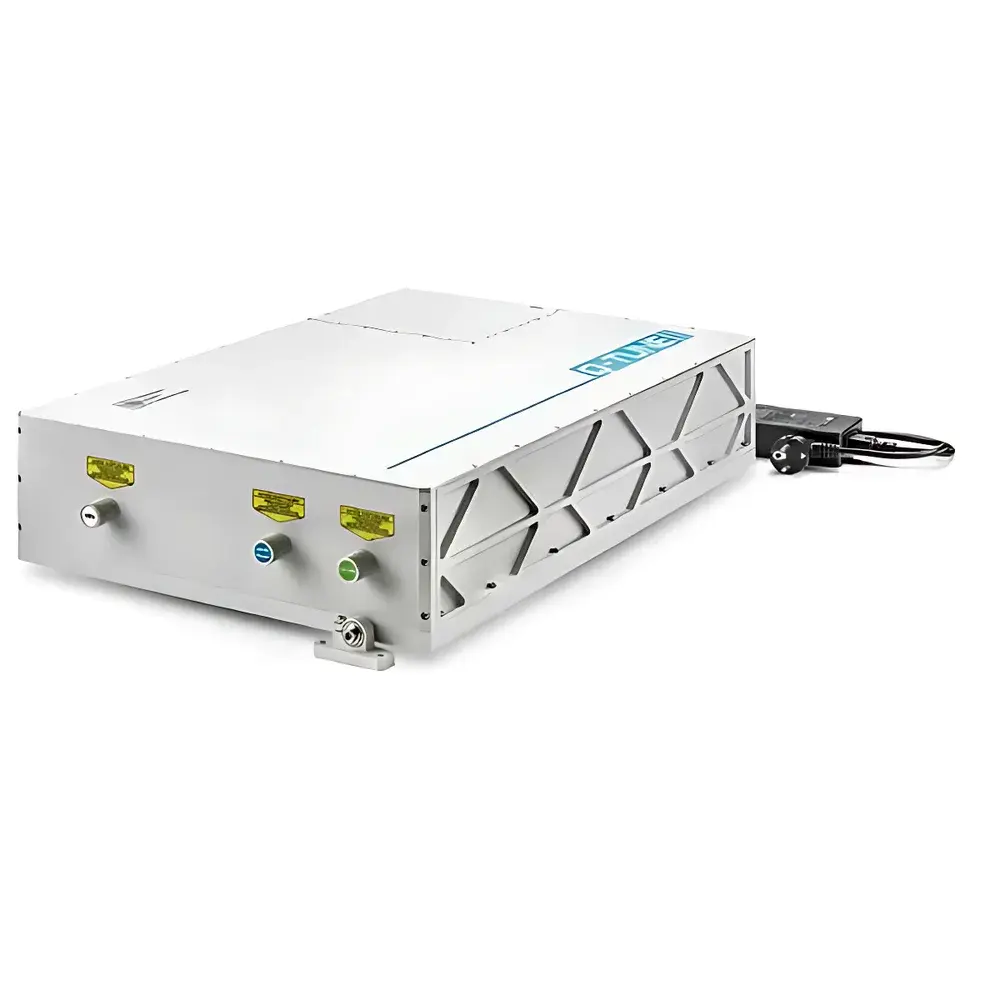
Auniontech Q-TUNE-HR-G100K High-Repetition-Rate Tunable Nanosecond OPO Laser
| Brand | Auniontech |
|---|---|
| Origin | Lithuania |
| Manufacturer Type | Authorized Distributor |
| Product Category | Imported Optical Instrument |
| Model | Q-TUNE-HR-G100K |
| Core Technology | Diode-Pumped Solid-State (DPSS) Laser with Intracavity Optical Parametric Oscillation (OPO) |
| Wavelength Range | 750–1800 nm |
| Repetition Rate | 10–100 kHz |
| Pulse Duration | 5–7 ns (FWHM @ 532 nm pump) |
| Pump Requirement | >350 µJ, 532 nm, 5–8 ns FWHM |
| Output Energy | <50 µJ @ 1200 nm |
| Spectral Linewidth | 20–100 cm⁻¹ |
| Beam Diameter (1/e²) | ~3 mm |
| Cooling | Air-Cooled (No Water Required) |
| Power Consumption | <50 W |
| Operating Temperature | 15–30 °C |
| Relative Humidity | 10–80% (non-condensing) |
| Dimensions (Laser Head) | 390 × 620 × 135 mm³ |
| Control Interface | Ethernet + USB |
Overview
The Auniontech Q-TUNE-HR-G100K is a high-repetition-rate, tunable nanosecond optical parametric oscillator (OPO) laser system engineered for precision spectroscopic and time-resolved applications requiring broad infrared coverage with exceptional temporal stability. Based on intracavity OPO architecture pumped by a diode-pumped solid-state (DPSS) Q-switched laser at 532 nm, the system delivers coherent, narrow-linewidth (20–100 cm⁻¹) pulses across 750–1800 nm at repetition rates scalable from 10 kHz to 100 kHz. Unlike conventional OPOs limited to ≤10 kHz operation, the Q-TUNE-HR-G100K maintains pulse-to-pulse energy stability and spectral fidelity even at maximum repetition rate—enabling high-throughput acquisition in Raman mapping, time-gated photoacoustic imaging, and multi-spectral remote sensing. Its fully air-cooled, water-free design eliminates thermal drift concerns associated with liquid cooling, ensuring long-term wavelength reproducibility under ambient laboratory conditions (15–30 °C). The laser head integrates real-time self-alignment optics and microprocessor-driven cavity optimization, reducing operator dependency while maintaining alignment robustness against mechanical perturbation.
Key Features
- Wide, continuous tuning range: 750–1800 nm via automated OPO crystal angle and temperature control
- High pulse repetition frequency: Adjustable from 10 kHz to 100 kHz with <±0.1% jitter over 24-hour operation
- Stable nanosecond pulse output: 5–7 ns FWHM duration, M² < 1.5, TEM₀₀ spatial profile
- Fully integrated control architecture: Web-based GUI accessible via Ethernet or Wi-Fi; compatible with desktop, tablet, and smartphone interfaces
- Programmable API support: Native Python and C++ SDKs for OEM integration into custom platforms (e.g., automated Raman workstations, LIDAR test benches)
- No external chiller required: Passive heatsink + forced-air convection ensures stable thermal management (<50 W total power draw)
- Self-optimizing alignment: Onboard position sensors and piezoelectric actuators maintain cavity resonance without manual intervention
Sample Compatibility & Compliance
The Q-TUNE-HR-G100K is designed for compatibility with standard optical tables, motorized translation stages, and commercial spectrometers (e.g., Horiba iHR, Andor Shamrock). Its 3 mm collimated output beam enables direct coupling into fiber-optic delivery systems (FC/PC or SMA connectors optional) or free-space scanning galvanometers. All firmware and control software comply with IEC 61000-6-3 (EMC emissions) and IEC 60825-1:2014 (laser safety Class IV certification). System logs—including wavelength setpoint, pulse energy, repetition rate, and thermal sensor readings—are timestamped and stored locally with optional network forwarding for GLP/GMP audit trails. While not FDA-cleared as a medical device, its performance parameters meet ASTM E2585–21 requirements for tunable source characterization in analytical spectroscopy validation protocols.
Software & Data Management
Control is managed through Quantum Light Instruments’ proprietary Q-LINK platform—a cross-platform application supporting Windows, Linux, and macOS. The software provides real-time spectral monitoring (when paired with optional compact spectrometer module), automatic wavelength calibration using built-in reference lines, and batch scripting for multi-point spectral acquisition. All operational parameters are exportable in CSV or HDF5 format with metadata tags compliant with FAIR data principles. For regulated environments, optional 21 CFR Part 11-compliant audit logging is available via enterprise license, including electronic signatures, role-based access control, and immutable event records. Remote diagnostics and firmware updates are delivered over secure HTTPS with TLS 1.3 encryption.
Applications
- Raman spectroscopy: Enables rapid hyperspectral imaging of polymers, pharmaceuticals, and 2D materials with excitation wavelength optimization to minimize fluorescence background
- Photoacoustic microscopy (PAM): Delivers high-duty-cycle pulsed IR illumination for depth-resolved oxygen saturation mapping in biological tissue
- Infrared absorption spectroscopy: Supports gas-phase detection of trace volatiles (e.g., CH₄, CO₂, NH₃) using tunable single-pass absorption cells
- LIDAR & remote sensing: Serves as a compact, field-deployable source for differential absorption LIDAR (DIAL) in atmospheric monitoring
- Micromachining of transparent dielectrics: Facilitates selective subsurface modification of fused silica and sapphire using wavelength-tuned nonlinear absorption
- Time-resolved fluorescence upconversion: Provides synchronized pump-probe excitation in ultrafast photophysics studies
FAQ
What pump laser specifications are mandatory for optimal Q-TUNE-HR-G100K operation?
A DPSS Nd:YAG or Nd:YVO₄ laser operating at 532 nm, delivering ≥350 µJ pulse energy, 5–8 ns FWHM duration, and ≥10 kHz repetition rate is required. M² < 1.3 and beam pointing stability <5 µrad are recommended for sustained OPO threshold efficiency.
Can the Q-TUNE-HR-G100K be integrated into an automated production line?
Yes—via its RESTful API and native Python SDK, the system supports deterministic triggering, closed-loop wavelength feedback, and synchronization with motion controllers (e.g., Galil, Aerotech) and data acquisition hardware (NI PXI, Keysight DAQ).
Is fiber coupling included as standard equipment?
Fiber coupling is an optional add-on; standard output is free-space, collimated, and polarization-maintained (horizontal linear). FC/APC or SMA-905 interfaces are available with adjustable focus optics.
How is wavelength accuracy verified and maintained over time?
Each unit undergoes factory calibration against NIST-traceable atomic emission lines (e.g., He–Ne, Ar⁺). In-field recalibration is supported via the integrated compact spectrometer option or external wavemeter input through Q-LINK’s calibration wizard.
Does the system support external TTL triggering or synchronization?
Yes—dedicated BNC inputs accept TTL-level start/stop and sync signals with ≤10 ns jitter; all internal timing is referenced to a low-phase-noise OCXO (±0.1 ppm stability).




