
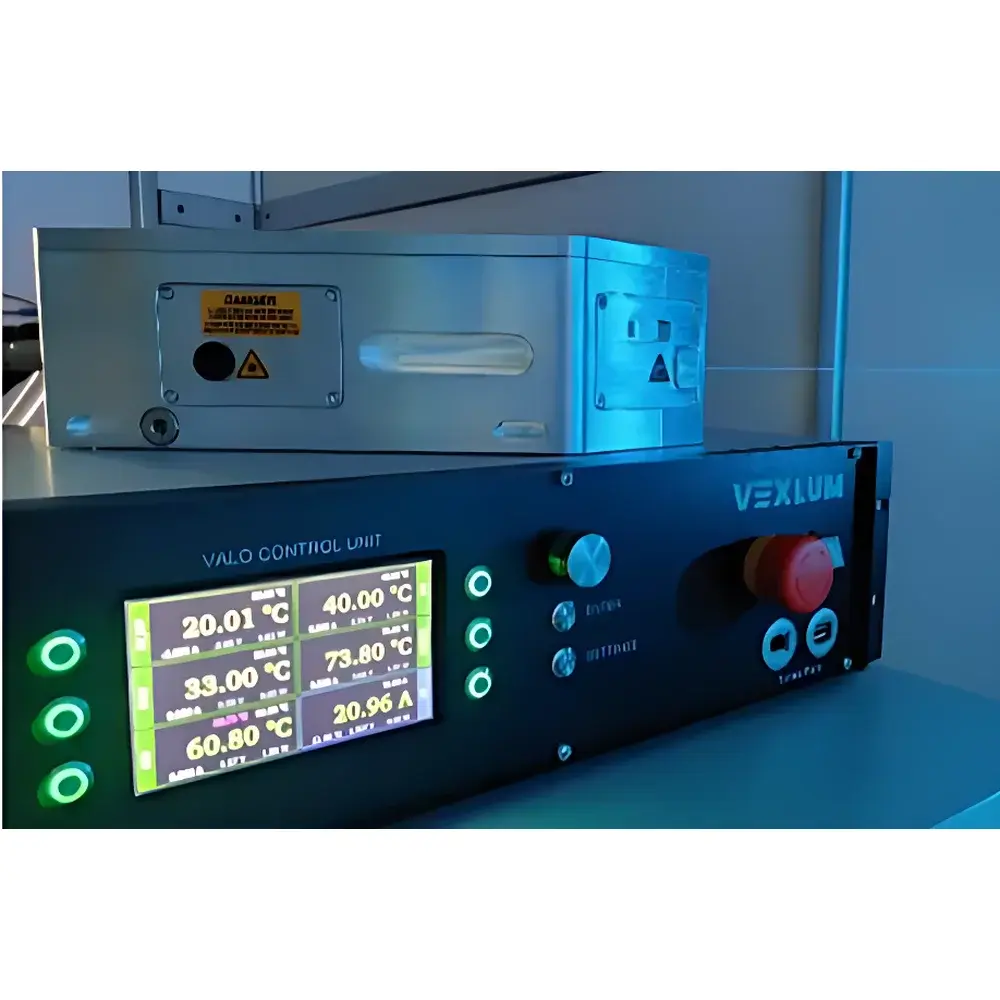
Auniontech VALO Series External-Cavity Vertical-External-Cavity Surface-Emitting Laser (VECSEL)
| Brand | Auniontech |
|---|---|
| Model | VALO SF / VALO SHG SF |
| Wavelength Range | 350–750 nm (SHG), 700–2100 nm (NIR) |
| Output Power | 0.5–4 W (integrated pump), >10 W (external pump) |
| Linewidth | <100 kHz (10 ms) |
| Tuning Range | ~10 THz (NIR), ±1 nm (VIS) |
| Beam Quality | M² < 1.1 |
| Dimensions | 320 mm × 190 mm × 100 mm (L×W×H) |
| Gain Medium | Epitaxially grown semiconductor chip (MBE) |
| Pump Configuration | Integrated or external diode laser |
| Compliance | CE, RoHS, ISO 9001-manufactured supply chain |
Overview
The Auniontech VALO Series External-Cavity Vertical-External-Cavity Surface-Emitting Laser (VECSEL) represents a hybrid solid-state laser architecture engineered for high-brightness, narrow-linewidth, and broadly tunable operation across the visible and near-infrared spectral domains. Unlike conventional edge-emitting diodes or monolithic VCSELs, the VALO platform integrates a semiconductor gain chip—epitaxially grown via molecular beam epitaxy (MBE)—into an extended external cavity incorporating intracavity frequency-doubling optics (for VIS models) and precision piezo-tuned mirrors. This design decouples thermal management from optical resonance, enabling simultaneous optimization of power scaling, spectral purity, and wavelength agility. The system operates on the principle of intracavity enhancement: the fundamental infrared emission (700–2100 nm) is resonantly amplified within a low-loss, diffraction-limited cavity before undergoing second-harmonic generation (SHG) in a nonlinear crystal (e.g., BBO or LBO) to produce coherent visible output (350–750 nm). This architecture delivers watt-level continuous-wave (CW) power with single-frequency stability, making it suitable for applications demanding high coherence length (>1 km), minimal phase noise, and long-term frequency reproducibility.
Key Features
- Single-Frequency Operation: Inherent longitudinal mode selection via intra-cavity etalons and high-finesse mirrors ensures stable TEM00 output with linewidth <100 kHz (measured over 10 ms), meeting stringent requirements for interferometric metrology and quantum optics.
- Broad Spectral Coverage: Dual-platform architecture supports two distinct operational bands: the VALO SF NIR system covers 700–2100 nm; the VALO SHG SF variant provides visible output from 350–750 nm through efficient intracavity SHG—enabling access to atomic transitions (e.g., Rb D2 line at 780 nm, Sr+ at 422 nm) without external nonlinear conversion stages.
- High Beam Quality & Power Scalability: Diffraction-limited beam profile (M² 10 W fundamental output while preserving spectral fidelity.
- Wide Continuous Tuning: Mechanical and thermal actuation of cavity length and chip temperature enables continuous tuning up to ~10 THz in NIR (equivalent to >30 nm at 1064 nm) and ±1 nm in VIS with sub-pm resolution—facilitating spectroscopic scanning and cavity lock acquisition.
- Turnkey Industrial Packaging: Compact 320 × 190 × 100 mm chassis integrates VECSEL head, electronic control unit, low-vibration thermoelectric cooler (TEC), and pump laser driver. All subsystems are pre-aligned and factory-characterized for plug-and-play deployment in laboratory or OEM integration environments.
Sample Compatibility & Compliance
The VALO Series is designed for use with optically transparent, non-absorbing samples in transmission or reflection geometries typical of high-resolution absorption spectroscopy, cavity ring-down measurements, and pump-probe experiments. Its narrow linewidth and low intensity noise (<0.3% RMS, 10 Hz–10 MHz) minimize artifacts in time-domain and frequency-domain sensing. From a regulatory standpoint, the system complies with CE marking directives (2014/35/EU Low Voltage Directive and 2014/30/EU EMC Directive), RoHS 2011/65/EU restrictions on hazardous substances, and conforms to ISO 9001-certified manufacturing practices for optical components. While not inherently FDA 21 CFR Part 11-compliant as a standalone instrument, its digital control interface supports audit-trail logging when integrated into GLP/GMP-compliant data acquisition frameworks. Calibration certificates traceable to NIST standards are available upon request for wavelength and power output verification.
Software & Data Management
Auniontech provides the VALO Control Suite—a Windows-based application supporting real-time monitoring and closed-loop stabilization of output wavelength, power, and cavity alignment. The software communicates via USB 2.0 or Ethernet (TCP/IP) using a documented ASCII command protocol compatible with LabVIEW, Python (PySerial), MATLAB, and EPICS. Key functionalities include automated wavelength sweep scripting, PID parameter tuning for cavity length feedback, harmonic locking routines for SHG efficiency maximization, and timestamped data export in CSV or HDF5 format. All settings—including pump current, TEC setpoints, piezo voltages, and photodiode readings—are logged with microsecond resolution. For regulated environments, optional firmware modules enable user-access logging, electronic signature enforcement, and encrypted configuration backups aligned with ALCOA+ principles (Attributable, Legible, Contemporaneous, Original, Accurate, Complete, Consistent, Enduring, Available).
Applications
- Atomic & Molecular Spectroscopy: Precision interrogation of alkali metal (Rb, Cs), alkaline earth (Sr, Ca), and rare-earth ion transitions in optical lattice clocks, magneto-optical traps (MOTs), and Doppler-free saturation spectroscopy.
- Quantum Optics & Cold Atom Physics: Pumping of narrow-line cooling transitions, optical dipole traps, and stimulated Raman adiabatic passage (STIRAP) protocols requiring high coherence and low phase noise.
- Biophotonics & Fluorescence Lifetime Imaging (FLIM): Time-resolved excitation of visible fluorophores (e.g., Alexa Fluor dyes, GFP variants) with picosecond timing jitter and minimal thermal load on biological specimens.
- Photonic Integrated Circuit (PIC) Testing: On-wafer characterization of silicon photonics modulators and resonators where narrow-linewidth probing is essential for Q-factor and dispersion mapping.
- Gas Sensing & Environmental Monitoring: High-sensitivity detection of trace gases (CH4, CO, NH3) via direct absorption or photoacoustic spectroscopy in the 1.3–2.1 µm atmospheric window.
FAQ
What distinguishes a VECSEL from a standard VCSEL or edge-emitting laser diode?
A VECSEL employs an external cavity to separate gain medium and resonator optics—enabling superior thermal management, higher output power, narrower linewidth, and broader tunability than monolithic VCSELs or Fabry–Pérot edge-emitters.
Can the VALO system be integrated into a vacuum environment or ultra-low-vibration optical table setup?
Yes—the mechanical design minimizes acoustic coupling, and the TEC-based cooling eliminates water lines. Optional vacuum-compatible versions (with hermetic feedthroughs and low-outgassing materials) are available under custom configuration.
Is wavelength calibration traceable to national standards?
Factory calibration uses a wavemeter referenced to NIST-traceable iodine-stabilized HeNe lasers. Full calibration reports—including uncertainty budgets per ISO/IEC 17025—are provided with each unit.
Does the system support active frequency stabilization to an external reference cavity?
Yes—integrated piezo-driven mirror mounts and fast current modulation allow implementation of Pound–Drever–Hall (PDH) locking with external cavities (FSR 1–10 GHz) via analog feedback inputs.
What maintenance is required during typical laboratory operation?
No routine optical alignment or consumable replacement is needed. Recommended annual verification includes power meter recalibration, wavelength accuracy check, and TEC performance validation—all supported remotely by Auniontech technical staff.






