
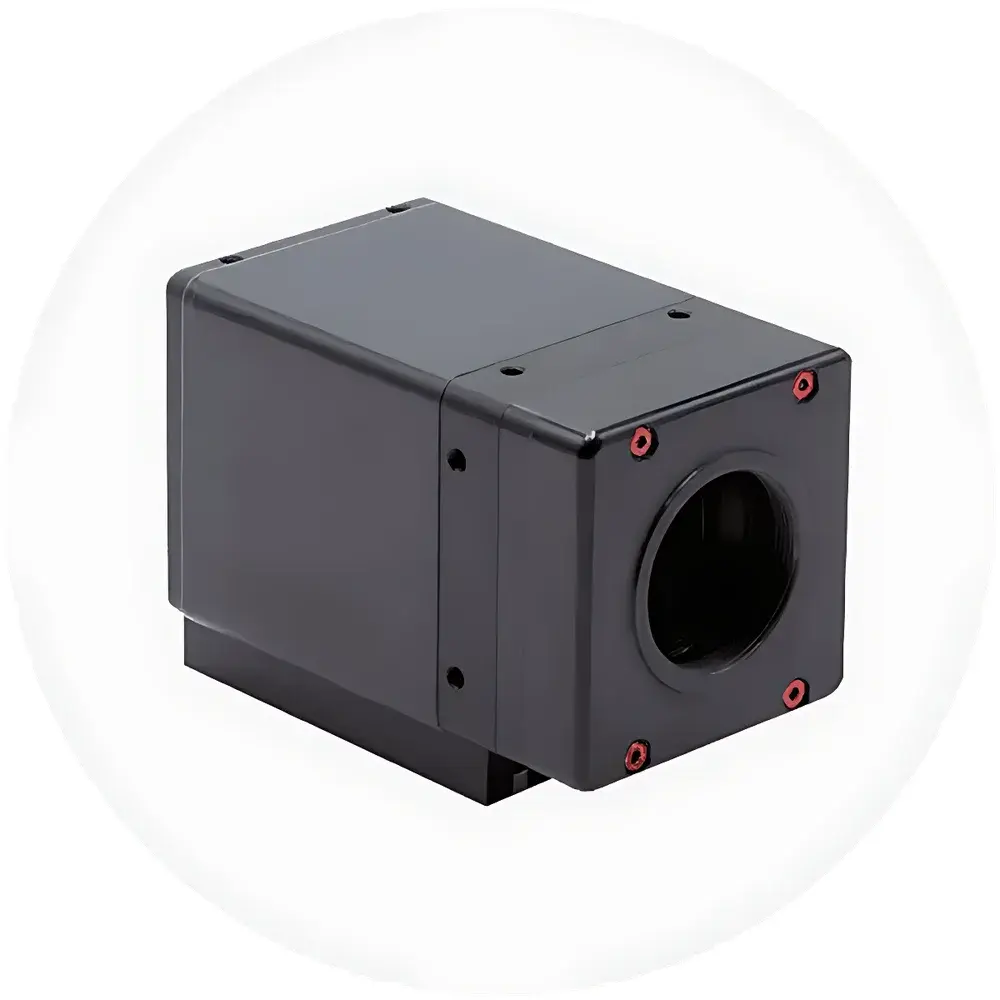
Auniontech WF-1000×1000 High-Resolution Shack-Hartmann Wavefront Sensor
| Brand | Auniontech |
|---|---|
| Origin | France |
| Model | WF-1000×1000 |
| Wavelength Range | 375–650 nm |
| Aperture Size | up to 15 × 15 mm² |
| Spatial Resolution | 7 µm |
| Pixel Pitch | 3 µm |
| Phase Sampling Grid | 1000 × 1000 pixels |
| Absolute Wavefront Accuracy | λ/30 RMS |
| Wavefront Sensitivity | λ/50 RMS |
| Frame Rate | 30 fps |
| Compliance | CE, RoHS |
Overview
The Auniontech WF-1000×1000 is a high-resolution Shack-Hartmann wavefront sensor engineered for precision optical metrology in research and industrial environments. Based on the well-established Shack-Hartmann principle, the device measures local wavefront slopes by analyzing centroid displacements of focal spot arrays generated through a microlens array. These slope measurements are then integrated using least-squares or modal reconstruction algorithms to yield full 2D phase maps with sub-wavelength fidelity. Designed for demanding applications in adaptive optics, laser beam characterization, ophthalmic diagnostics, and optical system alignment, the WF-1000×1000 delivers high spatial sampling density without compromising temporal resolution—enabling real-time closed-loop control in dynamic optical systems.
Key Features
- 1000 × 1000 pixel phase sampling grid—among the highest lateral resolution available in commercial Shack-Hartmann sensors—provides fine-grained spatial coverage across the full aperture.
- λ/30 RMS absolute wavefront accuracy and λ/50 RMS sensitivity enable reliable quantification of low-order aberrations (e.g., defocus, astigmatism) as well as higher-order modes (e.g., coma, spherical aberration) in visible-light systems.
- Optimized for the 375–650 nm spectral band, the sensor supports common visible lasers (e.g., 405 nm diodes, 488 nm argon-ion, 532 nm DPSS, 633 nm HeNe) and broadband sources used in microscopy and metrology.
- 7 µm effective lateral spatial resolution ensures resolvability of localized phase gradients typical in micro-optics inspection and thin-film interference analysis.
- 30 fps native frame rate supports real-time wavefront monitoring and integration into feedback-controlled adaptive optics loops—compatible with standard GigE Vision interfaces for deterministic data streaming.
- Compact 15 × 15 mm² maximum input aperture allows flexible integration into collimated beam paths or relayed pupil planes without requiring custom beam expansion optics.
Sample Compatibility & Compliance
The WF-1000×1000 is compatible with both continuous-wave (CW) and pulsed visible-light sources, provided average power remains within detector damage thresholds (≤10 mW/mm² for extended exposure). It supports direct imaging of pupil-plane wavefronts from telescopes, microscopes, laser cavities, and fiber-coupled systems. The sensor complies with CE marking requirements for electromagnetic compatibility (EMC Directive 2014/30/EU) and safety (Low Voltage Directive 2014/35/EU), and conforms to RoHS 2011/65/EU restrictions on hazardous substances. While not certified to ISO/IEC 17025 for calibration laboratories, its performance specifications align with measurement traceability practices recommended in ISO 10110-5 (optical element surface irregularity) and ISO 21254 (laser-induced damage threshold testing protocols).
Software & Data Management
The sensor ships with Auniontech’s WaveFront Studio—a cross-platform application supporting Windows and Linux. The software provides real-time visualization of Zernike coefficient trends, PV/RMS wavefront error reporting, point spread function (PSF) simulation, and export of phase maps in FITS, HDF5, and CSV formats. An open C++ SDK and Python bindings (via ctypes) allow integration into custom control architectures—including MATLAB, LabVIEW, and EPICS-based synchrotron beamline systems. Audit-trail functionality records acquisition timestamps, environmental metadata (ambient temperature, exposure time), and user-defined annotations—supporting GLP-aligned documentation workflows where required.
Applications
- Laser beam quality assessment: M² measurement, focus shift analysis, thermal lensing monitoring in high-power diode and solid-state lasers.
- Adaptive optics system calibration: Real-time correction of atmospheric turbulence in astronomical observatories or ocular aberrations in confocal scanning laser ophthalmoscopy.
- Micro-optics validation: Characterization of microlens arrays, diffractive optical elements (DOEs), and freeform surfaces via interferometric comparison.
- Biological sample imaging: Quantitative phase contrast of unstained biological specimens such as red blood cells, onion epidermal layers, and pollen grains—enabling label-free morphological analysis.
- Optical manufacturing QA: In-line verification of aspheric lens polishing errors, coating uniformity effects, and alignment-induced coma in multi-element assemblies.
FAQ
What is the maximum supported beam diameter?
The sensor accepts collimated beams up to 15 × 15 mm² at the microlens array plane; larger apertures require relay optics to maintain sampling Nyquist criteria.
Can the WF-1000×1000 operate with UV or NIR wavelengths?
No—it is optimized for 375–650 nm only; quantum efficiency drops sharply below 375 nm and above 650 nm due to sensor coating and silicon absorption limits.
Is calibration data traceable to NIST or other national standards?
Factory calibration uses reference wavefronts generated by fused-silica transmission flats certified to ISO 10110-5; full NIST-traceable calibration is available as an optional service.
Does the system support external triggering?
Yes—TTL-compatible trigger-in and trigger-out ports enable synchronization with pulsed lasers or stage motion controllers.
How is wavefront reconstruction performed?
Reconstruction uses a combination of least-squares slope integration and optional Zernike polynomial fitting; users may select between iterative Gerchberg-Saxton refinement and direct matrix inversion methods depending on noise conditions.




