
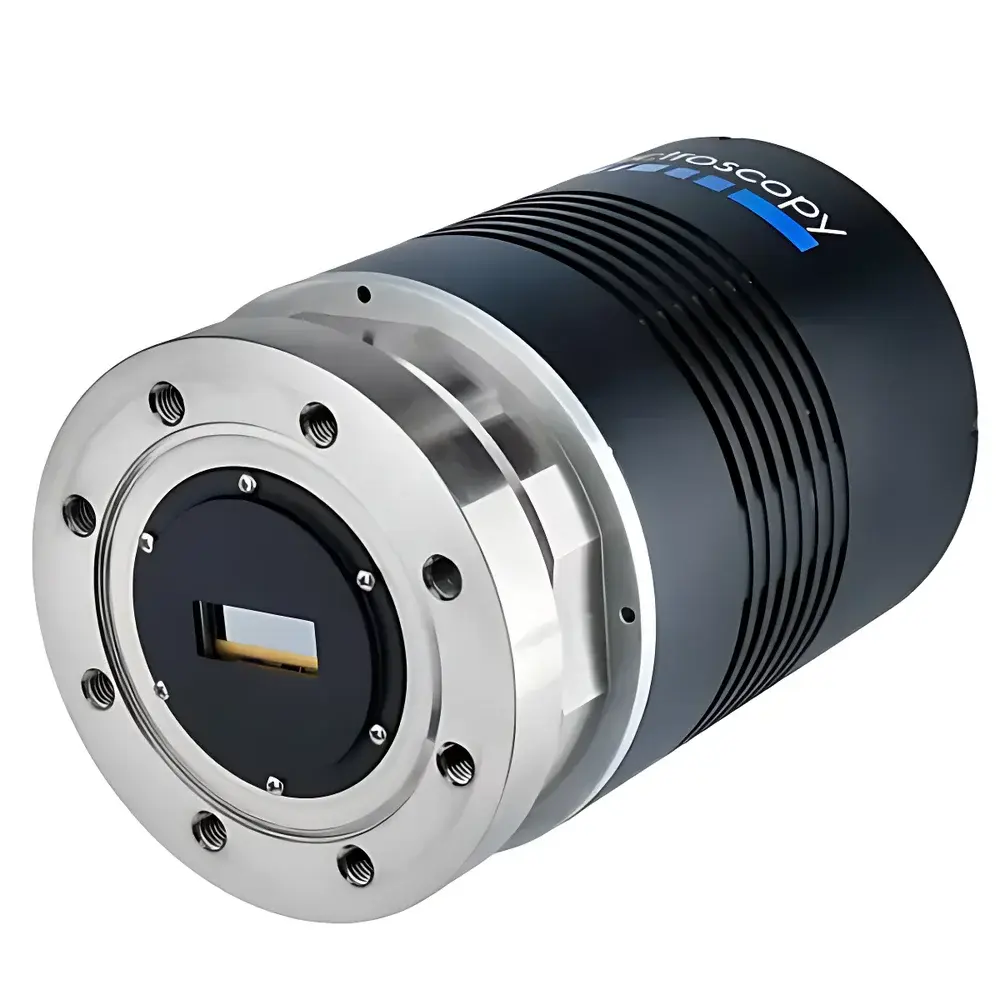
Auniontech XUV/VUV-Optimized Deep-Cooled Back-Illuminated CMOS Camera
| Brand | Auniontech |
|---|---|
| Model | XUV-VUV-CMOS Series |
| Spectral Range | 10–200 nm |
| Cooling | < −80 °C (thermoelectric + optional liquid N₂ assist) |
| Sensor Architecture | Back-illuminated, thinned CMOS |
| Vacuum Compatibility | CF63 flange mount, UHV-compatible materials (304/316 stainless steel, Kovar seals) |
| Interface | Gigabit Ethernet (1000BASE-T), GenICam-compliant |
| Readout Noise | < 1.5 e⁻ rms (at 1 MHz pixel rate) |
| Temporal Resolution | Adjustable exposure from 10 ns to 60 s |
| Software Support | Native SDK for C/C++, Python (PyAunion), MATLAB, LabVIEW |
| Compliance | ISO 9001 certified manufacturing |
Overview
The Auniontech XUV-VUV-Optimized Deep-Cooled Back-Illuminated CMOS Camera is a purpose-built imaging sensor engineered for quantitative detection in the extreme ultraviolet (XUV, 10–124 nm) and vacuum ultraviolet (VUV, 124–200 nm) spectral regions. Unlike conventional front-illuminated silicon detectors—whose quantum efficiency drops below 1% across this range—the camera employs a custom-thinned, back-illuminated CMOS architecture with anti-reflective and XUV-enhancing coatings optimized for high photoelectron collection at sub-100 nm wavelengths. Its operational principle relies on direct photoelectron generation in silicon under XUV illumination, followed by low-noise charge integration and correlated double sampling (CDS) readout. The system is designed for integration into synchrotron beamlines, laser-produced plasma diagnostics, space-based solar observatories (e.g., sounding rockets or CubeSat payloads), and EUV lithography development testbeds where radiometric accuracy, single-photon sensitivity, and vacuum compatibility are non-negotiable.
Key Features
- Deep-cooled operation down to −80 °C (standard) and optionally −120 °C via cryogenic assist—suppressing dark current to < 0.001 e⁻/pixel/s and enabling long-exposure stability without thermal drift.
- CF63 vacuum flange housing constructed from electropolished 316 stainless steel and radiation-hardened ceramic feedthroughs—rated for continuous operation at pressures ≤1×10⁻⁸ mbar and total ionizing dose (TID) tolerance >10 krad(Si).
- Nanosecond-scale shutter control synchronized to external TTL triggers, supporting time-resolved studies of transient plasmas, laser ablation events, and pulsed EUV sources.
- GenICam-compliant Gigabit Ethernet interface enabling deterministic frame acquisition, metadata embedding (exposure time, temperature, bias settings), and remote configuration in distributed lab environments.
- On-sensor microlens array and optimized passivation layers deliver peak quantum efficiency of 35–45% between 50–150 nm—surpassing standard MCP-intensified CCDs by >3× in absolute photon conversion yield.
Sample Compatibility & Compliance
The camera operates natively in high-vacuum and ultra-high-vacuum (UHV) environments without outgassing concerns, meeting ASTM E577 (Standard Test Method for Outgassing Characteristics of Vacuum Materials) requirements. Its mechanical and electrical design conforms to ISO 286-2 (geometric tolerances for CF flanges) and ECSS-E-ST-20-07C (European Space Agency standard for vacuum interface integrity). While not a medical or industrial safety-certified device, its firmware implements hardware-enforced exposure limits and thermal shutdown protocols compliant with IEC 61508 SIL-2 functional safety principles for unattended operation. All optical interfaces are compatible with standard XUV reflective optics (e.g., Ni-coated multilayer mirrors, SiC substrates) and support alignment via kinematic mounting options.
Software & Data Management
The bundled AunionTech Imaging Suite provides calibrated data acquisition, real-time histogram analysis, and spectral responsivity correction using NIST-traceable XUV irradiance standards (e.g., SURF III synchrotron calibrations). Raw frames include embedded EXIF-style metadata (temperature, gain, exposure, timestamp with µs resolution) for audit-ready traceability. Python API supports HDF5 export with NeXus-compatible group structure, facilitating integration into FAIR-compliant data pipelines. Optional FDA 21 CFR Part 11 compliance package includes electronic signature enforcement, audit trail logging, and role-based access control—validated for GLP/GMP-aligned laboratories conducting EUV source characterization per ISO 15737.
Applications
- Synchrotron radiation facilities: Single-shot imaging of undulator harmonics, coherence measurements via speckle analysis, and pump-probe experiments requiring sub-100 ps timing jitter.
- Laser-plasma interaction diagnostics: Spatially resolved EUV emission mapping during high-intensity laser-solid interactions, including spectral filtering via transmission gratings mounted directly on the CF63 port.
- Space-based solar physics: Flight-qualified variant used in sounding rocket payloads (e.g., Hi-C 2.1) for high-resolution imaging of solar coronal loops at 17.1 nm and 30.4 nm.
- EUV lithography R&D: Quantitative metrology of mask blank defects, resist outgassing monitoring, and source stability tracking over 10⁶ pulse cycles.
- Fundamental atomic physics: Time-of-flight imaging of photoelectrons from core-level ionization in gas-phase targets, enabled by precise gating and low-background operation.
FAQ
Is the camera sensitive below 10 nm (e.g., soft X-ray region)?
No—its optimized coating stack and silicon absorption depth limit effective response to ≥10 nm. For λ < 10 nm, grazing-incidence optics with specialized photocathodes (e.g., CsI) are recommended.
Can it be operated in air or nitrogen atmosphere?
Not without optical window insertion; atmospheric O₂ and H₂O absorb strongly below 190 nm. Operation requires direct vacuum coupling or use of MgF₂ or LiF windows (with associated QE reduction and spectral cutoff shifts).
Does the system support photon-counting mode?
Yes—via programmable thresholding and event-list acquisition at frame rates up to 100 fps, with dead-time correction algorithms included in the SDK.
What calibration certificates are provided?
NIST-traceable relative spectral responsivity (RSR) curves measured at SURF III (NIST) and PTB (Germany), plus dark current vs. temperature characterization reports and vacuum leak test documentation.
Is custom firmware development available?
Yes—Auniontech offers OEM firmware adaptation services including custom trigger logic, onboard FPGA-based image processing (e.g., centroiding, region-of-interest binning), and integration with proprietary beamline control systems.




