
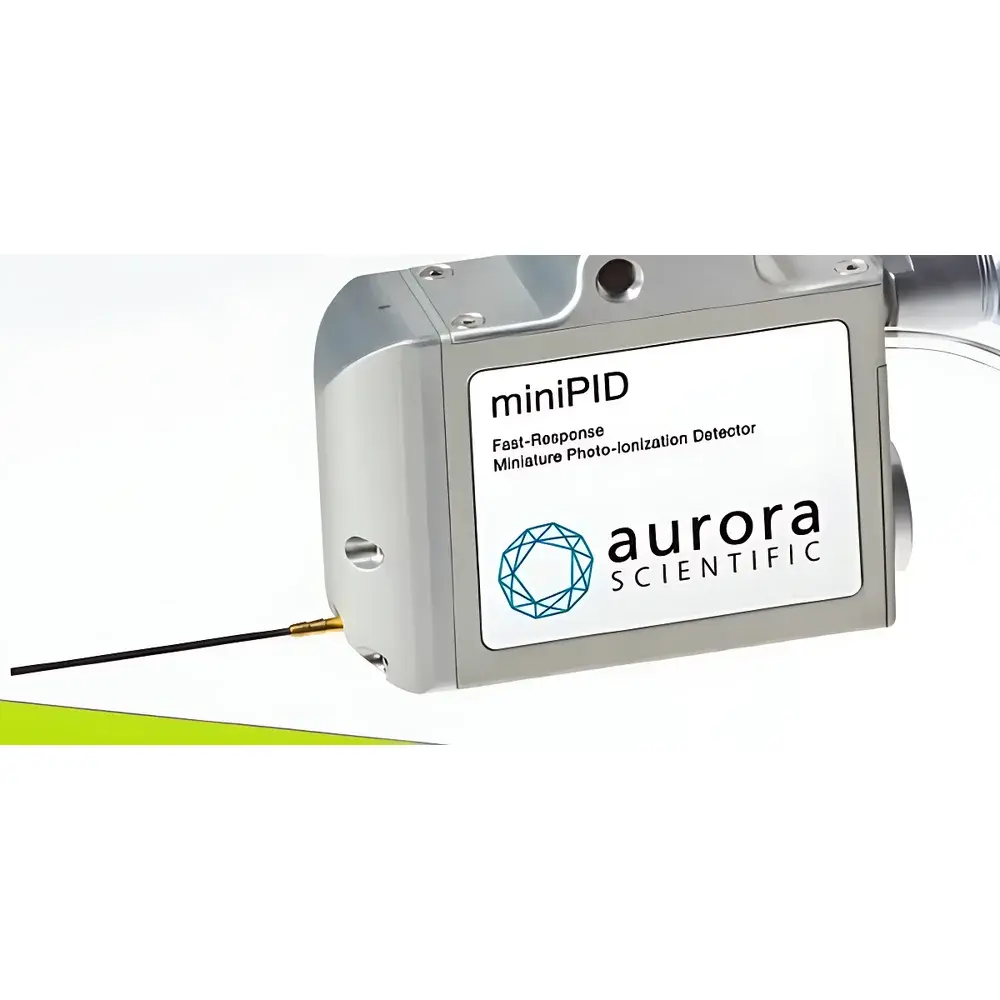
Aurora 200B MiniPID Olfactometry Sensor
| Origin | Canada |
|---|---|
| Manufacturer Type | Distributor |
| Origin Category | Imported |
| Model | 200B |
| Price Range | USD $13,500 – $68,000 |
Overview
The Aurora 200B MiniPID Olfactometry Sensor is a high-speed, laboratory-grade photoionization detector engineered for quantitative, time-resolved measurement of volatile organic compounds (VOCs) in olfactory research. Operating on the principle of vacuum ultraviolet (VUV) photoionization—typically at 10.6 eV—the sensor ionizes odorant molecules upon exposure to UV light, generating a proportional current signal that is amplified and digitized in real time. Designed specifically for integration into custom or commercial olfactometers, the 200B serves as a traceable, metrologically validated reference instrument for verifying stimulus delivery fidelity—including onset latency, concentration accuracy, temporal profile, and inter-trial reproducibility. Its sub-millisecond response kinetics enable precise alignment with neural recording modalities (e.g., electrophysiology, calcium imaging, optogenetic stimulation), making it indispensable for studies requiring millisecond-scale temporal resolution of odor dynamics in behaving animals or isolated tissue preparations.
Key Features
- Ultrafast temporal response: 330 Hz bandwidth with 0.6 ms rise time (10–90%); supports sampling up to 1 kHz without aliasing
- Detection limit: ≤100 ppb (propylene in clean air); linear dynamic range spans 100 ppb to 500 ppm
- Integrated detection head housing: VUV lamp (RF-excited, 10.6 eV), electrostatic collector, ion chamber, and lamp control circuitry—all co-located for minimal dead volume and dispersion
- Compact, modular architecture: Detection head (Ø25 mm × 45 mm) and control unit (170 × 120 × 55 mm) designed for benchtop or rack-mount integration
- Analog output (0–10 V, ±0.5% FS linearity) compatible with DAQ systems (e.g., National Instruments, Spike2, OpenEphys)
- Onboard anti-aliasing filter: 6th-order Butterworth, cutoff at 1 kHz, ensuring Nyquist-compliant signal acquisition
- Intuitive front-panel interface: Power switch, pump speed selector (3 fixed flow rates), gain adjustment (×1, ×10, ×100), zero-offset calibration, LED status indicators (power, lamp, pump, signal active), and LCD warning display for signal saturation or lamp fault
Sample Compatibility & Compliance
The Aurora 200B is optimized for gaseous-phase VOC detection under ambient pressure and temperature (15–30 °C, 40–70% RH). It has been validated across diverse biological models—including Mus musculus, Rattus norvegicus, Drosophila melanogaster, Manduca sexta, Aedes aegypti, and human subjects—in peer-reviewed studies published in Nature and Nature Neuroscience. While not certified for clinical diagnostics or environmental regulatory compliance (e.g., EPA Method TO-15), its performance characteristics meet or exceed requirements for GLP-aligned preclinical behavioral assays. The device adheres to IEC 61000-4 electromagnetic compatibility standards and includes CE marking for laboratory use within the EU. All firmware and hardware revisions are documented per ISO/IEC 17025 traceability guidelines for measurement uncertainty reporting.
Software & Data Management
The 200B operates as a standalone analog transducer; no proprietary software is required for basic operation. However, it integrates seamlessly with third-party acquisition platforms supporting analog voltage input (e.g., Spike2 v10+, MATLAB Data Acquisition Toolbox, Python-based PyDAQmx). For longitudinal experiment management, users commonly pair the sensor with timestamp-synchronized acquisition systems that support audit trails, metadata tagging (odor ID, concentration, trial number), and export to HDF5 or NWB 2.0 formats—enabling FAIR data principles. Optional firmware updates (distributed via secure HTTPS portal) include enhanced lamp lifetime monitoring and calibrated gain lookup tables traceable to NIST-traceable gas standards.
Applications
- Validation and calibration of custom-built or commercial olfactometers (e.g., olfactory virtual reality rigs, operant nose-poke systems, laminar flow odor ports)
- Quantification of odorant pulse dynamics: rise/fall times, overshoot, residual carryover, and inter-stimulus baseline recovery
- Correlation of peripheral odor kinetics with central nervous system responses (e.g., mitral cell spike timing, piriform cortex LFP phase-locking)
- High-throughput screening of odorant receptor activation profiles using controlled vapor-phase delivery
- Behavioral pharmacology: assessing how neuromodulators (e.g., norepinephrine, acetylcholine) alter olfactory coding fidelity at the periphery
- Cross-species comparative olfaction: standardized VOC quantification across rodent, insect, and primate models
FAQ
Is the Aurora 200B suitable for use in sterile or biosafety-level environments?
Yes—its sealed detection head and absence of consumables (e.g., no replaceable lamps or filters) allow safe operation inside ventilated biosafety cabinets or laminar flow hoods when properly grounded and isolated from conductive surfaces.
Can the sensor detect non-VOC compounds such as CO₂, NH₃, or H₂S?
No—the 10.6 eV photon energy limits ionization to compounds with ionization potentials ≤10.6 eV (e.g., aromatics, alkenes, sulfides, terpenes); it does not respond to permanent gases like CO₂ (IP = 13.8 eV), NH₃ (IP = 10.2 eV, weak response), or H₂S (IP = 10.5 eV, marginal sensitivity).
What maintenance is required to sustain calibration stability?
Annual lamp output verification using certified propylene standard gas (1 ppm in N₂) is recommended; zero calibration should be performed before each experimental session using purified zero air (hydrocarbon-free, <1 ppb total VOC).
Does the device comply with FDA 21 CFR Part 11 for electronic records?
The 200B itself is not a regulated medical device and does not implement Part 11 controls; however, when integrated into a validated acquisition workflow with audit-trail-enabled software (e.g., LabArchives ELN + NI DIAdem), full Part 11 compliance can be achieved at the system level.
Is technical support available for integration with custom Arduino- or Raspberry Pi–based olfactometers?
Yes—Aurora’s distributor provides schematic-level interface documentation, voltage-scaling guidance, and sample Python/Matlab scripts for analog signal acquisition and real-time visualization.



