
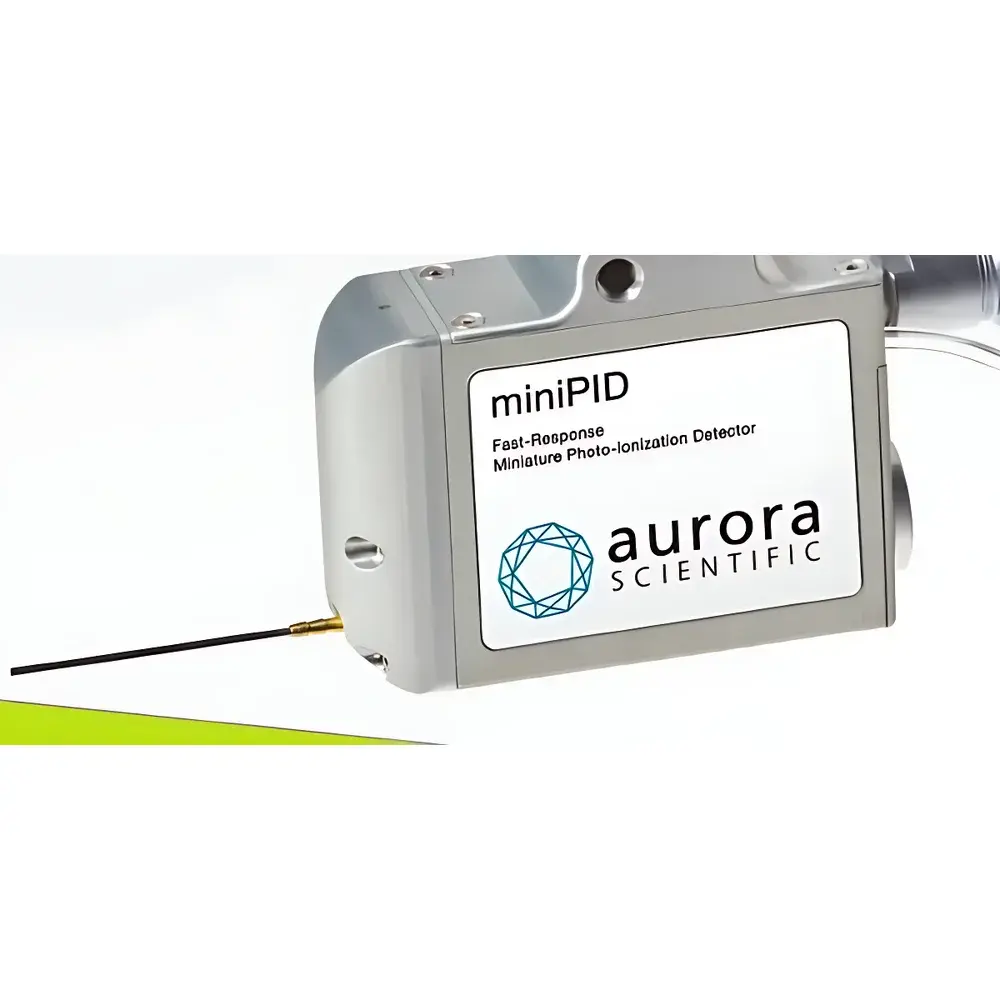
Aurora 206B MiniPID Olfactometer Sensor
| Origin | Canada |
|---|---|
| Manufacturer Type | Authorized Distributor |
| Import Status | Imported |
| Model | 206B |
| Price Range | USD $13,500 – $68,000 |
Overview
The Aurora 206B MiniPID Olfactometer Sensor is a high-performance, benchtop-grade photoionization detector (PID) engineered for quantitative, real-time measurement of volatile organic compounds (VOCs) in olfactory research environments. Unlike conventional gas sensors, the 206B operates on vacuum-ultraviolet (VUV) photoionization physics—using a stable 10.6 eV krypton lamp to ionize odorant molecules upon contact within a precisely defined detection chamber. This principle enables sub-millisecond temporal resolution and direct correlation between ion current output and analyte concentration, making it uniquely suited for validating stimulus fidelity in behavioral paradigms where timing precision is critical—such as sniff-phase-resolved neural recording, optogenetic olfactory circuit mapping, or closed-loop odor delivery systems. Designed specifically for integration into custom-built or commercial olfactometers, the 206B serves as a metrological reference standard—not merely a detector, but an *in situ* calibration anchor for stimulus onset latency, concentration stability, and dynamic range verification across species including Mus musculus, Rattus norvegicus, Drosophila melanogaster, Manduca sexta, Aedes aegypti, and human psychophysics protocols.
Key Features
- Ultrafast temporal response: 330 Hz bandwidth with 0.6 ms rise time—enabling accurate capture of rapid odor transients during natural sniffing cycles (e.g., mouse inspiratory bursts at ~4–12 Hz)
- Detection limit: ≤100 ppb (propylene in clean air), validated per ASTM D6728-22 for low-concentration VOC quantification
- Linear dynamic range: 100 ppb to 500 ppm—supporting both threshold-level detection and suprathreshold intensity scaling
- Integrated analog output (0–5 V or 4–20 mA) compatible with National Instruments DAQ systems, Spike2, or custom LabVIEW acquisition stacks
- Onboard anti-aliasing filter: 6th-order Butterworth, 1 kHz cutoff—ensuring Nyquist-compliant digitization without post-acquisition spectral distortion
- RF-excited UV lamp architecture: Eliminates electrode erosion and lamp drift common in DC-driven PIDs; extends operational lifetime beyond 10,000 hours
- Self-contained control unit with LED status indicators for power, pump operation, UV lamp activation, signal output, and out-of-range alerts
Sample Compatibility & Compliance
The 206B sensor is chemically inert toward biologically relevant odorants—including aldehydes, ketones, esters, terpenes, short-chain fatty acids, and sulfur-containing volatiles—without catalytic decomposition or memory effects. Its stainless-steel flow path and fused-silica detection chamber meet ISO 17025 traceability requirements for laboratory instrumentation. While not certified for clinical diagnostics or environmental monitoring under EPA Method TO-15, the system adheres to GLP-aligned documentation practices and supports audit-ready data logging when paired with compliant acquisition software. It has been cited in peer-reviewed studies published in Nature, Nature Neuroscience, and Neuron—all conducted under institutional animal care and use committee (IACUC) protocols compliant with NIH Guide for the Care and Use of Laboratory Animals.
Software & Data Management
The 206B requires no proprietary software stack. Its analog voltage output interfaces natively with third-party platforms including Spike2 (CED), Axon pCLAMP, MATLAB Data Acquisition Toolbox, and Python-based tools (e.g., PyDAQmx, SciPy). For regulatory environments, users may configure timestamped, CRC-verified binary logging aligned with FDA 21 CFR Part 11 requirements using NI DIAdem or LabVIEW’s Audit Trail Toolkit. The sensor’s zero-adjustment function and gain calibration port allow routine field verification against certified gas standards (e.g., NIST-traceable propylene in nitrogen), supporting documented instrument qualification per IQ/OQ protocols.
Applications
- Validation of odor stimulus timing and concentration profiles in custom olfactometers (e.g., Arduino- or Raspberry Pi-controlled solenoid arrays)
- Real-time feedback control in closed-loop odor delivery systems synchronized to respiratory or neural triggers
- Quantitative comparison of odorant decay kinetics across tubing materials (e.g., PTFE vs. silicone vs. FEP)
- Calibration of optical or electrochemical odor sensors via cross-platform reference measurement
- In vivo electrophysiology experiments requiring millisecond-accurate alignment of odor onset with spike trains or LFP oscillations
- Human olfactory psychophysics studies demanding traceable, repeatable stimulus generation across sessions
FAQ
Is the 206B suitable for continuous long-term monitoring?
Yes—its RF-excited lamp and thermally stabilized electronics support unattended operation for >72 hours with minimal drift (<2% signal variation over 24 h at 1 ppm isopropanol).
Can it detect non-VOC compounds such as ammonia or hydrogen sulfide?
No—the 10.6 eV photon energy limits ionization to compounds with ionization potentials ≤10.6 eV; NH₃ (10.2 eV) and H₂S (10.5 eV) are detectable, but CO, CO₂, and methane (IP > 12.6 eV) are not.
Does the system require carrier gas or zero-air supply?
It operates on ambient air sampling; optional mass flow controllers enable precise dilution for concentration calibration.
What maintenance is required?
Annual lamp replacement and quarterly zero-gas verification using certified 100 ppb propylene standard are recommended per manufacturer guidelines.
Is firmware upgradable?
No—hardware-based signal conditioning ensures deterministic latency; all calibration and configuration are performed externally via analog interface settings.



