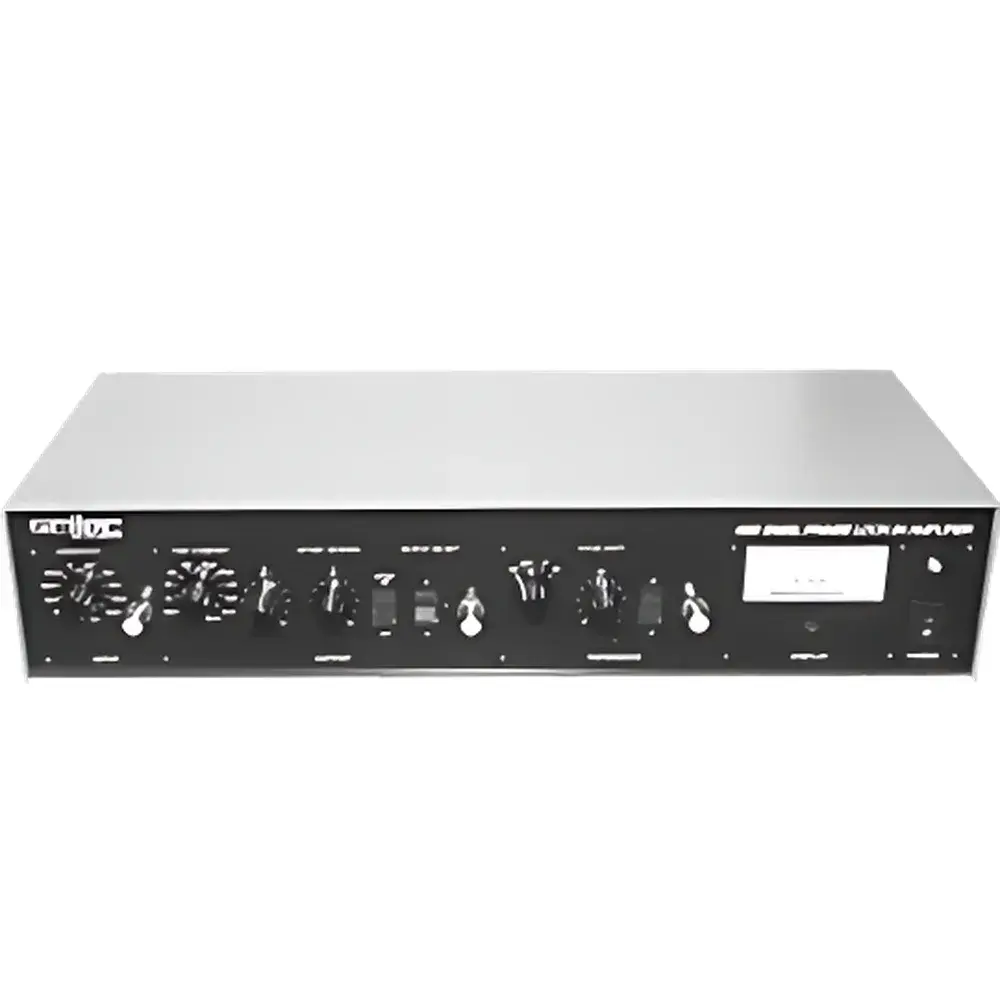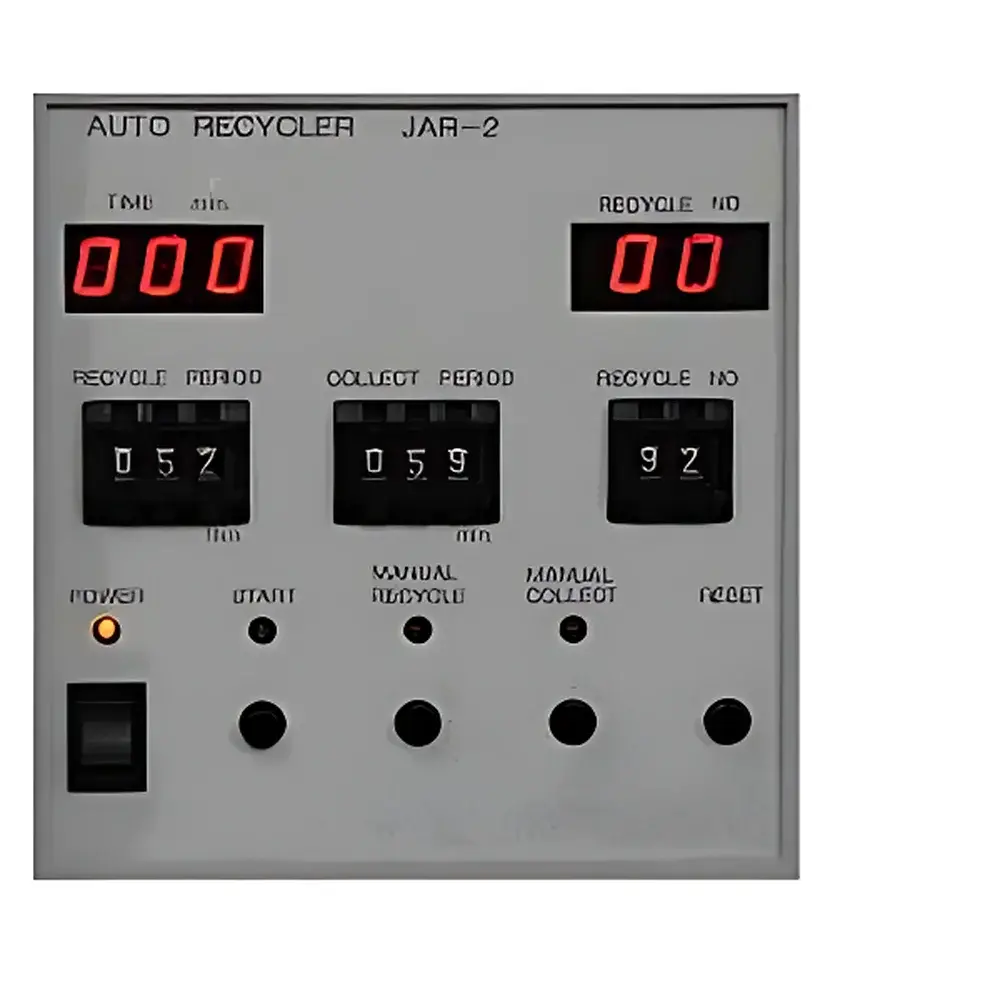
Automatic Circulation Control Unit JAR-2
| Origin | Japan |
|---|---|
| Manufacturer Type | Authorized Distributor |
| Origin Category | Imported |
| Model | JAR-2 |
| Pricing | Available Upon Request |
| Control System | Microprocessor-Based CPU Control |
| Cycle Start Delay | 1–999 minutes |
| Cycle Termination Time | 1–999 minutes |
| Maximum Cycle Count | 99 cycles |
Overview
The Automatic Circulation Control Unit JAR-2 is a precision-engineered timing and sequencing module designed for integration into high-performance preparative liquid chromatography systems—specifically the JASCO 9102 and 9103 Preparative HPLC platforms. It operates on a deterministic microprocessor-based control architecture to automate multi-cycle sample recirculation protocols without manual intervention. Unlike generic timers or PLC add-ons, the JAR-2 is purpose-built to synchronize with the hydraulic and detector timing logic of preparative HPLC systems, ensuring precise valve actuation, pump coordination, and fraction collection alignment across repeated analytical loops. Its primary function is to enforce time-gated, repeatable circulation sequences—critical for method development in chiral separations, gradient optimization, and iterative purification where reproducible residence time and column exposure are essential.
Key Features
- Integrated CPU-controlled timing engine with non-volatile memory retention for cycle parameters—even during power interruption.
- Independent configuration of start delay (1–999 min) and termination window (1–999 min), enabling flexible dwell-time modulation between injection events.
- Programmable cycle count up to 99 iterations, supporting both finite batch processing and extended stability testing protocols.
- Direct hardware-level interface with JASCO 9102/9103 system buses—no external relay modules or signal converters required.
- Front-panel LED indicators and status feedback signals compliant with IEC 61000-4 EMC standards for industrial laboratory environments.
- Compact DIN-rail mountable housing (105 × 70 × 120 mm) with IP20-rated enclosure suitable for controlled lab cabinets or integrated instrument racks.
Sample Compatibility & Compliance
The JAR-2 does not interact directly with samples; it governs system-level fluidic timing and sequence logic. As such, its compatibility is defined by mechanical and electrical interoperability—not chemical or biological constraints. It is certified for use with all solvent-compatible flow paths supported by the JASCO 9102/9103 platforms, including aqueous, acetonitrile-, methanol-, and THF-based mobile phases. From a regulatory standpoint, the unit complies with IEC 61326-1 (Electrical Equipment for Measurement, Control, and Laboratory Use) and meets CE marking requirements for electromagnetic compatibility and low-voltage safety. When deployed within validated chromatographic workflows, the JAR-2 supports adherence to GLP and GMP documentation practices through traceable parameter logging via host system interfaces.
Software & Data Management
The JAR-2 operates as a dedicated firmware-controlled peripheral rather than a standalone software-driven device. All configuration is performed via front-panel keypad entry and retained in EEPROM. No proprietary PC software is required for basic operation. However, when connected to JASCO’s ChromNAV preparative software suite (v2.2 or later), the JAR-2 exposes its cycle status registers and event timestamps over RS-232 or optional Ethernet gateway modules. This enables audit-trail generation—including start/stop timestamps, cycle completion flags, and error codes—for 21 CFR Part 11-compliant environments. Parameter changes are logged with user ID and timestamp if linked to a networked ChromNAV instance configured with electronic signature and role-based access controls.
Applications
- Automated multi-pass purification of synthetic intermediates requiring consistent column residence time across successive injections.
- Chiral resolution optimization where repeated elution under identical gradient conditions is necessary to assess enantiomeric excess drift.
- Stability-indicating methods involving forced degradation studies—where fixed-time recirculation mimics prolonged column exposure to stressed analytes.
- Method transfer validation between preparative and analytical-scale systems, using identical timing logic to isolate column performance variables from operational inconsistency.
- High-throughput screening of stationary phase candidates under standardized recirculation kinetics.
FAQ
Is the JAR-2 compatible with HPLC systems other than JASCO 9102/9103?
No—it relies on proprietary hardware handshake protocols and voltage-level signaling specific to those two models. Retrofitting to other platforms requires custom interface engineering and is not supported.
Does the JAR-2 support real-time adjustment of cycle parameters during active operation?
No. Parameters must be set prior to initiating the sequence. Runtime modification is intentionally disabled to preserve method integrity and prevent unintended deviations in regulated environments.
Can cycle completion data be exported to LIMS or ELN systems?
Yes—via ChromNAV’s ASCII log export function or OPC UA interface (with optional ChromNAV Enterprise license), enabling structured ingestion into laboratory informatics platforms.
What is the mean time between failures (MTBF) under continuous operation?
Based on field data from Japanese pharmaceutical QC labs, MTBF exceeds 25,000 hours at 25°C ambient, per IEC 62380 reliability prediction methodology.
Is firmware update capability available?
Firmware updates are performed only by authorized JASCO service centers using JTAG programming interfaces; no end-user flash utility is provided.