
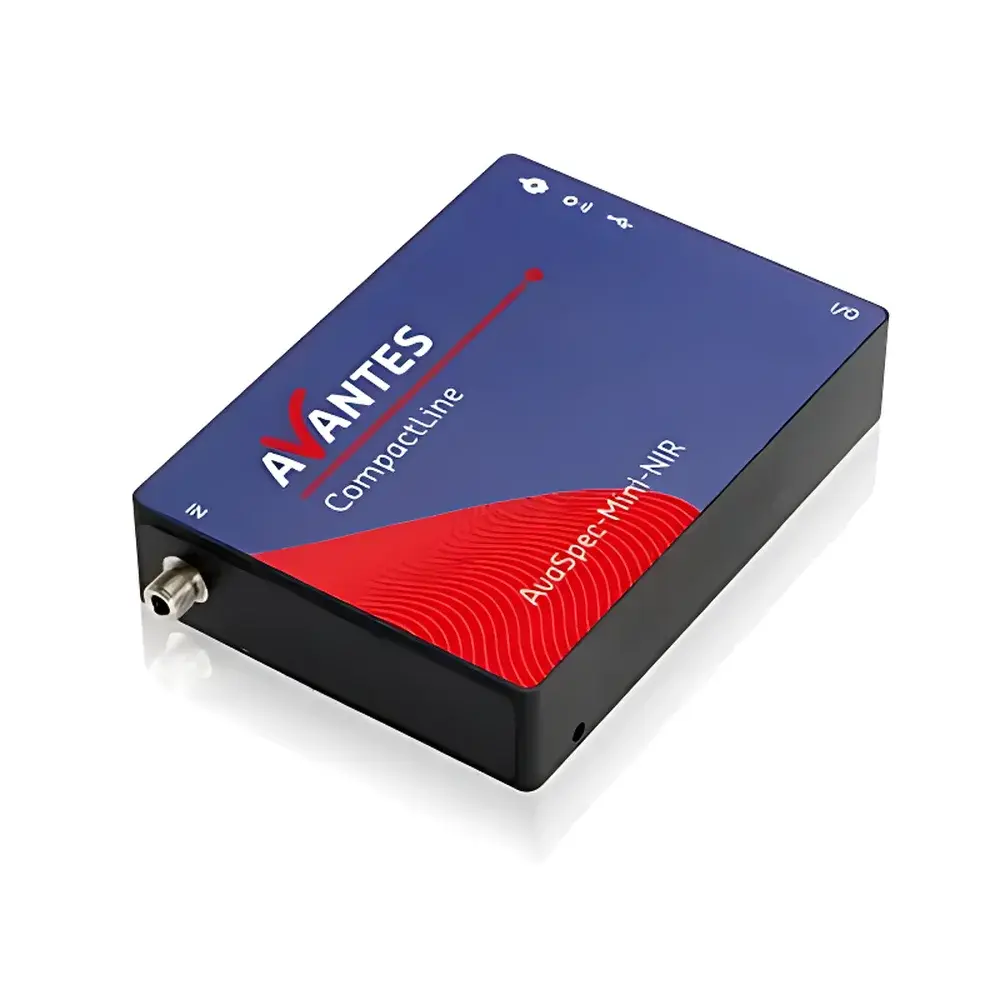
Avantes AvaSpec-NIR-Mini Compact Fiber Optic Near-Infrared Spectrometer
| Brand | Avantes |
|---|---|
| Origin | Netherlands |
| Model | AvaSpec-NIR-Mini |
| Spectral Range | 900–1750 nm |
| Detector | InGaAs (256-pixel array) |
| Optical Resolution | 6 nm (typical, slit- and grating-dependent) |
| Sensitivity (HS mode) | 665,000 counts/µW/ms (integrated over 1000–1750 nm) |
| Signal-to-Noise Ratio (HS) | 1900:1 |
| Dynamic Range (HS) | 4750:1 |
| Stray Light | <1% |
| A/D Converter | 16-bit, 500 kHz |
| Integration Time (HS) | 10 µs – 300 ms |
| Interface | USB 2.0 (480 Mbps), fiber-coupled input, 50 cm integrated cable |
| Dimensions | 95 × 68 × 20 mm |
| Weight | 185 g |
| Operating Temperature | 0–55 °C |
| Software Compatibility | AvaSoft v8+, Windows/Linux DLL support |
Overview
The Avantes AvaSpec-NIR-Mini is a compact, OEM-optimized fiber optic near-infrared spectrometer engineered for robust integration into portable, embedded, and industrial measurement systems. Based on the proven optical architecture of the AvaSpec-NIR256-1.7 platform and refined through the Mini-series mechanical design, it employs a symmetrical Czerny-Turner optical layout with a 75 mm focal length. The instrument operates across a calibrated spectral range of 900–1750 nm—covering key molecular absorption bands for O–H, C–H, and N–H functional groups—making it suitable for quantitative and qualitative analysis in process monitoring, raw material verification, and at-line quality control. Its core measurement principle relies on dispersive spectroscopy: incoming light from a fiber-optic probe is collimated, diffracted by a ruled or holographic InGaAs-optimized grating, and focused onto a thermoelectrically uncooled 256-pixel InGaAs linear array detector. No moving parts ensure long-term stability and resistance to mechanical shock—critical for field-deployable or handheld instrumentation.
Key Features
- Ultra-compact form factor (95 × 68 × 20 mm, 185 g) enables seamless integration into space-constrained platforms—including handheld analyzers, robotic end-effectors, and inline process cells.
- USB-powered operation (5 V, ≤500 mA) eliminates external power supplies; supports hot-plug functionality and full-speed data streaming via USB 2.0 (480 Mbps).
- Dual-gain detection architecture: High-Sensitivity (HS) mode delivers optimized signal capture for low-light applications (e.g., diffuse reflectance from granular solids); Low-Noise (LN) mode extends integration up to 5 seconds for high-dynamic-range measurements.
- Programmable I/O interface includes five bidirectional TTL lines, one analog input (0–5 V), one analog output (0–5 V), and one dedicated 5 V power output—enabling hardware synchronization with light sources, shutters, or PLCs.
- Thermally stable mechanical housing and precision-machined optical bench minimize wavelength drift (<0.02 nm/°C typical) across the 0–55 °C operating envelope.
- Grating interchangeability supported via standardized mounting; multiple grating options available (e.g., 200, 400, 600 lines/mm) to balance resolution, throughput, and spectral coverage per application requirement.
Sample Compatibility & Compliance
The AvaSpec-NIR-Mini interfaces exclusively via SMA905 fiber-optic connectors (standard 400 µm core, NA 0.22), supporting reflection probes (bifurcated or contact), transmission cells (1–10 mm pathlength), and diffuse reflectance accessories. It is routinely deployed in regulated environments where traceability and repeatability are essential: food authenticity screening (e.g., moisture, fat, protein in grains and dairy), polymer identification in recycling streams, active pharmaceutical ingredient (API) quantification in tablet blends, and catalyst monitoring in petrochemical processes. While not pre-certified as standalone GMP-compliant hardware, the spectrometer meets baseline requirements for analytical instrument qualification (AIQ) under ASTM E2962–14 (Standard Guide for NIR Spectroscopy Qualification) and supports 21 CFR Part 11–compliant data acquisition when used with validated AvaSoft-Bio or third-party LIMS-integrated software stacks featuring audit trails, electronic signatures, and user-access controls.
Software & Data Management
The spectrometer is fully supported by Avantes’ cross-platform AvaSoft v8.x suite, offering real-time spectrum visualization, multi-channel averaging, dark/baseline correction, and math-based preprocessing (Savitzky-Golay smoothing, SNV, derivatives). Native dynamic link libraries (DLLs) for Windows (x64/x86) and Linux (ARM64/x86_64) enable direct integration into custom C/C++, Python (via ctypes or PyAvantes), LabVIEW, and MATLAB applications. Raw spectra are stored in industry-standard formats (ASCII, CSV, JCAMP-DX), and metadata—including integration time, grating ID, slit width, and calibration coefficients—is embedded in header fields. On-device RAM buffering supports continuous acquisition at up to 1,880 spectra/second (0.53 ms/scan), while full-spectrum transfer (1,024-point float32) completes in 1.2 ms—ensuring minimal latency in closed-loop feedback systems.
Applications
- Food & Agriculture: Non-destructive moisture and starch content mapping in cereals; sugar concentration in fruit juices; adulteration detection in edible oils.
- Pharmaceuticals: Blend uniformity assessment of powder mixtures; coating thickness validation on controlled-release tablets; raw material identity testing (RMIT) per USP <1119>.
- Recycling & Plastics: Polymer type classification (PET, PP, PE, ABS) using spectral fingerprinting; black plastic sorting via NIR reflectance contrast.
- Chemical Manufacturing: Real-time monitoring of reaction endpoints (e.g., esterification, hydrogenation) via functional group absorbance trends.
- Research & Education: Teaching platform for chemometrics, multivariate calibration (PLS, PCR), and hyperspectral imaging system development.
FAQ
What is the typical optical resolution achievable with the AvaSpec-NIR-Mini?
Resolution is slit- and grating-dependent; with a 50 µm slit and 200 lines/mm grating, FWHM is approximately 6 nm across the 900–1750 nm range. Higher resolution (e.g., ~3 nm) is attainable using narrower slits or denser gratings—but at the expense of sensitivity and throughput.
Can the spectrometer operate without a PC?
No—it requires an external host (PC, SBC, or industrial controller) for configuration, triggering, and data acquisition. However, its USB interface and low power draw make it compatible with embedded Linux systems such as Raspberry Pi 4 or NVIDIA Jetson modules.
Is radiometric calibration available?
Yes—NIST-traceable irradiance and radiance calibration kits are offered separately, including tungsten-halogen and deuterium reference sources covering 900–1750 nm, enabling absolute intensity measurements compliant with ISO/IEC 17025 requirements.
How is thermal stability managed without detector cooling?
The InGaAs array is operated at ambient temperature, and dark current is actively compensated via real-time dark scan subtraction. Thermal wavelength shift is mitigated by mechanical design and factory characterization; users may apply optional temperature-compensated wavelength calibration tables in AvaSoft.
What fiber connector types are supported?
Standard SMA905; FC/PC and ST adapters are available upon request. Custom fiber bundles (e.g., 7-fiber illumination + 1-collection) can be pre-aligned and qualified for specific probe geometries.





