
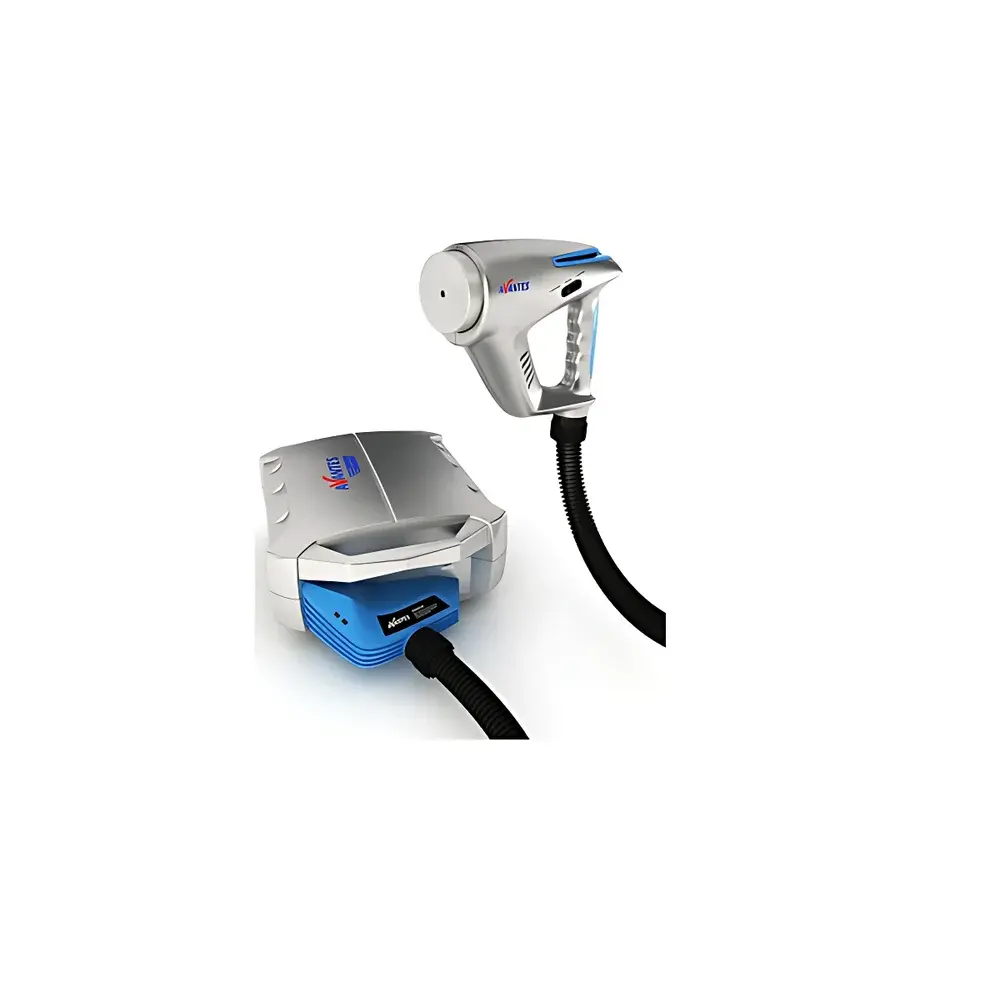
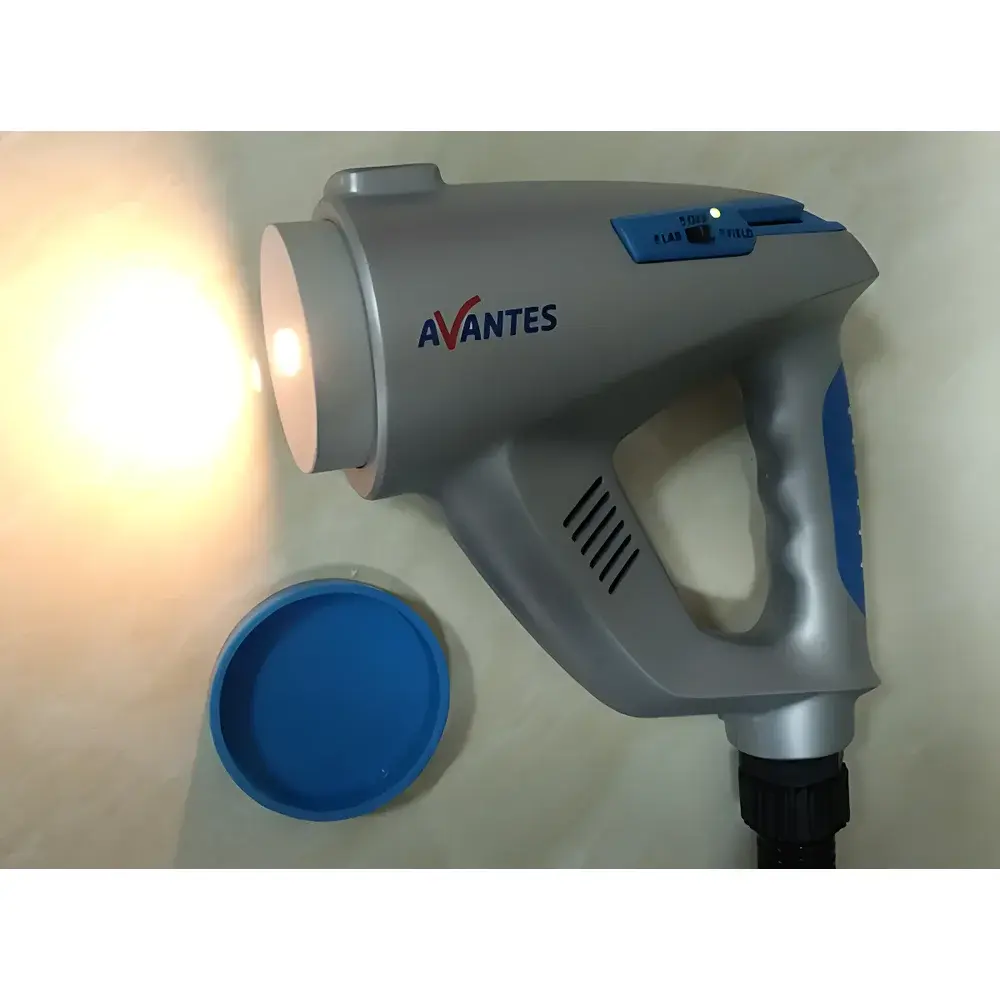
Avantes AvaSR-96 Portable Solar Reflectance Spectrometer
| Brand | Avantes |
|---|---|
| Origin | Netherlands |
| Model | AvaSR-96 |
| Detector | InGaAs |
| Spectral Range | 350–2500 nm |
| Resolution | 1.5 nm @ 350–1100 nm |
| Sampling Interval | 0.6 nm (VIS) / 6 nm (NIR-SWIR) |
| Wavelength Accuracy | ±0.3 nm (VIS) / ±3 nm (NIR-SWIR) |
| Wavelength Repeatability | ±0.1 nm over ±10 °C |
| Detector | Back-thinned CCD (2048 px) + TE-cooled InGaAs array (256 px) |
| Integration Time | 0.01–100 ms |
| Communication | Wireless (Wi-Fi/Bluetooth) |
| Operating Temp. | 0–40 °C |
| Dimensions | 310 × 270 × 135 mm |
| Weight | 5.2 kg |
Overview
The Avantes AvaSR-96 Portable Solar Reflectance Spectrometer is a field-deployable, dual-detector fiber-optic spectrometer engineered for quantitative solar reflectance measurement across the full solar spectral range (350–2500 nm). It operates on the principle of diffuse reflectance spectroscopy, utilizing calibrated D65-illuminated integrating sphere geometry to capture hemispherical reflectance under standardized illumination conditions. Designed in strict compliance with JGJ/T 287–2012 and ASTM C1549–2009, the instrument enables direct determination of solar reflectance ratio (SRR), a critical parameter for evaluating the energy performance of cool coatings, low-emissivity glazing, metallic façades, and architectural paints. Its dual-spectral-band architecture—combining high-resolution visible-NIR (350–1100 nm) and extended SWIR detection (1050–2500 nm)—ensures metrological traceability to national and international building energy standards while maintaining portability and operational robustness in uncontrolled outdoor environments.
Key Features
- Dual-detector optical path: Back-thinned 2048-pixel CCD for 350–1100 nm (1.5 nm resolution) and TE-cooled 256-pixel InGaAs array for 1050–2500 nm (15 nm resolution), enabling simultaneous high-fidelity acquisition across the full solar-weighted spectrum.
- Ergonomic hand-held probe with integrated D65-calibrated integrating sphere: Illumination stability 4000 h; UV/VIS/NIR broadband fiber coupling ensures signal integrity and minimizes stray light artifacts.
- Standardized sample interface: Four stainless-steel (AISI 304) positioning shims (0.5, 1.0, 1.5, 2.0 mm edge height) conforming to JGJ/T 287–2012 for controlled measurement geometry on substrates of varying surface roughness.
- IP54-rated ruggedized main unit with shock-absorbing roll-aluminum case (telescopic handle included); operating temperature range 0–40 °C; storage range −15–55 °C (non-condensing).
- Wireless real-time data streaming via Wi-Fi or Bluetooth; onboard storage and remote synchronization capability for synchronized multi-point field campaigns.
- Pre-calibrated reference white tile (certified by China National Institute of Metrology) with dedicated adapter; NIST-traceable calibration maintained through factory recalibration intervals.
Sample Compatibility & Compliance
The AvaSR-96 supports non-destructive, in-situ reflectance measurement on opaque, semi-opaque, and textured surfaces including acrylic-, silicone-, and ceramic-based reflective coatings; anodized aluminum; low-e glass; and elastomeric roof membranes. It meets the geometric and radiometric requirements of ISO 9050, ASTM E903, ASTM C1549, and multiple regional Chinese technical specifications—including DBJ15-75-2010 (Guangdong), DBJ/T45-001-2013 (Guangxi), and JG/T 026-2009 (Jiangsu)—for building envelope energy rating. All hardware and firmware comply with IEC 61326-1 (EMC) and IEC 61010-1 (safety). Software audit trails, user-level access control, and electronic signature support align with GLP and pre-GMP documentation workflows.
Software & Data Management
The bundled AvaSoft-SR software implements ASTM E903-compliant solar-weighted reflectance integration (CIE Standard Illuminant D65, 0.3–2.5 µm) and calculates SRR per JGJ/T 287–2012 Annex A. It computes CIE 1931 (x,y,Y) and CIE 1964 (u*,v*,L*) chromaticity coordinates, ΔE*ab color difference against user-defined references, and real-time RGB image overlay. The software enforces environmental validation (e.g., solar zenith angle, cloud cover thresholds) before measurement initiation and logs metadata including GPS coordinates, ambient temperature/humidity, and operator ID. All reports are exportable as PDF/CSV with embedded digital signatures, revision history, and calibration certificate linkage. Data encryption and role-based permissions satisfy 21 CFR Part 11 readiness requirements.
Applications
- Field verification of solar reflectance for LEED v4.1 MRc1 and Cool Roof Rating Council (CRRC) certification.
- R&D and QC testing of heat-reflective coating formulations under variable film thickness (0.5–2.0 mm).
- Comparative analysis of aging effects on spectral reflectance degradation (e.g., chalking, yellowing, soiling).
- Thermal emittance estimation when paired with FTIR emissivity measurements (via external correlation protocols).
- Color consistency monitoring in batch production of architectural coatings using CIELAB tolerancing.
- Government-mandated energy audit compliance for public infrastructure projects under GB/T 25261–2010 and JG/T 235–2014.
FAQ
Does the AvaSR-96 meet ASTM C1549–2009 requirements for portable solar reflectometers?
Yes. Its spectral coverage, D65-integrating sphere geometry, and software-based solar-weighted integration algorithm are fully aligned with ASTM C1549–2009 Section 6.2 and Appendix X1.
Can the instrument measure both reflectance and color in a single acquisition?
Yes. Simultaneous acquisition across 350–2500 nm enables concurrent calculation of solar reflectance ratio (SRR) and full CIE 1931/CIE 1964 colorimetric parameters without hardware reconfiguration.
What is the calibration interval recommendation and traceability basis?
Factory calibration is NIST-traceable via primary standard white tiles; annual recalibration is recommended. CNIM-certified reference tile included with each system provides on-site verification capability.
Is wireless operation supported in high-interference outdoor environments?
Yes. Dual-band Wi-Fi (2.4 GHz / 5 GHz) and Bluetooth 5.0 with adaptive frequency hopping ensure stable connectivity within 15 m line-of-sight, even near construction equipment or HVAC units.
How does the system handle variable surface roughness during field measurement?
The four precision-machined AISI 304 shims (0.5–2.0 mm) enforce consistent probe-to-sample distance and incident angle per JGJ/T 287–2012, minimizing topographic bias in diffuse reflectance quantification.




