
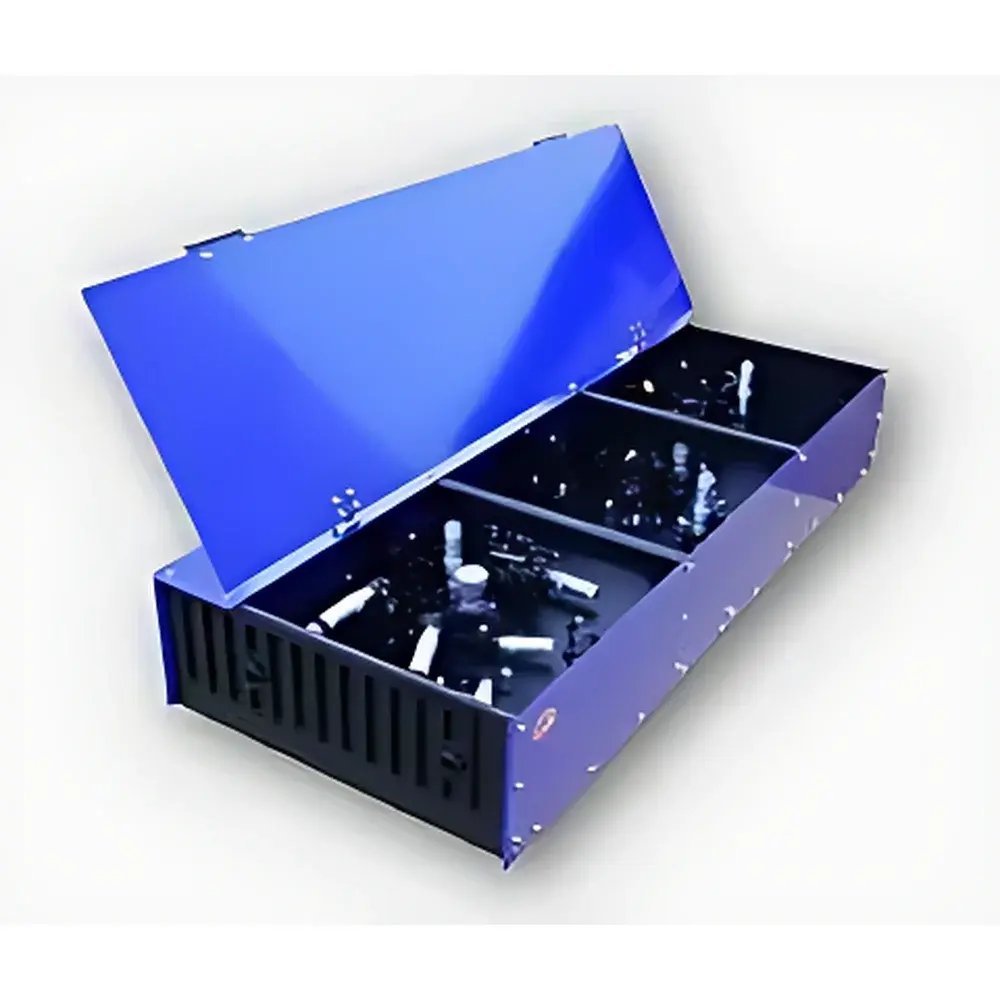
Avesta CrF-65 Chromium-Doped Forsterite Continuous-Wave Laser
| Brand | Avesta |
|---|---|
| Origin | Russia |
| Model | CrF-65 |
| Laser Type | Solid-State CW Tunable Laser |
| Gain Medium | Cr⁴⁺:Mg₂SiO₄ (Chromium-doped Forsterite) |
| Tuning Range | 1210–1290 nm |
| Output Power | Up to 400 mW (typ.) |
| Spatial Mode | TEM₀₀ |
| Spectral Bandwidth | ≤10 cm⁻¹ (FWHM) |
| Pump Source | Diode-pumped, 1064 nm or 1342 nm Nd:YVO₄/Nd:YAG laser (requires external pump, up to 10 W) |
| Beam Diameter (1/e²) | ~0.8 mm |
| Beam Divergence (full angle) | <1.5 mrad |
| Polarization | Linear, >100:1 |
| Cooling | Water-cooled (recommended for stable CW operation) |
| Compliance | CE-marked, RoHS-compliant |
Overview
The Avesta CrF-65 is a high-stability, continuous-wave (CW), tunable solid-state laser based on chromium-doped forsterite (Cr⁴⁺:Mg₂SiO₄) as the gain medium. Engineered for precision mid-infrared spectroscopy and ultrafast optics applications, the CrF-65 operates in the 1210–1290 nm spectral window — a region critical for probing vibrational overtones of C–H, O–H, and N–H bonds, as well as for seeding optical parametric oscillators (OPOs) and amplifiers targeting the 2–5 µm range. Unlike pulsed Cr:forsterite lasers optimized for femtosecond pulse generation, the CrF-65 is specifically designed for narrow-linewidth, single-spatial-mode CW emission with excellent power stability (<±1.5% RMS over 8 hours) and low amplitude noise (<0.3% RMS, 10 Hz–10 MHz). Its TEM₀₀ output ensures diffraction-limited beam quality essential for interferometric setups, cavity-enhanced absorption spectroscopy (CEAS), and frequency stabilization experiments.
Key Features
- Wide, continuous tuning range from 1210 nm to 1290 nm — covering the biologically and chemically relevant “water window” edge and enabling access to first-overtone transitions in organic molecules
- Up to 400 mW output power under optimized 10 W diode-pumped solid-state (DPSS) excitation at 1064 nm or 1342 nm — scalable via pump power and cavity alignment
- TEM₀₀ spatial mode with M² < 1.1 and beam divergence <1.5 mrad — suitable for fiber coupling (SMF-28 compatible with appropriate collimation), scanning microscopy, and nonlinear frequency conversion
- Integrated water-cooling interface and thermally stabilized crystal mount — ensures long-term wavelength repeatability (±0.05 nm over 24 h) and minimizes thermal lensing effects
- Manual or motorized grating-based wavelength selection with calibrated micrometer drive — resolution better than 0.1 nm (limited by cavity mode spacing and gain bandwidth)
- Low-noise analog modulation input (0–5 V, 10 kHz bandwidth) for intensity stabilization or external feedback control
Sample Compatibility & Compliance
The CrF-65 is intended for laboratory-based optical measurement systems requiring stable, narrowband near-infrared sources. It is compatible with standard optomechanical components (e.g., Thorlabs, Newport mounts), free-space and fiber-coupled spectrometers (e.g., Ocean Insight QE Pro, Andor Shamrock), and heterodyne detection platforms. The system complies with IEC 60825-1:2014 Class 3B laser safety requirements when operated with appropriate interlocks and beam enclosures. All electrical subsystems meet CE Directive 2014/30/EU (EMC) and 2011/65/EU (RoHS). While not certified for GMP or FDA-regulated environments out-of-the-box, its design supports integration into ISO/IEC 17025-accredited calibration labs — traceable wavelength calibration can be performed using a NIST-traceable wavemeter (e.g., Bristol 621A) and power verified with a calibrated thermopile sensor (e.g., Ophir 3A-FS).
Software & Data Management
The CrF-65 operates in standalone mode without proprietary software dependency. Wavelength positioning is manually indexed via engraved scale and digital readout (optional encoder upgrade available). For automated integration, Avesta provides LabVIEW-compatible VI drivers and ASCII command protocol over RS-232 or USB-to-serial interface (baud rate 9600, 8N1). Commands include WAVELENGTH? , WAVELENGTH=1250.0, and POWER? . All operational parameters are logged in human-readable .csv format upon request. Audit trails, electronic signatures, and 21 CFR Part 11 compliance are achievable only when integrated into third-party LIMS or instrument control platforms (e.g., Keysight PathWave, MATLAB Instrument Control Toolbox) with validated configuration and user access controls.
Applications
- High-resolution absorption spectroscopy of greenhouse gases (CH₄, CO, NH₃) and isotopic species (¹³CH₄, HDO) in atmospheric monitoring and industrial process control
- Pump source for intracavity OPOs generating tunable mid-IR radiation between 2.5–4.5 µm for trace gas sensing and biomedical tissue characterization
- Local oscillator in coherent anti-Stokes Raman scattering (CARS) microscopy for label-free lipid imaging in live cells
- Frequency reference in dual-comb spectroscopy systems where sub-MHz linewidth stability is maintained via Pound–Drever–Hall locking to ultra-low-expansion (ULE) cavities
- Calibration source for NIR photodiode linearity verification and spectrometer pixel registration in metrology-grade instrumentation
FAQ
Is the CrF-65 supplied with a pump laser?
No. The CrF-65 is a laser oscillator module requiring an external DPSS pump source — typically a 1064 nm or 1342 nm Nd:YVO₄ laser delivering up to 10 W of CW power with M² < 1.3.
What cooling method is recommended for continuous operation?
Water cooling at 18–22 °C with flow rate ≥1.5 L/min is mandatory for rated output power and thermal stability; air-cooled operation is limited to ≤100 mW and short-duration tests.
Can the CrF-65 be fiber-coupled?
Yes — with optional aspheric collimator and adjustable kinematic mount, it couples efficiently (>75%) into SMF-28 fiber; polarization-maintaining (PM980) fiber coupling requires additional half-wave plate and polarization controller.
Does Avesta provide wavelength calibration certificates?
Factory calibration is performed using a NIST-traceable high-finesse étalon and wavemeter; full calibration certificate (ISO/IEC 17025 accredited) is available as a paid add-on service.
Is remote computer control supported?
Yes — via RS-232 or USB serial emulation using ASCII commands; no dedicated GUI is provided, but integration with Python (pySerial), MATLAB, or LabVIEW is fully documented in the operator manual.






