
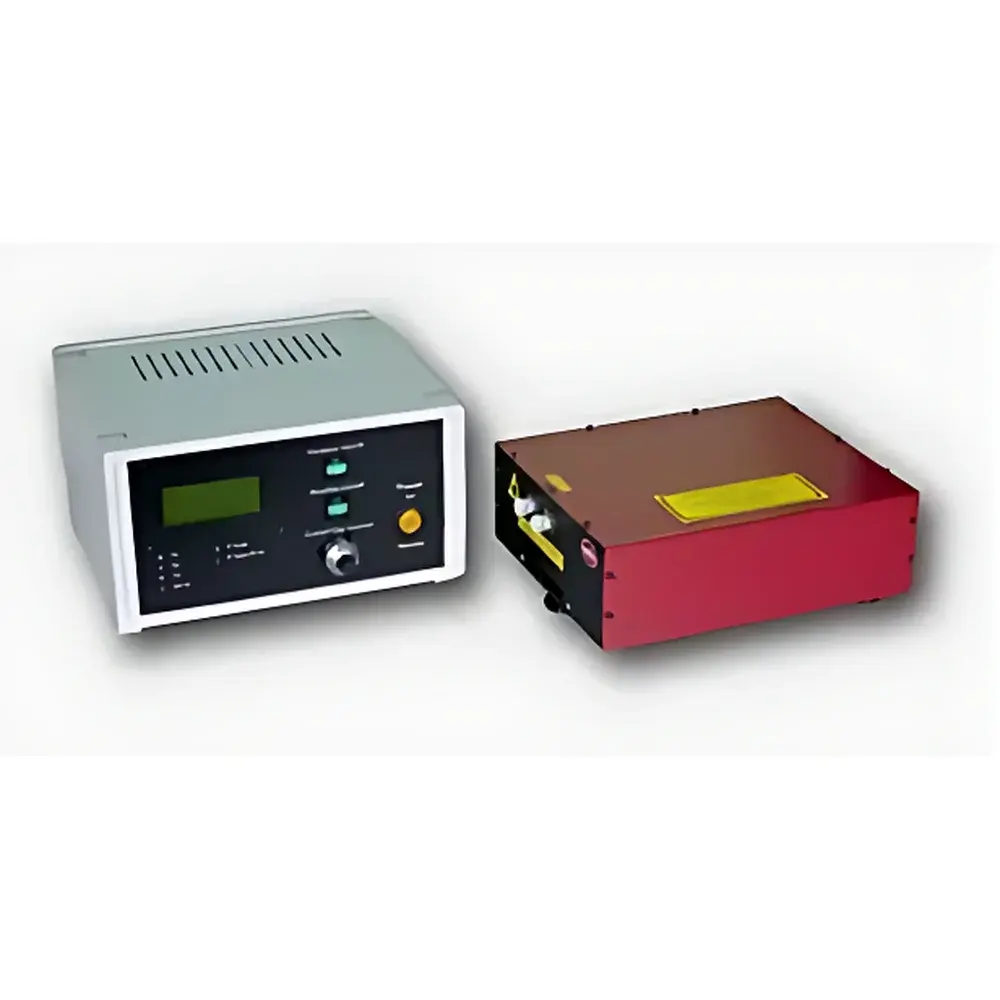
AVESTA EFOA-UB Ultra-Broadband Supercontinuum Source
| Origin | Russia |
|---|---|
| Manufacturer Type | Authorized Distributor |
| Origin Category | Imported |
| Model | EFOA-UB |
| Core Technology | Solid-State Pumped Fiber-Based Supercontinuum Generation |
| Output Coupling | FC/APC Fiber-Pigtailed (SMF-28 or PM1550 Optional) |
| Spectral Range | 1100–2000 nm |
| Average Output Power | >150 mW |
| Repetition Rate | 50–70 MHz |
| Laser Head Dimensions | 180 × 210 × 70 mm |
| Power Supply Dimensions | 230 × 200 × 130 mm |
Overview
The AVESTA EFOA-UB Ultra-Broadband Supercontinuum Source is a turnkey, fiber-pigtailed supercontinuum (SC) generator engineered for high-reproducibility broadband illumination in demanding optical measurement and spectroscopic applications. Based on nonlinear spectral broadening in highly nonlinear photonic crystal fiber (HNLF) pumped by a mode-locked Yb-doped fiber laser, the EFOA-UB delivers a smooth, high-brightness continuum spanning the short-wave infrared (SWIR) region from 1100 nm to 2000 nm. Unlike tunable lasers or LED-based sources, this system provides inherently coherent, pulsed broadband emission with excellent temporal stability and shot-to-shot spectral consistency—critical for time-resolved spectroscopy, OCT reference arm illumination, and absolute wavelength calibration. Its all-fiber architecture eliminates free-space alignment, ensuring robustness against environmental drift and enabling integration into OEM instruments or portable field-deployable platforms.
Key Features
- Fully aligned, maintenance-free supercontinuum generation—no user adjustment required post-installation
- FC/APC fiber-coupled output compatible with standard SMF-28 or polarization-maintaining PM1550 fiber
- Stable average power >150 mW across full 1100–2000 nm bandwidth, measured at fiber output under controlled thermal conditions
- Repetition rate fixed at 50–70 MHz, synchronized to the internal oscillator for precise pump-probe timing
- Compact dual-unit design: laser head (180 × 210 × 70 mm) and external AC/DC power supply (230 × 200 × 130 mm)
- Low RMS power fluctuation (<1.5% over 8 hours), verified per ISO 11551 for intensity noise characterization
- Compliant with IEC 60825-1:2014 Class 3B laser safety requirements; includes interlock interface and key-switch enable
Sample Compatibility & Compliance
The EFOA-UB is designed for use with standard single-mode and polarization-maintaining fibers, optical circulators, interferometers, spectrometers (e.g., InGaAs array detectors), and scanning galvanometer systems. Its SWIR spectral coverage supports absorption-based detection of C–H, O–H, and N–H vibrational overtones—enabling quantitative analysis in pharmaceutical tablet coating, polymer degradation studies, and agricultural moisture sensing. The source meets essential regulatory frameworks for laboratory instrumentation, including conformity with CE marking directives (EMC 2014/30/EU, LVD 2014/35/EU), RoHS 2011/65/EU, and compatibility with GLP-compliant data acquisition workflows. While not certified for clinical diagnostics per FDA 21 CFR Part 820, its performance stability and traceable power calibration support validation under ISO/IEC 17025-accredited metrology laboratories.
Software & Data Management
The EFOA-UB operates as a hardware-independent light source: no proprietary software or drivers are required for basic operation. Output power can be monitored via analog voltage output (0–5 V proportional to photodiode signal) and digitally accessed through RS-232 serial interface for integration into LabVIEW, Python (PySerial), or MATLAB control environments. Optional OEM firmware enables TTL-triggered gating (pulse-on-demand mode) and real-time power feedback loops. All factory calibration data—including spectral irradiance curves (W/nm), power stability logs, and pulse autocorrelation traces—are provided in HDF5 format, supporting FAIR (Findable, Accessible, Interoperable, Reusable) data principles. Audit trails for power-on cycles and thermal history are recorded internally for GxP-aligned instrument qualification (IQ/OQ/PQ).
Applications
- Optical Coherence Tomography (OCT): Broadband SWIR illumination improves axial resolution in ophthalmic and dermatological imaging while reducing water absorption artifacts
- FTIR and Dispersive Spectroscopy: Serves as high-brightness reference source for spectral response calibration of InGaAs and extended-InGaAs detectors
- Nonlinear Microscopy: Enables multi-modal excitation in coherent anti-Stokes Raman scattering (CARS) and stimulated Raman scattering (SRS) setups
- Fiber Optic Component Testing: Characterizes wavelength-dependent loss (WDL), polarization-dependent loss (PDL), and chromatic dispersion in passive devices
- Atmospheric LIDAR Probing: Supports differential absorption LIDAR (DIAL) in the 1200–1900 nm atmospheric window for CO2, CH4, and H2O vapor profiling
- Time-of-Flight Metrology: Provides stable pulse train for femtosecond-level timing reference in asynchronous optical sampling (ASOPS) systems
FAQ
Is the EFOA-UB compatible with third-party spectrometers operating in the 1100–2000 nm range?
Yes—the FC/APC fiber output is standardized for direct coupling into InGaAs array spectrometers, monochromators, or integrating spheres equipped with SMA905 or FC adapters.
Does the system require water cooling or active thermal management?
No—it employs conduction-cooled, passively regulated thermal design; ambient air circulation is sufficient for continuous operation at rated power.
Can the repetition rate be externally modulated or synchronized to an external clock?
The internal oscillator is fixed at 50–70 MHz and not user-tunable; however, the RS-232 interface supports synchronization commands for gated operation relative to external triggers.
What is the typical spectral flatness across the 1100–2000 nm band?
Measured spectral density variation is ≤ ±3.5 dB (RMS) over the specified range when normalized to peak power, consistent with ISO 13697 for broadband source uniformity.
Is OEM integration support available, including custom housing or electrical interfaces?
Yes—AVESTA offers mechanical, electrical, and firmware customization under NDA, including 24 V DC input variants, DIN-rail mounting kits, and TTL-modulated pump diode control.




