
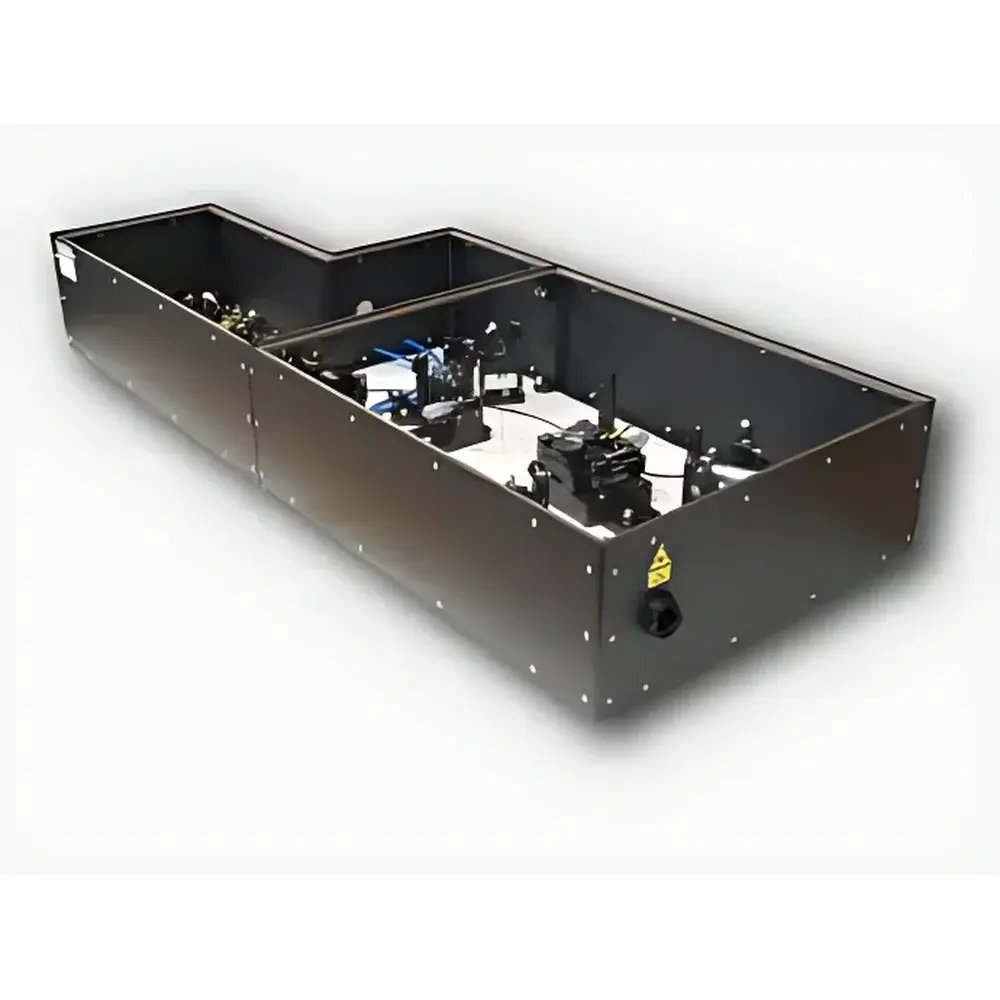
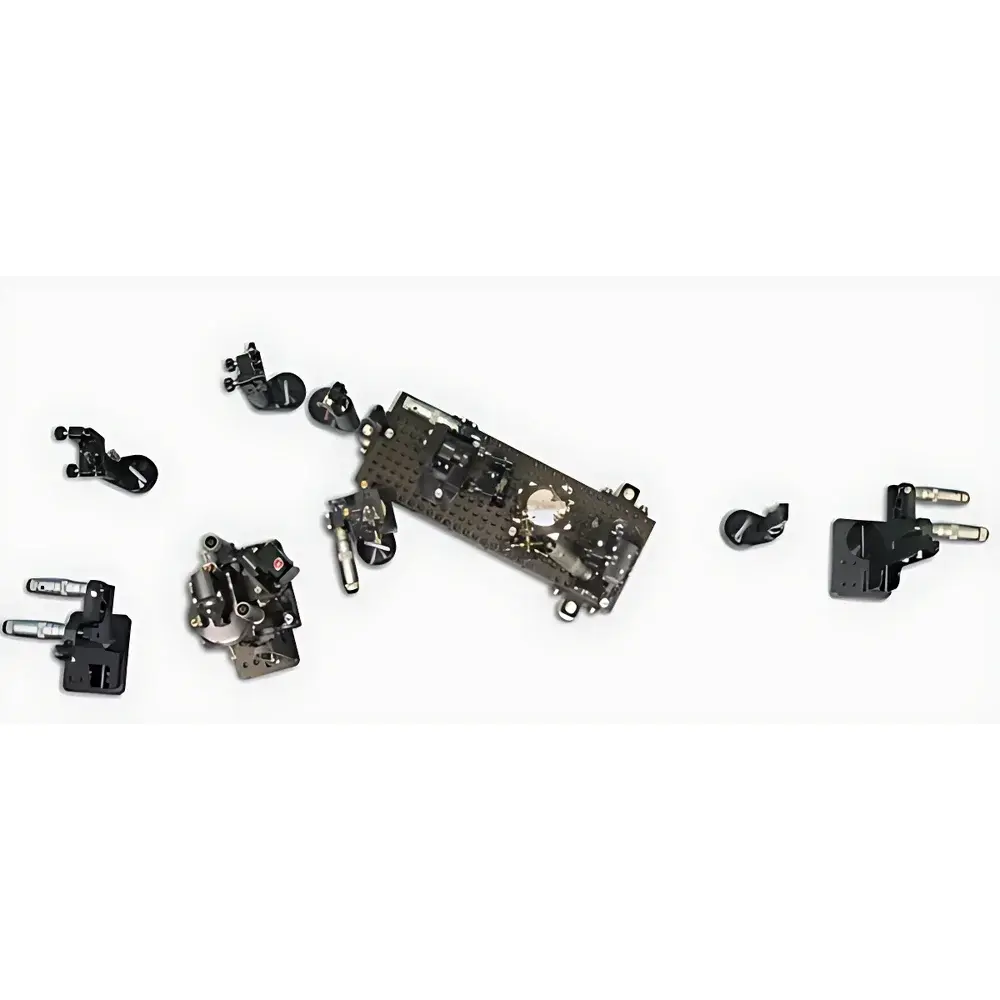
Avesta TiF-Kit Femtosecond Laser Self-Assembly Kit
| Brand | Avesta |
|---|---|
| Origin | Russia |
| Manufacturer Type | Authorized Distributor |
| Product Category | Imported |
| Model | TiF-Kit |
| Core Components | Solid-State Laser System Components |
| Pump Source | 532 nm DPSS Laser |
| Pulse Duration | <15–100 fs (model-dependent) |
| Tuning Range | 715–980 nm (TiF-Kit-100) |
| Avg. Output Power | Up to 1.5 W |
| Repetition Rate | 70–95 MHz (fixed cavity) |
| Polarization | Linear, Horizontal |
| Spatial Mode | TEM₀₀ |
| Max. Pump Power | 2–15 W (model-dependent) |
Overview
The Avesta TiF-Kit Femtosecond Laser Self-Assembly Kit is a modular, research-grade platform engineered for the hands-on construction and optimization of tunable titanium:sapphire (Ti:Sa) femtosecond oscillators. Unlike turnkey commercial lasers, the TiF-Kit provides all essential optical and mechanical subsystems required to build a fully functional, alignment-accessible ultrafast oscillator from first principles. It operates on the principle of Kerr-lens mode-locking (KLM), where nonlinear self-focusing in the Ti:Sa crystal—combined with precise intracavity dispersion management via prism pairs and dielectric mirrors—enables stable sub-100-fs pulse generation. The system is optically pumped by an external 532 nm diode-pumped solid-state (DPSS) laser, with output performance directly scalable with pump power and thermal stabilization. Designed for university optics labs, ultrafast spectroscopy groups, and advanced photonics teaching facilities, the TiF-Kit bridges theoretical instruction with practical laser engineering—supporting deep pedagogical engagement with cavity design, dispersion compensation, and mode-locking dynamics.
Key Features
- Modular architecture enabling full optical path customization: users select mirror dispersion profiles, prism insertion depth, crystal orientation, and cavity length to match specific pulse duration and spectral bandwidth targets.
- Dedicated ultrafast dielectric cavity mirrors with group delay dispersion (GDD) optimized for Ti:Sa gain bandwidth (680–1080 nm), supporting transform-limited pulses across all TiF-Kit variants.
- Thermally stabilized Ti:Sa crystal mount with adjustable tilt, translation, and forced-air cooling interface—critical for maintaining mode-locking stability under variable pump conditions.
- Manual prism pair and tuning slit assembly for continuous wavelength selection; optional motorized CW etalon or USB-controlled slit actuator available for automated spectral scanning.
- Rigid kinematic optical baseplate compatible with standard 1″ and 2″ post holders, facilitating integration into existing optical tables and alignment workflows.
- Scalable pump compatibility: supports DPSS pump lasers delivering 2–15 W at 532 nm, with power-handling design validated per ISO 11146 for beam quality preservation and thermal lensing mitigation.
Sample Compatibility & Compliance
The TiF-Kit is not a finished instrument but a foundational platform requiring user integration and alignment. As such, it complies with general laboratory safety standards for Class 4 laser systems (IEC 60825-1:2014), and all supplied optics meet ISO 10110 surface quality specifications (scratch-dig 10-5). While the kit itself carries no CE or FDA designation, final assembled systems must undergo institutional laser safety officer (LSO) review prior to operation. The TiF-Kit supports experimental configurations aligned with common ultrafast metrology standards—including pulse characterization per ISO 13695 (autocorrelation), spectral measurement per ISO 13694, and beam profiling per ISO 11146. When paired with certified autocorrelators or FROG devices, systems built from the TiF-Kit routinely achieve traceable pulse duration validation for publications in Optics Letters, JOSA B, and Review of Scientific Instruments.
Software & Data Management
No embedded firmware or proprietary control software is included with the base TiF-Kit. However, optional accessories integrate with open-standard interfaces: the USB-controlled tuning slit uses HID-compliant drivers compatible with Python (PyUSB), LabVIEW (NI-VISA), and MATLAB (Instrument Control Toolbox). Pulse train diagnostics—when coupled with external photodiodes and oscilloscopes—can be logged using vendor-agnostic timestamped binary formats (e.g., HDF5) suitable for long-term archival and cross-platform analysis. All mechanical components are dimensionally documented in STEP and PDF formats, enabling CAD-based layout planning and custom enclosure design. For GMP/GLP-aligned environments, users may implement audit-trail logging via third-party DAQ platforms compliant with FDA 21 CFR Part 11 when recording alignment parameters or pump power settings during qualification runs.
Applications
- Teaching laboratories: direct demonstration of KLM initiation, cavity stability analysis (via Fox–Li simulations), and dispersion mapping using prism insertion curves.
- Ultrafast spectroscopy: seeding amplified Ti:Sa systems (e.g., regenerative amplifiers), pump-probe experiments, and time-resolved fluorescence lifetime measurements.
- Nonlinear microscopy development: integration as excitation source for multiphoton imaging setups requiring tunable 700–980 nm output.
- Frequency comb preliminary studies: investigation of f–2f interferometry feasibility using octave-spanning spectra generated via nonlinear broadening in photonic crystal fiber.
- Laser physics research: empirical study of thermal lensing effects, SESAM-free mode-locking thresholds, and cavity-length-dependent repetition rate harmonics.
FAQ
Is the TiF-Kit supplied as a pre-aligned system?
No. The TiF-Kit is delivered as a set of precision-machined, individually tested components. Full cavity alignment—including dispersion balancing, KLM optimization, and mode-matching—is performed by the end user.
Can the TiF-Kit be upgraded to support carrier-envelope phase (CEP) stabilization?
The base kit does not include f–2f interferometer optics or fast piezo-driven mirrors. However, its rigid mechanical design and accessible cavity points allow straightforward integration of CEP stabilization hardware per standard protocols (e.g., Menold et al., Opt. Express 2012).
What pump laser specifications are recommended for TiF-Kit-100 operation at 1.5 W average output?
A 10 W, M² < 1.3, TEM₀₀ 532 nm DPSS laser with < 0.5% RMS power stability over 8 hours and water-cooling capability is recommended. Beam diameter should be 1.2–1.5 mm (1/e²) at the Ti:Sa crystal face.
Are replacement crystals or mirror sets available separately?
Yes. Avesta offers certified Ti:Sa crystals (3 × 3 × 12 mm³, >99.99% purity) and GDD-matched mirror sets (R > 99.9% @ 750–900 nm, GDD = −40 to −80 fs²) as spares, each supplied with individual spectral reflectance and GDD measurement reports.




