
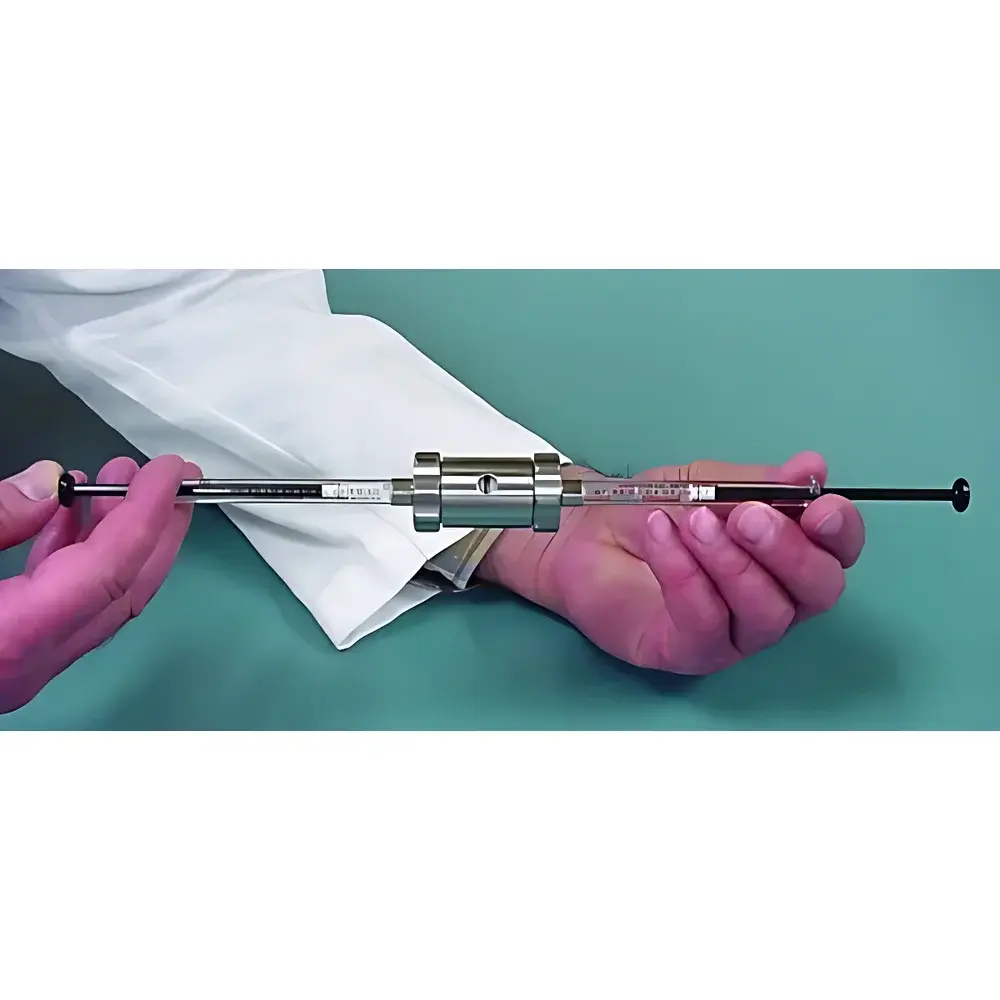
AVESTIN LF-1 Liposome Extruder
| Brand | AVESTIN |
|---|---|
| Origin | Canada |
| Model | LF-1 |
| Type | Manual Piston-Driven Extrusion Device |
| Dimensions (W×D×H) | 280 × 40 × 40 mm |
| Sample Volume Range | 0–1 mL |
| Membrane Compatibility | Polycarbonate (PC) Track-Etched Filters (common pore sizes: 100 nm, 200 nm, 400 nm, 800 nm, 1 µm) |
| Construction | Stainless Steel Housing & Anodized Aluminum Components |
| Residual Volume | < 5 µL |
| Regulatory Compliance | Designed for GLP-compliant lab environments |
Overview
The AVESTIN LF-1 Liposome Extruder is a manually operated, precision-engineered piston-driven extrusion device designed for reproducible size reduction and homogenization of lipid-based nanocarriers—including liposomes, lipid nanoparticles (LNPs), nanoemulsions, and micelles. It operates on the principle of membrane extrusion: a defined volume of pre-sonicated or extruded suspension is forced under controlled mechanical pressure through stacked polycarbonate (PC) track-etched membranes with precisely calibrated pore diameters. This process induces hydrodynamic shear and physical sieving, resulting in narrow polydispersity index (PDI) distributions and consistent mean particle diameters—typically in the range of 50–1000 nm—depending on membrane selection and extrusion cycles. Unlike high-pressure homogenizers or sonication-based methods, the LF-1 delivers gentle yet effective processing without thermal degradation or chemical denaturation, making it ideal for temperature-sensitive biologics, mRNA-LNPs, and peptide-loaded vesicles.
Key Features
- Compact, benchtop-friendly design (280 × 40 × 40 mm) optimized for space-constrained laboratories and cleanroom integration.
- Full disassembly capability: all wetted parts—including stainless steel filter holder, piston rod, syringe barrel, and O-rings—are removable for thorough cleaning, autoclaving (up to 121°C, 20 min), or solvent rinsing.
- Negligible sample carryover: residual volume is consistently below 5 µL after extrusion, ensuring high recovery yield and minimizing cross-contamination between batches.
- Modular syringe compatibility: accepts standard Luer-lock glass or polymer syringes (0.5–1.0 mL), enabling flexible volume handling while maintaining consistent flow dynamics and pressure transmission.
- Stainless steel and anodized aluminum construction ensures long-term corrosion resistance, dimensional stability, and compliance with ISO 13485-aligned manufacturing practices.
- No external power supply or compressed gas required—ideal for use in biosafety cabinets, glove boxes, or mobile GMP pilot facilities.
Sample Compatibility & Compliance
The LF-1 supports aqueous suspensions, organic-aqueous mixtures, and low-viscosity lipid dispersions (e.g., ethanol-injection pre-formulations, thin-film hydration resuspensions). It is routinely validated for use with phospholipid formulations (DSPC, DOPC, HSPC), cholesterol, PEGylated lipids, and ionizable cationic lipids. All extrusion protocols align with regulatory expectations for nanomedicine development: membrane selection and cycle number are documented as critical process parameters (CPPs) per ICH Q5A(R2) and FDA Guidance for Industry on Liposome Drug Products (2022). The device meets functional requirements for USP (light scattering particle size analysis of liposomal products), ISO 13322-2 (electron microscopy and filtration-based sizing), and ASTM E2456-20 (standard practice for characterization of lipid-based nanocarriers).
Software & Data Management
As a manual, non-electronic instrument, the LF-1 does not incorporate embedded firmware or digital interfaces. However, its operation is fully traceable within electronic lab notebook (ELN) systems and quality management software (QMS) platforms. Users record extrusion parameters—including membrane lot number, pore size, number of forward/backward passes, ambient temperature, and post-extrusion DLS/PCE results—in structured templates compliant with 21 CFR Part 11 when deployed in regulated environments. AVESTIN provides a comprehensive SOP template package (available upon request) supporting audit readiness for GLP, GMP, and ISO 17025-accredited laboratories.
Applications
- Pre-clinical formulation development of mRNA, siRNA, and plasmid DNA delivery systems.
- Final-step size homogenization prior to sterile filtration (0.22 µm) of liposomal drug products.
- Reproducible generation of reference standards for dynamic light scattering (DLS), nanoparticle tracking analysis (NTA), and cryo-TEM validation.
- Scale-down modeling for industrial extrusion processes—data generated on the LF-1 directly informs process parameters for AVESTIN’s larger-scale EmulsiFlex-C5 or C3 systems.
- Structural biology studies requiring monodisperse vesicle populations for SAXS, SANS, or fluorescence resonance energy transfer (FRET) assays.
FAQ
What pore sizes of polycarbonate membranes are compatible with the LF-1?
Standard PC membranes with nominal pore diameters of 100 nm, 200 nm, 400 nm, 800 nm, and 1.0 µm are supported. Custom pore sizes (e.g., 50 nm or 5 µm) may be accommodated upon request, subject to membrane supplier availability.
Can the LF-1 be used with organic solvents such as chloroform or ethanol?
Yes—provided all elastomeric components (O-rings, seals) are chemically compatible. We recommend Viton® or Kalrez® seals for extended exposure to aggressive solvents; standard nitrile components are suitable for brief contact with ≤20% ethanol/water mixtures.
How many extrusion cycles are typically required to achieve a stable size distribution?
For most liposomal formulations hydrated above the phase transition temperature, 11–21 total passes (i.e., 5–10 full forward-and-backward cycles) through a single membrane stack yield optimal PDI (<0.1) and size reproducibility. Cycle count should be validated per formulation using orthogonal sizing techniques.
Is the LF-1 suitable for GMP manufacturing environments?
While the LF-1 itself is a Class I laboratory device, it is routinely employed in GMP pilot-scale operations for clinical batch preparation. Its mechanical simplicity, cleanability, and lack of software dependencies facilitate qualification (IQ/OQ/PQ) and reduce validation burden compared to automated systems.



