
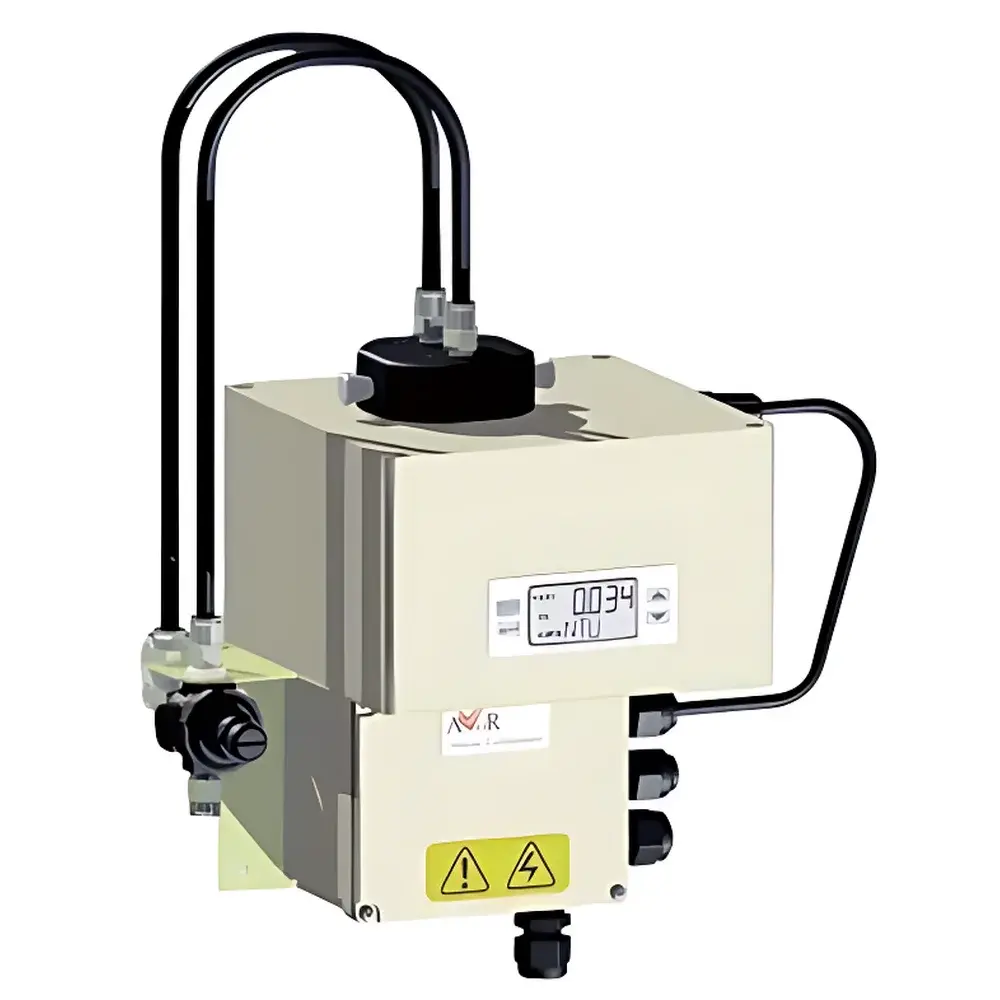
AVVOR 9000 Online Turbidimeter
| Brand | AVVOR |
|---|---|
| Origin | Canada |
| Model | AVVOR 9000 |
| Measurement Principle | 90° White Light (WL) & Near-Infrared (NIR) Scattering |
| Range | 0–1000.0 NTU / 0–100 NTU |
| Accuracy | ±2% of reading or ±0.02 NTU (whichever is greater) for <40 NTU |
| Resolution | 0.0001 NTU (selectable, <10 NTU) |
| Response Time | 5–500 s (adjustable) |
| Light Sources | White LED (7-year lifetime), NIR LED (10-year lifetime) |
| Display | Multi-line backlit LCD |
| Analog Output | 4–20 mA (loop-powered, max 600 Ω load) |
| Digital Interface | RS-485, Modbus RTU |
| Alarm Outputs | Two programmable relays (120–240 VAC, 2 A) |
| Max Operating Pressure | 1380 kPa (with integrated pressure regulator) |
| Flow Rate | 100 mL/min – 1 L/min |
| Sample Temperature Range | +1 °C to +50 °C |
| Compliance | EPA Method 180.1, ISO 7027, EN ISO 7027 |
Overview
The AVVOR 9000 Online Turbidimeter is an industrial-grade, continuous-monitoring turbidity sensor engineered for high-reliability operation in municipal drinking water treatment, wastewater effluent control, process water loops, and pharmaceutical clean utilities. It employs dual-wavelength, 90° light scattering detection—compliant with both U.S. Environmental Protection Agency (EPA) Method 180.1 and ISO 7027/EN ISO 7027—to deliver traceable, metrologically sound turbidity measurements across a broad dynamic range (0–1000.0 NTU). The instrument utilizes two independent optical paths: a white-light (WL) channel optimized for low-level turbidity detection in potable water applications, and a near-infrared (NIR) channel that minimizes interference from color, fluorescence, or dissolved organic matter—critical for compliance-driven environments where spectral artifacts must be suppressed. Its robust flow-through cell design integrates pressure regulation and thermal stabilization to maintain measurement integrity under variable hydraulic conditions.
Key Features
- Dual-mode optical detection: Simultaneous or selectable 90° WL and 90° NIR scattering per EPA 180.1 and ISO 7027 standards
- High-resolution measurement capability: 0.0001 NTU resolution (configurable below 10 NTU) supports ultra-low turbidity verification required by USP , EP 2.2.1, and pharmacopeial water specifications
- Extended-source LED optics: White LED (7-year rated lifetime) and NIR LED (10-year rated lifetime) eliminate lamp replacement cycles and ensure long-term photometric stability
- Integrated pressure regulation: Built-in pressure relief valve maintains constant sample cell pressure up to 1380 kPa, enabling direct installation into pressurized distribution lines without external regulators
- Adjustable response time: User-selectable integration period (5–500 seconds) balances real-time responsiveness with noise rejection in turbulent or particulate-laden flows
- Industrial I/O architecture: Loop-powered 4–20 mA analog output (600 Ω max load), two programmable SPDT relays (120–240 VAC, 2 A), and Modbus RTU over RS-485 for seamless SCADA and DCS integration
Sample Compatibility & Compliance
The AVVOR 9000 is validated for continuous monitoring of clarified surface water, filtered drinking water, membrane filtrate, reverse osmosis permeate, and secondary-treated wastewater. Its flow cell accommodates sample temperatures from +1 °C to +50 °C and flow rates between 100 mL/min and 1 L/min—enabling compatibility with side-stream bypass configurations and inline installations. All optical calibration and performance verification procedures align with ASTM D6695, ISO 7027 Annex A (formazin-based calibration), and GLP-compliant audit trails. The device meets the electrical safety requirements of UL 61010-1 and IEC 61000-6-2/6-4 for electromagnetic compatibility in industrial settings.
Software & Data Management
While the AVVOR 9000 operates as a standalone field instrument, its Modbus RTU interface enables bidirectional communication with supervisory systems supporting data logging, alarm history, and remote parameter configuration. When integrated into validated laboratory or production networks, the instrument supports 21 CFR Part 11-compliant electronic records through compatible SCADA platforms—provided audit trail, electronic signature, and data integrity controls are implemented at the system level. Firmware updates are performed via serial interface using manufacturer-provided utilities; all configuration changes are timestamped and logged internally.
Applications
- Real-time turbidity surveillance at drinking water plant final filters and clearwells per EPA LT2ESWTR requirements
- Effluent compliance monitoring for NPDES permits, particularly where sub-1 NTU thresholds apply
- In-process verification of ultrafiltration and nanofiltration membrane integrity
- Pharmaceutical purified water (PW) and water-for-injection (WFI) loop monitoring per USP and EU GMP Annex 1
- Calibration verification of portable turbidimeters using stable, on-line reference points
- Early-warning detection of filter breakthrough, coagulant dosing errors, or sediment resuspension events
FAQ
Does the AVVOR 9000 require periodic recalibration with formazin standards?
Yes—initial factory calibration is traceable to NIST-certified formazin standards, and routine verification (e.g., quarterly or per SOP) is recommended using certified liquid or solid secondary standards compliant with ISO 7027.
Can the instrument operate in high-turbidity wastewater without clogging?
The flow cell features a self-cleaning geometry and minimum 100 mL/min flow requirement; however, pre-filtration or settling is advised for samples exceeding 500 NTU or containing >50 µm suspended solids.
Is the 4–20 mA output intrinsically safe for hazardous area installation?
No—the analog output is not IS-rated; for Class I Div 1 or ATEX Zone 1 environments, signal isolation and barrier integration must be provided externally.
How is temperature compensation applied during measurement?
An integrated Pt1000 RTD continuously monitors sample temperature and applies algorithmic correction per ISO 7027 Annex B, ensuring NTU values remain referenced to 25 °C.
What maintenance intervals are recommended for long-term deployment?
Optical window inspection every 6 months; full mechanical cleaning and zero-check annually; LED source replacement is not required within the first 7–10 years under normal operating conditions.





