
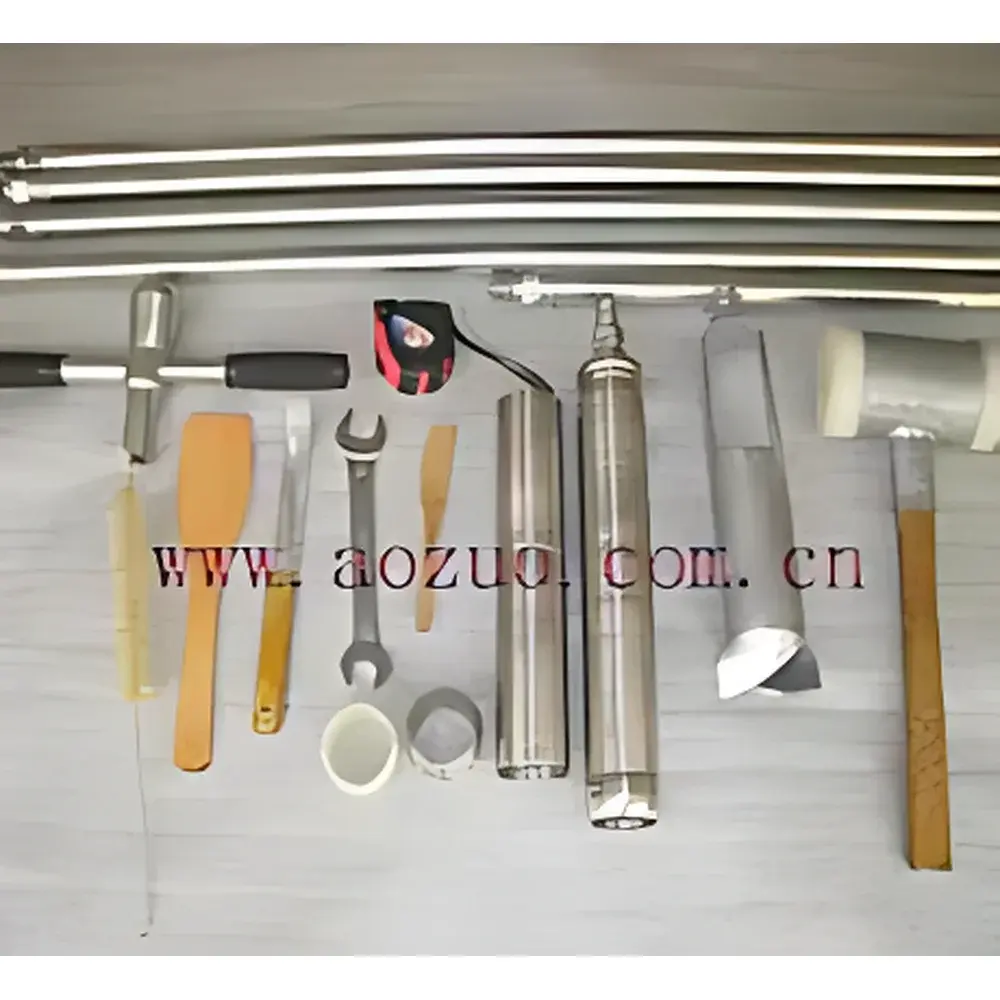
AZ-SOC-101 Soil Organic Carbon (SOC) Sampling Kit
| Origin | Beijing, China |
|---|---|
| Manufacturer Type | Distributor |
| Origin Category | Domestic (China) |
| Model | AZ-SOC-101 |
| Pricing | Available Upon Request |
Overview
The AZ-SOC-101 Soil Organic Carbon (SOC) Sampling Kit is a field-deployable, precision-engineered system designed for the standardized collection of undisturbed soil cores intended for laboratory-based quantification of soil organic carbon (SOC), total organic matter (SOM), and associated biogeochemical parameters. It operates on the principle of minimally invasive, depth-stratified coring—utilizing stainless-steel sampling tubes inserted vertically into pre-augered pilot holes to preserve structural integrity, minimize compaction, and prevent cross-contamination between strata. This methodology aligns with internationally recognized soil sampling protocols, including ISO 28258:2013 (Soil quality — Guidance on sampling strategies) and ASTM D5030–21 (Standard Test Method for Total Organic Carbon in Soil), ensuring data compatibility for regulatory reporting, carbon sequestration verification (e.g., Verra VM0042, Plan Vivo), and long-term environmental monitoring programs.
Key Features
- Stainless-steel construction throughout: All core tubes, end caps, spacers, and handling tools are fabricated from 316-grade stainless steel to eliminate leachable organics, plasticizers, or surface contaminants that could bias SOC analysis—critical for low-concentration (<0.5%) or isotopic (δ13C) measurements.
- Controlled atmospheric isolation: Each collected core is immediately sealed at both ends using machined stainless-steel plugs and inert metal washers, followed by dual-layer sealing with threaded aluminum caps—preventing oxidation, moisture loss, and microbial activity during transit and storage.
- Modular depth extension system: Includes four 100 cm and one 50 cm hardened steel extension rods with precision-machined couplings, enabling reliable penetration to the standard maximum depth of 4.5 m; custom-length configurations are available for deep-profile studies (e.g., permafrost or paleosol investigations).
- Pre-augering compatibility: Integrated pilot auger bit ensures clean, low-disturbance entry into heterogeneous or compacted soils—including clay-rich, gravelly, or root-dense matrices—reducing torque-induced smearing and maintaining core geometry.
- Field-optimized ergonomics: Includes energy-absorbing hammer, torque-limiting hand grip, calibrated measuring tape, and dedicated core ejection tool to ensure consistent, operator-independent sample recovery without manual extrusion or scraping artifacts.
Sample Compatibility & Compliance
The AZ-SOC-101 is validated for use across USDA soil texture classes (sand to heavy clay), volcanic ash, loess, anthropogenic fill, and moderately rocky substrates (up to 15% gravel fraction <2 cm). Core diameter (5.0 cm nominal) conforms to ISO 28258-recommended dimensions for volumetric SOC normalization. All components comply with EU REACH Annex XVII restrictions on heavy metals and are non-reactive under ICP-MS, TOC combustion, and pyrolysis-GC/MS analytical workflows. The kit supports GLP-compliant chain-of-custody documentation when used with certified field logbooks and barcoded sample tube labels.
Software & Data Management
While the AZ-SOC-101 is a hardware-only sampling system, it integrates seamlessly with digital field data capture platforms such as ESRI Field Maps, QField, or OpenDataKit (ODK). Each aluminum transport case includes space for QR-coded inventory tags linked to centralized LIMS databases. Optional companion software modules (sold separately) provide automated depth calibration logging, GPS-tagged core metadata export (GeoJSON), and audit-trail generation aligned with ISO/IEC 17025:2017 requirements for measurement traceability.
Applications
- Long-term ecological research (LTER) network soil carbon inventories
- UNFCCC National GHG Inventory reporting (Tier 2/3 methodologies)
- Agricultural soil health assessments (e.g., USDA NRCS Soil Health Card)
- Contaminated site baseline characterization prior to remediation
- Wetland restoration monitoring and peatland carbon stock estimation
- Calibration/validation of proximal sensing (Vis-NIR, LIBS) and remote-sensing (Sentinel-2, Landsat) SOC prediction models
FAQ
What is the maximum recommended sampling depth without custom extensions?
The standard configuration achieves up to 4.5 meters using the included extension rods and pre-augering protocol.
Can this kit be used for frozen or water-saturated soils?
Yes—with modified hammering technique and optional anti-freeze lubricant on threads; however, full saturation may require vacuum-assisted core retrieval not included in base kit.
Are replacement parts available individually?
Yes: Stainless-steel core tubes, end caps, spacers, and extension couplings are stocked and supplied with material certification (EN 10204 3.1).







