
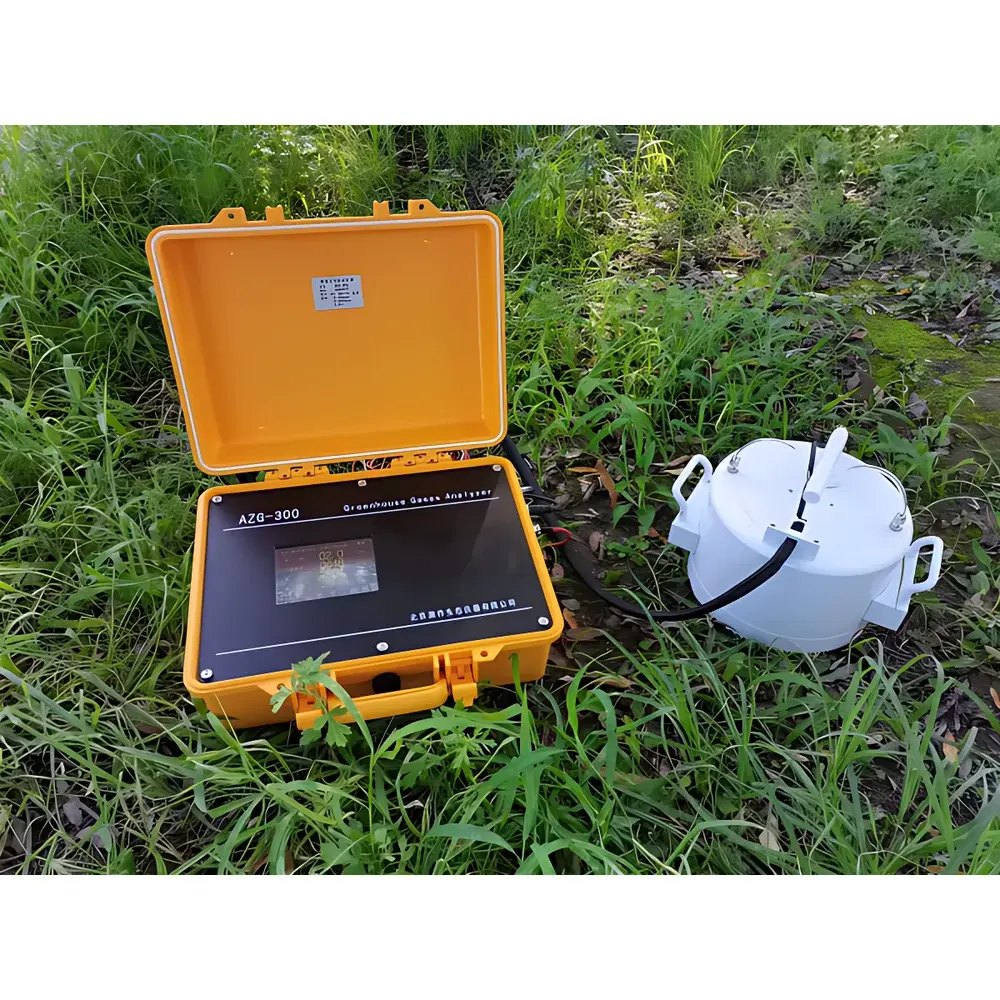
AZG-300 Portable Soil and Aquatic Greenhouse Gas Analyzer
| Brand | AZ (Beijing Aozuo) |
|---|---|
| Model | AZG-300 |
| Measurement Principle | NDIR for CO₂ & O₂ |
| Measurement Range | CO₂: 0–2000 ppm, CH₄: 0–100 ppm, O₂: 0–21% vol |
| Resolution | CO₂: 1 ppm, CH₄: 0.1 ppm, O₂: 0.1% vol |
| Accuracy (Linearity) | ≤±2% FS |
| Repeatability | ≤±2% FS |
| Zero Drift | ≤±2% FS / 24 h |
| Span Drift | ≤±2% FS / 24 h |
| Response Time | <120 s (with 2 m sampling line) |
| Operating Temperature | 0–45 °C |
| Operating Humidity | 1–90% RH (non-condensing) |
| Power Supply | Internal 14.4 V DC / 2 A battery (8 h runtime) + AC 85–265 V, 50 ±0.5 Hz, 40 W |
| Data Storage | 9900 records (circular overwrite) |
| Display | 320×240 color TFT touchscreen |
| Communication | RS232 |
| Dimensions (AZG-300) | 480 × 340 × 180 mm |
| Weight | ~12 kg (typical for field-portable GHG analyzer) |
Overview
The AZG-300 Portable Soil and Aquatic Greenhouse Gas Analyzer is an engineered field-deployable instrument designed for in situ, real-time quantification of carbon dioxide (CO₂), methane (CH₄), and oxygen (O₂) fluxes across heterogeneous terrestrial and aquatic ecosystems. It operates on dual optical detection principles: non-dispersive infrared (NDIR) absorption for CO₂ and O₂, and either NDIR or tunable diode laser absorption spectroscopy (TDLAS) — depending on configuration (AZG-300L) — for high-selectivity CH₄ measurement. This architecture enables simultaneous, interference-resistant gas analysis under variable ambient conditions, supporting rigorous biogeochemical process studies in soils, sediments, wetlands, reservoirs, paddy fields, and eutrophic water columns. The system is calibrated to meet the metrological requirements of ecosystem-scale carbon and nitrogen cycle research, where trace-level CH₄ detection (sub-ppm LOD) and stable CO₂/O₂ co-monitoring are essential for partitioning autotrophic vs. heterotrophic respiration, evaluating methanogenic/methanotrophic activity, and interpreting redox-driven gas exchange dynamics.
Key Features
- Field-rugged, battery-powered portable design with integrated sampling pump, flow control (0–3 L/min), and temperature/pressure/humidity compensation algorithms
- Dual-mode optical detection: Standard AZG-300 uses NDIR for all three gases; AZG-300L integrates TDLAS for CH₄ to achieve 0.8 ppm detection limit (at 20 °C, 1013 hPa, 50 ±1.5% RH)
- High-stability optical path with automatic zero/span calibration routines, minimizing drift (<±2% FS over 24 h)
- Real-time data acquisition with 320×240 color touchscreen interface, onboard storage of up to 9900 timestamped records (circular buffer)
- RS232 serial output for integration with external data loggers, eddy covariance systems, or custom flux calculation software
- Operational flexibility: supports both static chamber and dynamic closed-loop flux measurement protocols per ISO 18512:2022 and ASTM D8177-21 guidelines
Sample Compatibility & Compliance
The AZG-300 is validated for direct interfacing with standard soil collars (10–30 cm diameter), aquatic floating chambers, and custom-built incubation vessels. Its gas inlet accepts 6–8 mm OD PTFE or stainless-steel sampling lines up to 5 m in length, with built-in flow regulation and back-pressure monitoring to maintain laminar, contamination-free sample transport. All wetted components comply with USP Class VI and ISO 10993-5 biocompatibility standards. Instrument firmware supports GLP-compliant audit trails, including operator ID tagging, calibration event logging, and sensor health diagnostics. Data export formats (CSV, ASCII) align with FAO’s Global Soil Laboratory Network (GLOSOLAN) metadata schema and are compatible with FluxNet, ICOS, and AmeriFlux data ingestion pipelines.
Software & Data Management
No proprietary desktop software is required for basic operation; however, optional PC-based configuration utility (Windows/macOS/Linux) enables advanced parameter tuning, firmware updates, and batch data export. Raw sensor outputs include analog voltage signals (0–5 V) alongside digital RS232 packets containing calibrated concentration values, auxiliary environmental readings (T, P, RH), and diagnostic flags. Timestamps are synchronized via internal RTC with ±1 s/day accuracy. Exported datasets embed ISO 8601-formatted UTC timestamps and support direct import into R (flux, eddyproc), Python (pandas, scikit-flux), or MATLAB for automated flux calculation using HMR, LGR, or quadratic regression methods. All calibration certificates and factory verification reports adhere to ISO/IEC 17025:2017 requirements.
Applications
- Soil carbon flux quantification in agricultural systems (e.g., no-till vs. conventional tillage, cover cropping trials)
- Methane ebullition and diffusion dynamics in freshwater wetlands, rice paddies, and reservoir sediments
- O₂ depletion kinetics during organic matter decomposition and denitrification assays
- Validation of remote sensing-derived GHG emission models (e.g., Sentinel-5P TROPOMI CH₄ inversions)
- Long-term ecological research (LTER) site monitoring under NSF, NERC, or DFG-funded programs
- Evaluation of biochar amendment effects on microbial respiration and greenhouse gas trade-offs
FAQ
What is the recommended calibration frequency for field deployments?
Calibration is advised before each intensive campaign (e.g., seasonal flux surveys) and after exposure to extreme humidity (>85% RH) or particulate-laden air. Factory-certified span gases (NIST-traceable CO₂/CH₄/N₂/O₂ mixtures) are used for two-point calibration.
Can the AZG-300 operate at altitudes above 1000 meters?
Yes, but atmospheric pressure compensation must be enabled and verified using local barometric reference; full recalibration is recommended for altitudes >1500 m.
Is the instrument compliant with FDA 21 CFR Part 11 for regulated environmental monitoring?
While not marketed for pharmaceutical applications, its audit trail, electronic signature support, and secure data handling meet core Part 11 functional requirements for environmental compliance reporting.
How does the system handle condensation in high-humidity environments?
An integrated Nafion™ dryer module (optional accessory) maintains dew point <5 °C downstream of the sample inlet; firmware automatically flags humidity-induced signal attenuation above 90% RH.
What is the expected service life of the optical sensors?
NDIR sources and detectors are rated for >5 years continuous operation; TDLAS lasers in the AZG-300L variant have a typical lifetime of 10,000 hours under controlled thermal management.
Related Products







