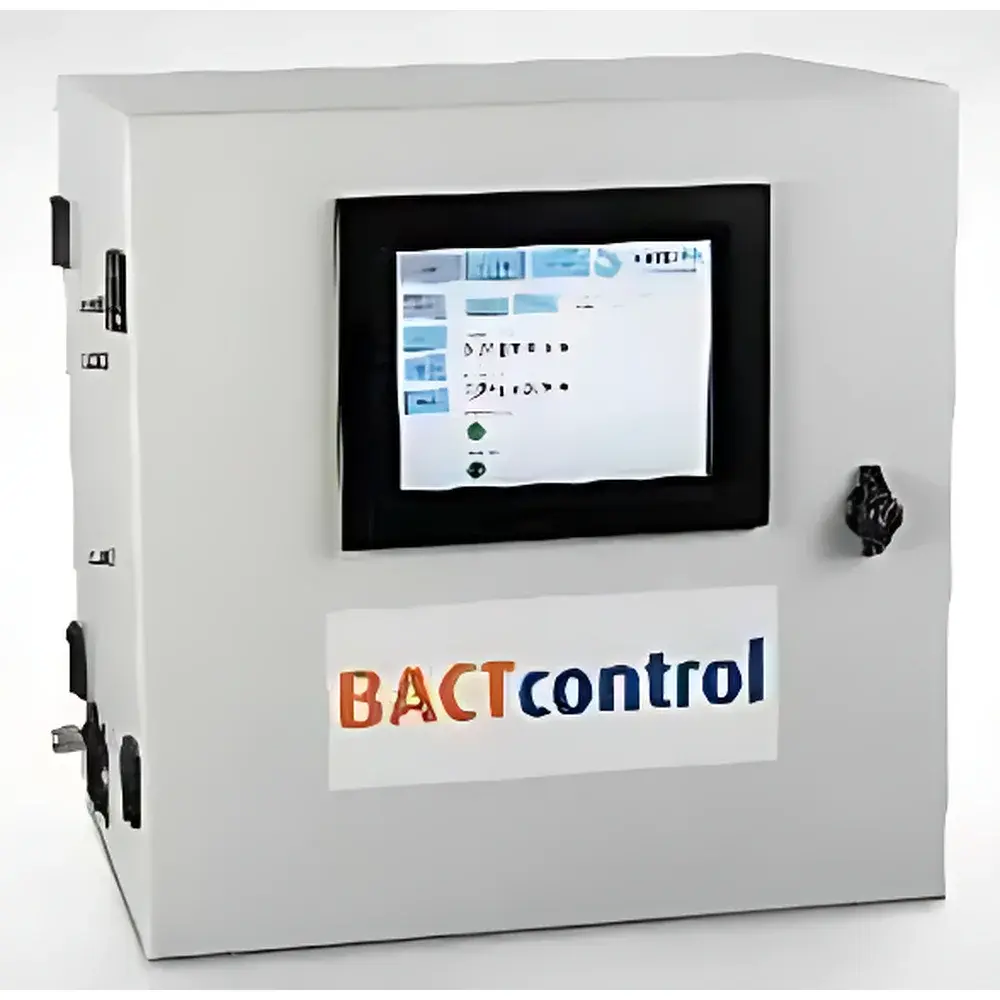
BACTcontrol Online Coliform and Total Bacteria Analyzer
| Origin | Shanghai, China |
|---|---|
| Manufacturer Type | Authorized Distributor |
| Origin Category | Domestic (China) |
| Model | BACTcontrol |
| Price Range | USD 14,000–28,000 |
| Instrument Type | Fully Automated Microbial Enumeration System |
| Counting Speed | <15 min per assay (typical cycle time: 60–240 min) |
Overview
The BACTcontrol Online Coliform and Total Bacteria Analyzer is an industrial-grade, real-time microbial monitoring system engineered for continuous, unattended quantification of indicator bacteria in water matrices. It operates on the principle of enzyme-triggered fluorogenic substrate hydrolysis — specifically targeting β-D-galactosidase (for total coliforms) and β-D-glucuronidase (for Escherichia coli and fecal coliforms). Upon enzymatic cleavage, non-fluorescent substrates release highly fluorescent metabolites (e.g., 4-methylumbelliferone), whose intensity is linearly proportional to viable bacterial concentration. Unlike culture-based or ATP-bioluminescence methods, BACTcontrol delivers quantitative results without incubation delays, colony isolation, or membrane filtration — enabling rapid response to microbiological excursions within 1–4 hours. Designed for deployment at critical process nodes — including raw water intakes, drinking water treatment trains, distribution network monitoring points, wastewater effluent discharge channels, and high-purity utility loops — it meets the operational rigor required under ISO 9001, ISO/IEC 17025, and EU Directive 98/83/EC (Drinking Water Quality) frameworks.
Key Features
- Fully automated, self-contained operation with integrated sampling pump, reagent delivery, reaction chamber, optical detection module, and waste management — requiring no manual intervention between scheduled cycles.
- Robust fluorescence detection architecture calibrated against NIST-traceable standards; immune to sample turbidity (up to 1000 NTU), suspended solids, and colored dissolved organic matter — eliminating pre-filtration or dilution steps.
- Programmable assay frequency: up to six independent measurements per 24-hour period, with configurable cycle duration (60–240 min) to balance sensitivity and temporal resolution.
- IP54-rated enclosure (IP56 optional) with aluminum alloy chassis; optimized for ambient temperatures of 15–30 °C and sample temperatures of 10–35 °C.
- Onboard automatic cleaning system using low-concentration sodium hypochlorite (<0.05% active chlorine), programmable cleaning intervals, and anti-scaling protocol — supporting uninterrupted operation for ≥2 weeks without maintenance.
- Modular expandability: optional dual-sample inlet, secondary cleaning circuit, external modem (UMTS/ISDN/analog), and HVAC integration for elevated ambient environments (>30 °C).
Sample Compatibility & Compliance
The BACTcontrol is validated for use with potable water, surface water (rivers, lakes, reservoirs), treated wastewater effluents, reclaimed water, swimming pool recirculation streams, and process water from beverage, dairy, pharmaceutical, and semiconductor manufacturing facilities. Its enzymatic methodology aligns with EPA Method 1604 (for total coliforms and E. coli) and ISO 9308-1:2014 (water quality — enumeration of Escherichia coli and coliform bacteria). While not a replacement for regulatory-compliant culture confirmation per ISO 9308-2 or USP , it serves as a primary screening and trending tool compliant with GLP data integrity requirements — including audit-trail-enabled event logging, user access control, and electronic signature support via optional software modules.
Software & Data Management
The embedded Windows-based HMI features a 7-inch capacitive touchscreen interface with intuitive graphical workflow navigation. All measurement data — including raw fluorescence intensity, calculated CFU/100 mL equivalents, QC flag status, calibration history, and maintenance logs — are timestamped and stored locally on a removable SD card (≥16 GB). Network connectivity includes dual Gigabit Ethernet ports (RJ-45), two USB 2.0 Type-A host interfaces, and dual RS-232/422/485 serial channels (DB-9), enabling native Modbus TCP and Modbus RTU protocol integration into SCADA, DCS, or LIMS platforms. Optional 4–20 mA analog outputs support hardwired PLC interfacing for alarm triggering or cascade control. Data export formats include CSV and XML; remote diagnostics and firmware updates are supported over LAN or cellular backhaul.
Applications
- Real-time early-warning surveillance for fecal contamination events in municipal drinking water supply systems.
- Process validation and verification of disinfection efficacy at wastewater treatment plant outfalls.
- Continuous compliance monitoring for ISO 22000-certified food & beverage production lines and sterile pharmaceutical water systems (PW/WFI).
- Trend analysis of biofilm formation potential in cooling towers and recirculating industrial water circuits.
- Emergency response deployment during natural disasters or infrastructure failures — rapidly deployed as a mobile unit with battery backup option.
- Research-grade longitudinal studies of microbial dynamics in aquatic ecosystems and bioreactor effluents.
FAQ
What bacterial groups does the BACTcontrol quantify?
It provides quantitative estimates for total coliforms, fecal coliforms (including E. coli), total heterotrophic bacteria (via broad-spectrum esterase activity), and enterococci (with optional substrate configuration).
Does turbidity affect measurement accuracy?
No — the optical design incorporates background subtraction algorithms and excitation/emission wavelength filtering that eliminate interference from particulate scattering and chromophoric dissolved organic matter.
How frequently can the system perform analyses?
Up to six independent assays per day, with customizable start times and cycle durations ranging from 60 to 240 minutes.
Is regulatory approval required for routine use?
While BACTcontrol is not certified as a primary compliance method under US EPA or EU Annex I, it satisfies performance criteria for indicative monitoring under WHO Guidelines for Drinking-water Quality and supports ALARA-based risk management per ISO 22000 Annex A.
What maintenance is required beyond automated cleaning?
Annual verification of photometric calibration using reference standards, biannual replacement of consumable reagent cartridges and optical filters, and quarterly inspection of fluidic seals and tubing integrity.