
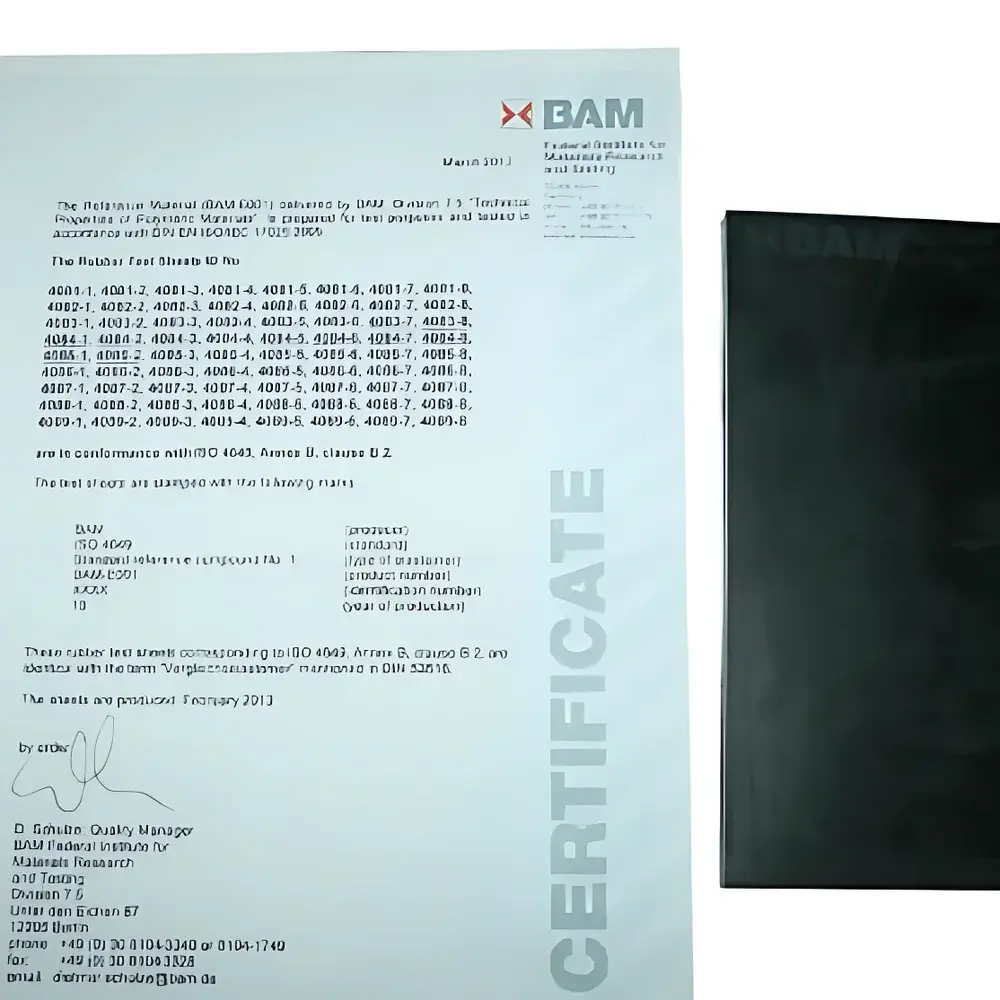
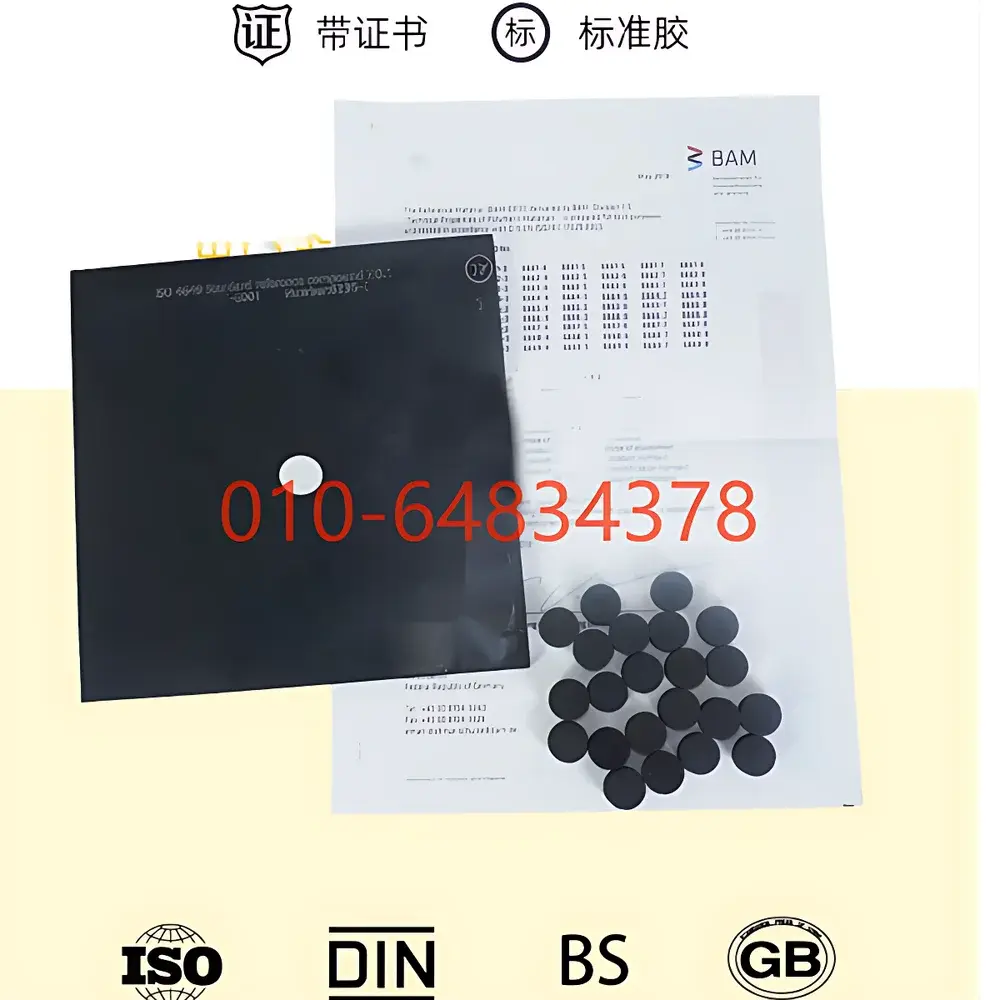
BAM-E001 DIN Abrasion Standard Reference Rubber (Certified by BAM, Germany)
| Brand | SUSS |
|---|---|
| Origin | Germany |
| Model | BAM-E001 |
| Dimensions | 8 mm × 181 mm × 181 mm |
| Density | 1.35 ± 0.02 g/cm³ (ISO 1183-1) |
| Hardness | 60 ± 3 Shore A (ISO 7619) |
| Mass Loss | 210 ± 10 mg per test piece (DIN ISO 4649, median of 3 runs × 15 specimens) |
| Compliance | DIN 53516, ISO 4649, GB/T 9867, SATRA TM174, BS 903 |
Overview
The BAM-E001 DIN Abrasion Standard Reference Rubber is a certified, traceable reference material produced under strict quality control by the Bundesanstalt für Materialforschung und -prüfung (BAM), Germany’s national metrology institute for materials science. Engineered specifically for calibration and performance verification of rotary drum-type abrasion testers operating in accordance with DIN 53516, this reference rubber serves as the primary benchmark for inter-laboratory comparability and method validation in rubber and elastomer wear testing. Its physical properties—including density, hardness, and standardized mass loss behavior—are rigorously characterized using BAM’s accredited measurement protocols and certified against SI-traceable standards. Unlike generic calibration rubbers, the BAM-E001 is not a consumable but a metrological reference standard: each batch is issued with a BAM Certificate of Conformance that documents certified values, uncertainty budgets, and full compliance with ISO/IEC 17025 requirements for reference materials.
Key Features
- Manufactured and certified by BAM (Federal Institute for Materials Research and Testing), Berlin—Germany’s designated authority for reference materials in polymer testing.
- Dimensionally precise block format: 8 mm thickness × 181 mm × 181 mm, enabling consistent specimen cutting (typically ~90 test pieces per block) with minimal edge-effect variability.
- Traceable density of 1.35 ± 0.02 g/cm³, measured per ISO 1183-1 using buoyancy-based pycnometry with calibrated glass weights and thermostatically controlled immersion fluid.
- Shore A hardness of 60 ± 3, verified on five representative locations per sheet using a calibrated durometer per ISO 7619-1, with temperature and humidity controlled to 23 °C / 50 % RH during conditioning and measurement.
- Defined abrasion resistance: mean mass loss of 210 ± 10 mg per test piece, determined via DIN ISO 4649 methodology—i.e., median of three independent abrasion runs per specimen, averaged across 15 statistically representative specimens cut from a single production sheet.
- Supplied with a BAM Certificate containing full uncertainty statements, homogeneity assessment data, stability monitoring records, and statement of compliance with ISO Guide 35 and EU Regulation (EC) No 765/2008.
Sample Compatibility & Compliance
The BAM-E001 is compatible exclusively with DIN-compliant abrasion testers featuring a rotating drum geometry, fixed sample holder pressure (10 N ± 0.2 N), standardized abrasive paper (P100 grit, FEPA designation), and defined rotational speed (40 rpm ± 1 rpm). It is validated for use in laboratories operating under GLP, ISO/IEC 17025, and GMP frameworks where documented metrological traceability is mandatory. The material meets the technical requirements of DIN 53516 (rubber—determination of abrasion resistance—rotating drum method), ISO 4649:2010 (rubber—determination of abrasion resistance—rotating drum method), GB/T 9867.1–2017 (Chinese national standard, identical to ISO 4649), SATRA TM174 (footwear sole abrasion), and BS 903-A9 (British Standard for rubber physical testing). Its certification supports audit readiness for FDA 21 CFR Part 11-compliant quality systems when paired with validated instrument software.
Software & Data Management
While the BAM-E001 itself is a physical reference material, its integration into digital quality workflows requires alignment with laboratory information management systems (LIMS) and electronic lab notebooks (ELN). Each certificate includes a unique BAM batch ID and QR code linking to BAM’s public reference database for real-time access to archival test reports and revision history. Laboratories performing ISO/IEC 17025-accredited testing must record BAM-E001 usage—including lot number, certificate expiry, storage conditions (23 ± 2 °C, <65 % RH), and calibration interval—in their instrument qualification files. When used with automated abrasion testers equipped with digital mass measurement (e.g., analytical balances compliant with OIML R76 Class I), BAM-E001 data can be imported directly into statistical process control (SPC) dashboards to monitor tester drift over time.
Applications
- Calibration and periodic verification of DIN abrasion testers prior to routine sample testing.
- Inter-laboratory proficiency testing programs coordinated by national metrology institutes or industry consortia (e.g., IRG, ETRMA).
- Validation of new test methods or modified test parameters against an internationally recognized reference baseline.
- Root cause analysis of unexpected wear results—e.g., distinguishing instrument malfunction from material formulation changes.
- Supporting regulatory submissions for medical device elastomers, automotive seals, and industrial conveyor belts where abrasion performance is a critical design parameter.
- Training personnel on standardized specimen preparation, mounting technique, and result interpretation per ISO 4649 Annex B.
FAQ
What is the shelf life of BAM-E001, and how should it be stored?
BAM-E001 has a certified stability period of 24 months from date of manufacture when stored in original packaging at 23 ± 2 °C and relative humidity below 65 %. Exposure to UV light, ozone, or elevated temperatures (>30 °C) may accelerate surface oxidation and invalidate certified values.
Can BAM-E001 be reused after initial testing?
No. Each test piece is intended for single-use only. Reuse introduces uncontrolled surface degradation, edge rounding, and cumulative thermal effects that compromise measurement repeatability and invalidate traceability claims.
Is the BAM Certificate accepted for ISO/IEC 17025 accreditation audits?
Yes. BAM is a signatory to the ILAC MRA and its certificates are recognized globally as valid evidence of metrological traceability under Clause 6.6 of ISO/IEC 17025:2017.
How many test pieces can be cut from one BAM-E001 block?
A standard 8 mm × 181 mm × 181 mm block yields approximately 90 test pieces measuring 25 mm × 25 mm × 6 mm (per DIN 53516 specimen dimensions), assuming optimized nesting and allowance for kerf loss.
Does BAM provide technical support for method troubleshooting using BAM-E001?
Yes. BAM offers remote consultation services for accredited laboratories encountering deviations exceeding ±10 mg from the certified mass loss value—covering instrument alignment, abrasive paper verification, and environmental control diagnostics.
Related Products





