
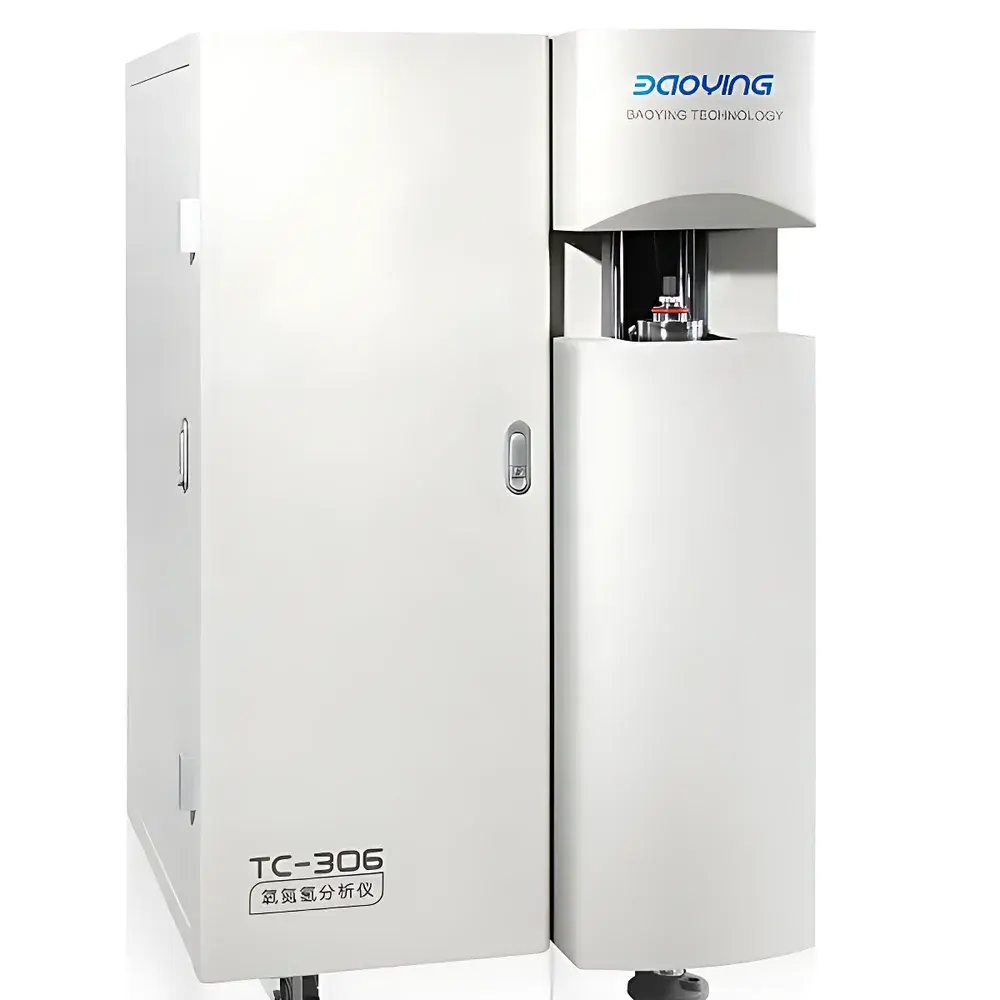
Baoying TC-306 Oxygen-Nitrogen-Hydrogen Analyzer
| Brand | Baoying |
|---|---|
| Origin | Shanghai, China |
| Manufacturer Type | Direct Manufacturer |
| Region of Origin | Domestic (China) |
| Model | TC-306 |
| Price Range | USD 14,000 – 42,000 |
| Instrument Type | Simultaneous O/N/H Analyzer |
| Analytical Range | Oxygen/Nitrogen/Hydrogen — Low-level mode: 0.1 ppm to 5,000 ppm |
| High-level mode | 0.5 wt% to 30 wt% |
| Accuracy | ±1 ppm or RSD ≤ 1% (for nitrogen) |
| Sensitivity | 0.01 ppm |
| Analysis Time | 120–240 s per sample (for nitrogen determination) |
| Pulse Furnace Power | 8 kW |
| Detection Principle | Inert Gas Fusion coupled with NDIR (Non-Dispersive Infrared) and TCD (Thermal Conductivity Detection) |
| Cooling System | Precision Water Temperature Control Unit |
| Footprint | Freestanding Floor Model (no lab bench required) |
| Optional Module | Remote Diagnostic Interface |
Overview
The Baoying TC-306 Oxygen-Nitrogen-Hydrogen Analyzer is a high-performance inert gas fusion elemental analyzer engineered for precise, simultaneous quantification of oxygen (O), nitrogen (N), and hydrogen (H) in solid metallic and non-metallic materials. It operates on the principle of high-temperature inert gas fusion: samples are rapidly heated to temperatures exceeding 3,000 °C in a graphite crucible under ultra-pure helium or argon atmosphere, causing complete thermal decomposition. Oxygen reacts with carbon from the crucible to form CO; nitrogen is released as N₂; and hydrogen evolves as H₂. The evolved gases are swept through a series of calibrated, temperature-stabilized gas pathways into dedicated detection modules—NDIR cells for O and H, and a high-sensitivity thermal conductivity detector (TCD) for N—enabling trace-level and major-element analysis within a single run.
Key Features
- Inert gas fusion system with an 8 kW high-power electrode pulse furnace, delivering rapid heating rates (>1,000 °C/s) and stable peak temperatures up to 3,200 °C for complete liberation of interstitial and bound O/N/H.
- Dual-detection architecture: NDIR detection for oxygen and hydrogen using thermoelectrically stabilized infrared cells with narrow-band interference filters (center wavelength accuracy ±0.5 nm, out-of-band rejection >OD5); TCD optimized for nitrogen with enhanced signal-to-noise ratio and sub-ppm baseline stability at ambient operating temperature.
- Independent mass-flow-controlled gas channels for O, N, and H—each equipped with precision digital mass flow controllers (MFCs) enabling reproducible carrier gas distribution, leak-tight verification, and method-specific flow optimization.
- Integrated water-cooling system with PID-regulated chiller unit maintaining coolant temperature within ±0.1 °C over extended operation—critical for long-term detector thermal stability and furnace thermal cycling consistency.
- Fully freestanding floor-mount design: eliminates dependency on vibration-isolated lab benches; includes integrated caster base, service panel access, and ergonomic sample loading height (850 mm).
- Optional remote diagnostic module compliant with IEC 62443-3-3 cybersecurity guidelines, supporting encrypted SSH-based firmware updates, real-time sensor health monitoring, and automated error log export for GLP/GMP audit trails.
Sample Compatibility & Compliance
The TC-306 accommodates solid samples up to 1.0 g (standard crucible) or 2.5 g (high-capacity crucible), including steels, superalloys, titanium alloys, ceramics, carbides, and refractory metals. Sample preparation follows ASTM E1019, ISO 14284, and JIS G 1211 standards for O/N/H determination. All gas-handling components meet ISO 8573-1 Class 1 compressed air purity requirements; helium/argon supply lines incorporate dual-stage filtration (0.01 µm particulate + moisture/organic scavenger). The instrument’s analytical output complies with FDA 21 CFR Part 11 for electronic records and signatures when paired with validated software configurations, and supports full audit trail generation per ALCOA+ principles (Attributable, Legible, Contemporaneous, Original, Accurate, Complete, Consistent, Enduring, Available).
Software & Data Management
Control and data acquisition are managed via Baoying’s proprietary FusionSuite™ v4.2 software, running on Windows 10 IoT Enterprise LTSB. The interface provides method-driven workflow automation—including automatic blank subtraction, multi-point calibration curve fitting (linear, quadratic, or spline), and dynamic integration window adjustment based on peak shape recognition. Raw detector signals are stored in HDF5 format with embedded metadata (operator ID, timestamp, furnace power profile, gas flow logs). Export options include CSV, PDF analytical reports (with customizable templates), and direct LIMS integration via ASTM E1384-compliant HL7 messaging or ODBC drivers. Software validation documentation (IQ/OQ/PQ protocols) and 21 CFR Part 11 configuration files are supplied with each system.
Applications
The TC-306 serves quality control laboratories in aerospace manufacturing (e.g., verifying H content < 2 ppm in Ti-6Al-4V forgings), specialty steel production (monitoring interstitial O in stainless grades per ASTM A1088), nuclear-grade zirconium alloy certification (O/N/H spec limits per ASTM B351), and advanced ceramic R&D (quantifying residual H in SiC sintered bodies). It is routinely employed in failure analysis labs to correlate hydrogen embrittlement susceptibility with measured H concentrations, and in metallurgical research for studying deoxidation kinetics during ladle refining processes.
FAQ
What sample forms are compatible with the TC-306?
Solid metallic and non-metallic specimens only—powders must be pelletized; chips, turnings, and machined coupons are accepted. Liquids, gases, or organic matrices are not supported.
Does the system require external cooling water?
No—the integrated chiller provides closed-loop temperature regulation; only standard 230 V AC power and dry instrument air (for purge valves) are required.
Can the TC-306 analyze nitrogen independently without oxygen/hydrogen measurement?
Yes—method configuration allows selective activation of individual detection channels; users may run N-only, O-only, or full O/N/H sequences.
Is calibration traceable to NIST standards?
Yes—certified reference materials (CRMs) from NIST (e.g., SRM 2136, 2137), BAM, and LGC are supported; calibration certificates include uncertainty budgets per ISO/IEC 17025.
What maintenance intervals are recommended?
Graphite crucibles: replaced after 200–300 analyses; IR source lifetime: ≥5 years under normal use; TCD filament replacement: every 18 months; annual preventive maintenance includes MFC recalibration, furnace alignment verification, and detector optical path inspection.





