
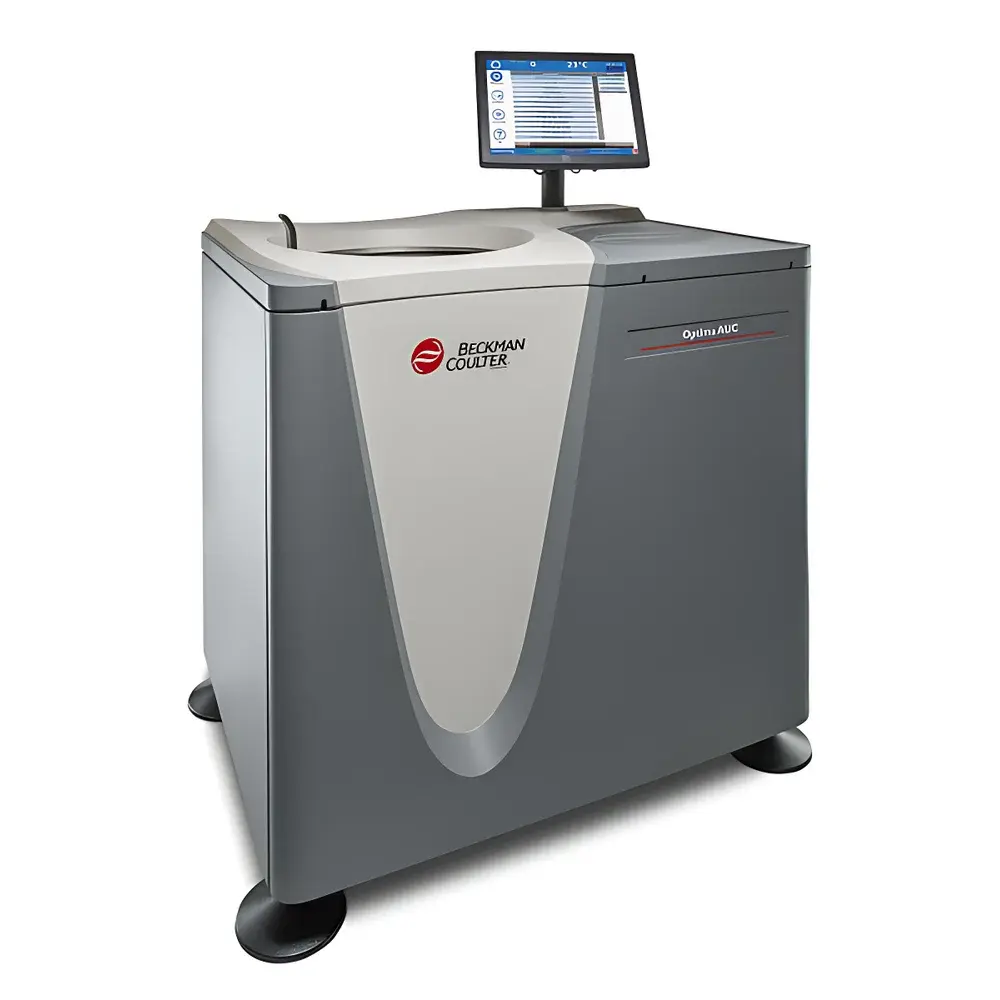
Beckman Coulter Optima AUC Analytical Ultracentrifuge
| Brand | Beckman Coulter |
|---|---|
| Origin | USA |
| Manufacturer | Beckman Coulter, Inc. |
| Product Type | Imported Instrument |
| Model | OPTIMA AUC |
| Detection Range | 5 µg/mL – 150 mg/mL |
| Sample Volume | 380 µL |
| Analysis Duration | Hours (typically 2–8 h per run) |
| Temperature Control Range | 0–40 °C |
| Detection Modes | UV-Vis Absorbance (190–800 nm) and Interference Optics |
| Simultaneous Wavelengths | Up to 20 |
| Maximum Rotor Capacity | 8 cells (An-50 Ti rotor) |
| Throughput | Up to 7 samples per run (standard configuration), up to 21 sample conditions via sequential or multi-temperature protocols |
Overview
The Beckman Coulter Optima AUC is a high-performance analytical ultracentrifuge engineered for first-principles characterization of macromolecules and nanoparticles in solution. Based on sedimentation velocity (SV) and sedimentation equilibrium (SE) principles, the instrument applies controlled centrifugal forces—up to 60,000 rpm—to induce differential migration of solutes according to their mass, shape, density, and hydration. Unlike chromatographic or light-scattering techniques, AUC operates without stationary phases, immobilization, or labeling, preserving native conformation and enabling quantitative analysis under physiologically relevant buffer conditions. The Optima AUC integrates dual optical detection systems—UV-Vis absorbance and Rayleigh interference—allowing rigorous, orthogonal validation of sedimentation behavior across diverse analytes, including proteins, nucleic acids, glycoproteins, liposomes, extracellular vesicles, viral vectors, and ADCs.
Key Features
- Dual optical detection: High-sensitivity UV-Vis absorbance (190–800 nm, 0.001 AU resolution) and interferometric optics for label-free, concentration-independent measurement of refractive index gradients—critical for carbohydrate-rich or highly absorbing samples (OD < 5).
- Advanced optical architecture: Elliptical holographic diffraction grating and quadruple-beam illumination minimize stray light and enhance signal-to-noise ratio, ensuring reproducible baseline stability during extended scans.
- Precision temperature control: Active refrigeration and heating system maintains ±0.1 °C accuracy across the full 0–40 °C operating range—essential for thermodynamic studies and aggregation kinetics.
- High-throughput capability: Supports up to 7 sample cells per run (An-50 Ti 8-hole rotor, one position reserved for reference); enables up to 21 independent experimental conditions via programmable temperature ramps, rotor speed gradients, or sequential acquisition protocols.
- Real-time data acquisition: Simultaneous monitoring at up to 20 discrete wavelengths per scan; no cumulative acquisition time penalty when collecting multi-wavelength datasets.
- Sample recovery: >95% sample recovery post-run preserves precious material for orthogonal assays or reanalysis—eliminating dilution artifacts and enabling serial characterization.
Sample Compatibility & Compliance
The Optima AUC accommodates a broad spectrum of biomolecular and nanoscale systems—including monoclonal antibodies, bispecifics, fusion proteins, oligonucleotides, PEGylated therapeutics, lipid nanoparticles, adeno-associated virus (AAV) preparations, lentiviral vectors, and exosome isolates. Its matrix-free environment imposes minimal buffer restrictions (e.g., compatible with high-salt, reducing, or detergent-containing formulations), making it ideal for formulation screening and stability assessment. Data generated comply with regulatory expectations for higher-order structure and heterogeneity evaluation: methods are inherently traceable to SI units, support GLP/GMP-aligned documentation workflows, and align with ICH Q5E, USP , and ASTM E2918 guidelines for biophysical characterization. Full audit trails, electronic signatures, and 21 CFR Part 11–compliant software modules are available upon configuration.
Software & Data Management
Optima AUC is operated via Beckman Coulter’s UltraScan software—a validated platform supporting automated experiment design, real-time visualization, and advanced modeling (e.g., c(s), ls-g*(s), and g(s*) distributions; continuous size-distribution analysis; binding isotherms; and thermodynamic fitting). Raw interferometric and absorbance scans are stored in vendor-neutral formats (e.g., .auc, .xml) and exportable to third-party tools such as SEDFIT, SEDPHAT, and UltraScan III. All processing steps—including meniscus/floor positioning, baseline correction, noise filtering, and model selection—are fully documented and repeatable. Version-controlled method templates ensure inter-laboratory consistency and facilitate technology transfer across development, QC, and CMC teams.
Applications
- Determination of absolute molecular weight, sedimentation coefficient (s20,w), frictional ratio (f/f0), and hydrodynamic radius—without calibration standards.
- Quantification of monomer–dimer–oligomer equilibria, higher-order aggregates (>10 nm), and subvisible particles in therapeutic protein formulations.
- Binding stoichiometry, association/dissociation constants (Ka/Kd), and cooperativity analysis for protein–protein, protein–ligand, and protein–nucleic acid interactions.
- Viral vector analytics: empty-to-full capsid ratio determination for AAV, LV, and adenovirus preparations; batch-to-batch comparability assessment.
- Characterization of nanoparticle size distribution, polydispersity, and structural integrity under varying pH, ionic strength, or excipient conditions.
- Thermodynamic profiling: temperature-dependent sedimentation to extract ΔH, ΔS, and ΔG of folding or assembly transitions.
FAQ
What sample volume is required for a standard AUC experiment?
A minimum of 380 µL per cell is recommended; however, successful analyses have been performed with as little as 100 µL using custom centerpieces and optimized scanning protocols.
Can the Optima AUC analyze samples without intrinsic UV absorbance?
Yes—the interferometric detection system measures changes in refractive index, enabling robust analysis of carbohydrates, polysaccharides, lipids, and other non-chromophoric analytes.
Is calibration required before each run?
No. AUC is a first-principles technique: all parameters (molecular weight, s-value, diffusion coefficient) are derived directly from physical laws (Svedberg equation, Fick’s law) without reliance on reference standards.
How does AUC compare to SEC-MALS or DLS for aggregation analysis?
AUC resolves co-eluting or overlapping species with superior resolution and provides direct, model-independent quantitation of heterogeneity—unlike SEC, which suffers from column interaction artifacts, or DLS, which reports intensity-weighted averages biased toward larger species.
Is the instrument suitable for regulated GMP environments?
Yes—when configured with UltraScan IQ/OQ/PQ packages and 21 CFR Part 11-compliant software options, the Optima AUC supports audit-ready operation in quality control laboratories supporting IND, BLA, and marketing authorization applications.



