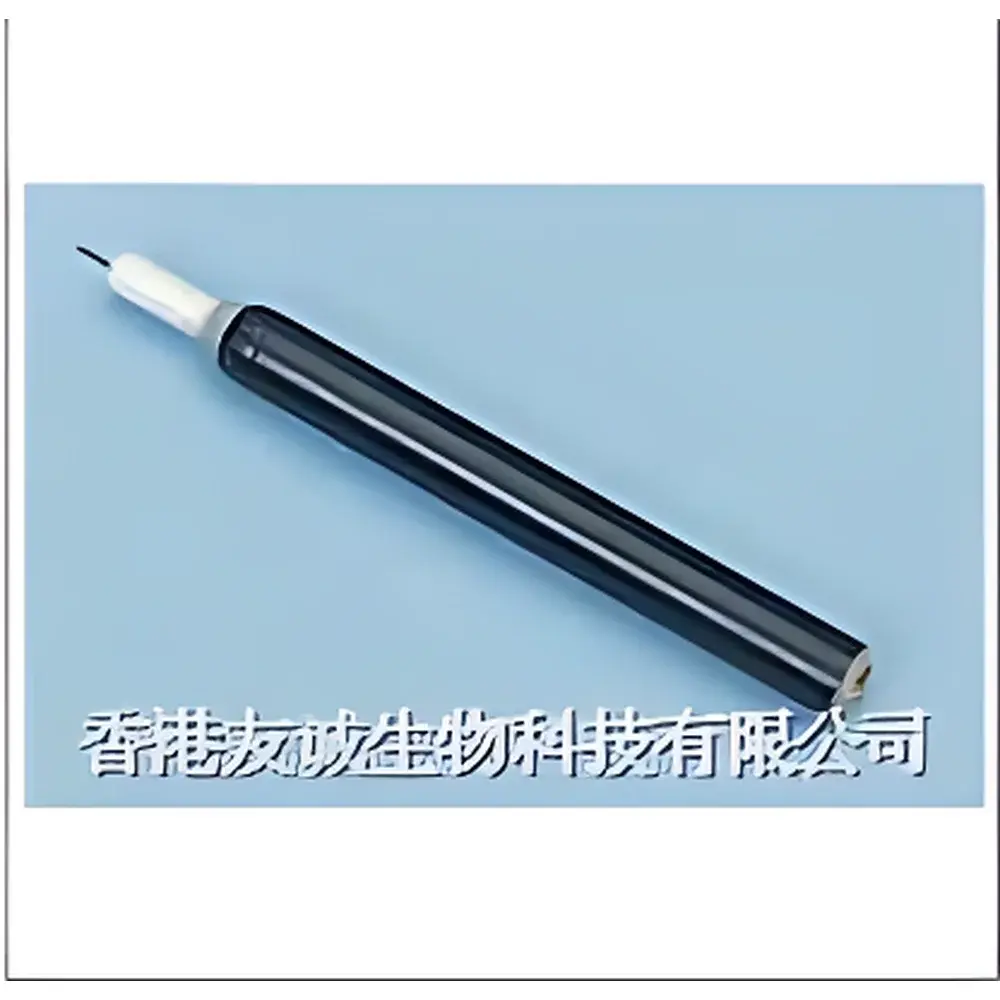
Beetrode Micro pH Electrode
| Origin | USA |
|---|---|
| Manufacturer Type | Distributor |
| Origin Category | Imported |
| Model | Beetrode Micro |
| Pricing | Upon Request |
Overview
The Beetrode Micro pH Electrode is a specialized potentiometric sensor engineered for precise extracellular and intracellular pH measurement in physiological, pharmacological, and neuroscientific research applications. Unlike conventional glass pH electrodes, the Beetrode utilizes a solid-state iridium oxide (IrOx) sensing membrane, which exhibits a significantly higher electrode offset (E0)—typically exceeding ±300 mV—enabling enhanced signal resolution in low-ionic-strength or micro-volume environments where traditional glass electrodes suffer from instability and high impedance. Its micro-scale tip geometry (tip diameter < 10 µm) supports minimally invasive insertion into tissues, single cells, or confined microfluidic chambers. The electrode operates on the Nernstian principle: hydrogen ion activity generates a measurable potential difference relative to a stable reference electrode, with a theoretical slope of −59.16 mV/pH at 25 °C. It requires external reference coupling—such as WPI’s Dri-Ref series—to complete the electrochemical cell and ensure thermodynamic equilibrium.
Key Features
- Microfabricated iridium oxide (IrOx) sensing element with high E0 for improved signal-to-noise ratio in low-conductivity media
- 1 mm active-length sensing tip optimized for cellular and tissue-level measurements
- BNC-compatible output interface for direct integration with standard laboratory pH meters or data acquisition systems
- Unshielded 1 m coaxial cable (no connector termination) for custom routing and sterilization compatibility
- Designed for use with BEE-CAL™ — a portable, battery-powered analog offset compensator that converts raw mV output into calibrated pH units via adjustable DC bias injection
- Compatible with NMPH 2B amplifier systems when paired with ZBEECAL module (required for dual-channel pH monitoring)
Sample Compatibility & Compliance
The Beetrode Micro is validated for use in aqueous biological matrices including cerebrospinal fluid (CSF), interstitial fluid, cell culture supernatants, and perfusates. It maintains stable performance across pH 2.0–12.0 under continuous flow or static immersion conditions. While not intended for routine clinical diagnostics per FDA 21 CFR Part 862, its design aligns with ISO 15197:2013 principles for analytical performance verification in research-grade instrumentation. When used in GLP-compliant electrophysiology studies, the electrode supports traceable calibration protocols using certified NIST-traceable buffer standards (e.g., pH 4.01, 7.00, 10.01 at 25 °C). Sterilization is limited to ethanol wipe-down; autoclaving or chemical immersion is not recommended due to IrOx layer sensitivity.
Software & Data Management
The Beetrode Micro delivers analog mV output only; digital pH conversion occurs externally via hardware compensation (BEE-CAL™ or ZBEECAL). No proprietary software is required. When integrated with commercial data acquisition platforms—including WPI’s PowerLab, ADInstruments’ LabChart, or National Instruments DAQ systems—the electrode’s output is recorded as time-synchronized voltage traces. Offset correction values applied via BEE-CAL™ must be documented manually or logged programmatically to ensure auditability. For regulatory submissions, users are advised to maintain calibration logs, offset adjustment records, and electrode response verification reports in accordance with ISO/IEC 17025 documentation requirements.
Applications
- Intracellular pH monitoring during patch-clamp electrophysiology experiments
- Real-time extracellular pH mapping in brain slice preparations and organotypic cultures
- pH dynamics tracking in microphysiological systems (MPS) and organ-on-chip devices
- Pharmacokinetic assessment of acidifying or alkalinizing drug effects on neuronal tissue
- Validation of pH-responsive hydrogel degradation kinetics in biomaterial studies
- Calibration reference for optical pH sensors (e.g., SNARF-1, BCECF) in multi-modal imaging setups
FAQ
Is the Beetrode Micro pH electrode autoclavable?
No. Autoclaving will irreversibly damage the iridium oxide sensing layer and degrade cable insulation. Surface decontamination should be performed using 70% ethanol followed by sterile saline rinse.
Why is an external reference electrode mandatory?
The Beetrode Micro is a non-reference (indicator-only) electrode. A stable, low-junction-potential reference—such as WPI’s Dri-Ref—is required to establish a complete electrochemical circuit and eliminate liquid junction potential drift.
Can I use this electrode with any pH meter?
Yes—provided the meter accepts high-impedance BNC input and allows manual mV mode operation. However, pH-value output requires either BEE-CAL™ or system-integrated offset compensation (e.g., ZBEECAL for NMPH 2B).
What is the typical lifetime under continuous use?
Under controlled physiological conditions (pH 6.5–7.8, 37 °C), functional lifespan averages 4–6 weeks. Performance decline is indicated by reduced Nernstian slope ( 30 s), or unstable E0 drift (> ±15 mV/h).