
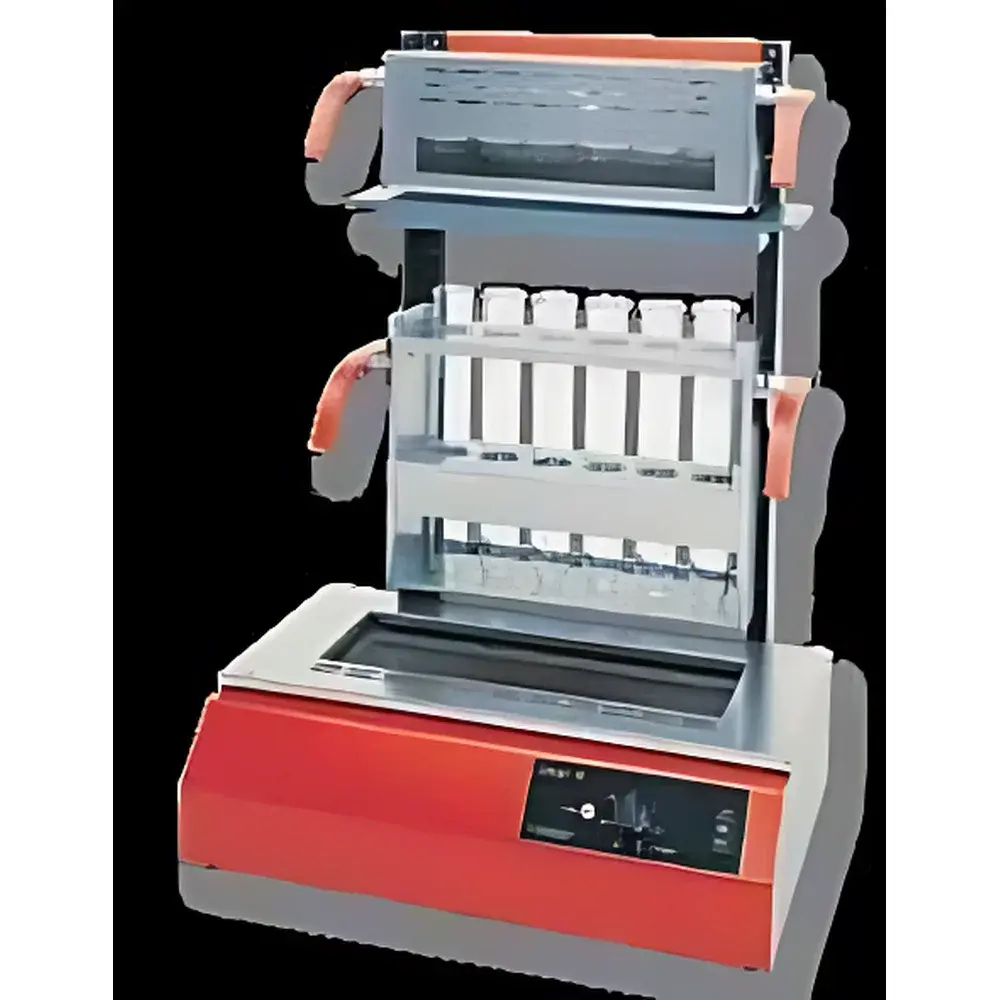
Behr Kjeldahl Digestion System with Automatic Lift Arm
| Origin | Germany |
|---|---|
| Manufacturer Type | Distributor |
| Origin Category | Imported |
| Model | Behr Kjeldahl Digestion System with Automatic Lift Arm |
| Price Range | USD 13,500 – 27,000 |
| Instrument Type | Kjeldahl Nitrogen Determinator |
| Distillation Time | 1–99 minutes |
| Repeatability | ±0.5% |
| Recovery Rate | >99.5% |
| Power Consumption | 750–1500 W |
Overview
The Behr Kjeldahl Digestion System with Automatic Lift Arm is a laboratory-grade, fully automated digestion unit engineered for precision and safety in classical Kjeldahl nitrogen analysis. Based on the standardized wet-chemical digestion principle—where organic nitrogen is converted to ammonium sulfate under concentrated sulfuric acid and catalytic heating—the system delivers reproducible, traceable sample preparation prior to steam distillation and titration. Designed and manufactured in Germany, this instrument integrates thermal control, programmable timing, and mechanical automation to eliminate manual handling of hot, corrosive digestates. Its core function is to perform controlled, high-temperature acid digestion (typically 360–420 °C) of biological, agricultural, food, feed, and environmental samples—ensuring complete mineralization while minimizing operator exposure and procedural variability.
Key Features
- Automated lift arm mechanism: Electromechanically raises and lowers the sample rack and fume hood assembly, eliminating manual lifting of heavy (up to 15 kg) digestion blocks and reducing ergonomic risk.
- Integrated fume extraction control: Synchronized operation with BEHR SOG 3 exhaust system ensures continuous, programmable vapor capture during digestion and cooling phases.
- Programmable temperature and time profiles: Up to 5-step ramp-and-hold programs per run; independent control of heating zones for optimized digestion kinetics across heterogeneous sample matrices.
- RAM-based cooling and post-digestion extraction timing: Customizable delay intervals before lift activation ensure safe thermal equilibration and residual fume removal.
- Single-button start workflow: Reduces operational complexity and training requirements while maintaining full parameter auditability.
- Modular sample capacity options: Available in 12-, 20-, 24-, and 40-position configurations with standard digestion vessel volumes of 100 mL or 250 mL—compatible with standard Kjeldahl flasks and digestion tubes.
- Robust construction: Stainless steel housing, ceramic-coated heating plates, and corrosion-resistant internal components ensure long-term reliability in aggressive acid environments.
Sample Compatibility & Compliance
The system accommodates a broad range of organic and semi-organic matrices including cereals, dairy products, meat, soil, wastewater sludge, and plant tissues. It complies with internationally recognized Kjeldahl methodology standards—including AOAC Official Method 984.13, ISO 8968-1:2014 (milk), ISO 1871:2009 (food), and DIN EN ISO 14891 (fertilizers). All temperature, time, and lift sequences are logged with timestamps and user IDs, supporting GLP and GMP documentation requirements. While not intrinsically 21 CFR Part 11 compliant, the system supports integration with validated LIMS or ELN platforms via RS232/USB for electronic record retention and audit trail generation.
Software & Data Management
The embedded controller enables local programming and real-time monitoring without external PC dependency. Parameter settings—including ramp rates, hold temperatures, digestion duration, lift timing, and exhaust activation windows—are stored in non-volatile memory. Each run generates a timestamped log file containing setpoints, actual measured temperatures (via dual Pt100 sensors per zone), lift actuation events, and error codes. Optional data export (CSV format) facilitates traceability audits and method validation reporting. Firmware updates are performed via USB stick, ensuring version control and regulatory alignment over the instrument’s lifecycle.
Applications
This system is routinely deployed in QC laboratories of food and beverage manufacturers, agricultural testing facilities, environmental monitoring agencies, and academic research groups conducting protein quantification, nutritional labeling, fertilizer efficacy studies, and wastewater nutrient load assessments. Its automation significantly improves throughput in high-volume routine testing (e.g., daily dairy intake analysis), while the lift arm enhances safety compliance in ISO 45001-aligned lab environments. The consistent recovery rate (>99.5%) and repeatability (±0.5%) meet stringent accreditation criteria for ISO/IEC 17025 testing laboratories performing accredited Kjeldahl nitrogen determinations.
FAQ
Is the lift arm compatible with third-party distillation units?
Yes—the lift arm operates independently of distillation hardware and can be synchronized manually or via dry-contact relay signals with most Kjeldahl steam distillers.
What maintenance is required for the heating block?
Annual calibration of Pt100 sensors and visual inspection of ceramic coating integrity are recommended; no routine lubrication or consumable replacement is needed for the lift mechanism.
Can digestion programs be password-protected?
Yes—user levels (Operator, Supervisor, Administrator) support role-based access to program editing, parameter modification, and system configuration.
Does the system include acid-resistant digestion tubes?
No—tubes must be ordered separately; compatibility is confirmed for standard borosilicate glass or quartz Kjeldahl digestion vessels rated for H₂SO₄ at 420 °C.
What electrical specifications apply outside the EU?
Dual-voltage models (115 V~/230 V~) are available; refer to article numbers ending in “K” (230 V) or “L” (115 V) for regional compliance.




