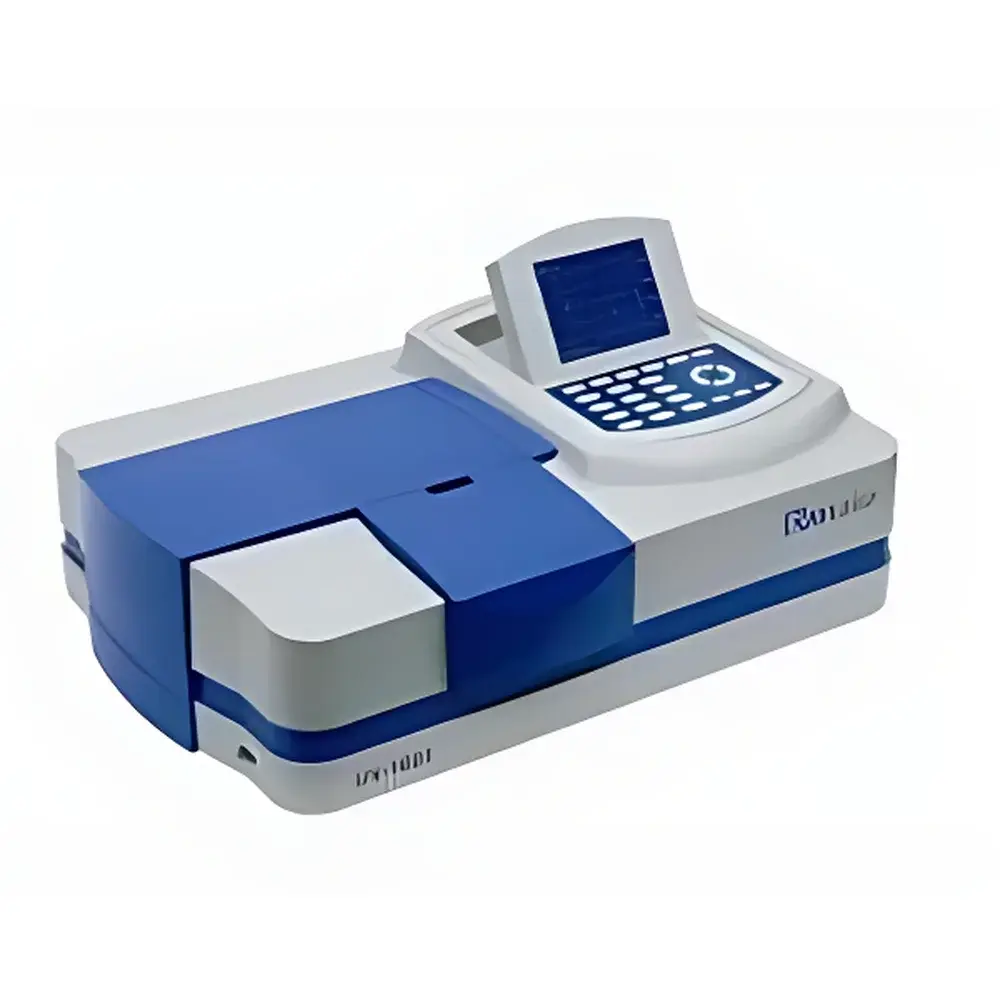
Beifen Ruili UV-1601 UV-Vis Spectrophotometer
| Origin | Beijing, China |
|---|---|
| Manufacturer Type | Authorized Distributor |
| Origin Category | Domestic (PRC) |
| Model | UV-1601 / UV-1600 |
| Spectral Bandwidth Options | 0.5 nm, 1 nm, 2 nm, 4 nm, 5 nm |
| Detector | Imported Silicon Photodiode |
| Light Sources | Socket-type Imported Deuterium Lamp & Tungsten Halogen Lamp |
| Wavelength Range | 190–1100 nm (typical for class) |
| Power Supply | AC 220 V / 50 Hz or 110 V / 60 Hz |
| Power Consumption | 180 W |
| Dimensions (W×D×H) | 630 × 470 × 210 mm |
| Net Weight | 26 kg |
| Warranty | 6 months limited warranty |
| Condition | Refurbished — 90% operational life remaining, fully functional, factory-tested |
| Compliance | Designed to meet general requirements of ISO/IEC 17025 supporting laboratories |
Overview
The Beifen Ruili UV-1601 UV-Vis Spectrophotometer is a dual-beam, microprocessor-controlled analytical instrument engineered for precision absorbance, transmittance, and concentration measurements across the ultraviolet and visible spectrum (190–1100 nm). Based on classical double-beam optical architecture with real-time reference beam compensation, it minimizes drift and enhances photometric stability—critical for quantitative analysis in regulated environments. Its modular optical design integrates imported deuterium and tungsten-halogen lamps, high-efficiency monochromator optics, and a temperature-stabilized silicon photodiode detector to ensure reproducible spectral response over extended operation cycles. The system supports both standalone operation via front-panel interface and PC-based control through optional USB communication, enabling seamless integration into routine QC/QA and research workflows.
Key Features
- Dual-beam optical path with automatic baseline correction and real-time reference channel monitoring
- Selectable spectral bandwidths (0.5, 1, 2, 4, or 5 nm) — configurable to align with pharmacopoeial requirements (e.g., USP , EP 2.2.25, ChP IV)
- Pre-aligned, socket-type lamp modules for rapid source replacement without optical recalibration
- Automated 8-position, dual-lid sample holder accommodating standard 10 mm cuvettes; optionally upgradeable to 4-position wide-format accessory supporting 5–100 mm pathlength cells
- Embedded firmware with persistent memory: retains method parameters, calibration data, and measurement history after power loss
- USB 2.0 interface for direct data export to external storage or PC; optional Windows-compatible software for advanced scanning, kinetic profiling, and multi-wavelength quantitation
- Robust mechanical construction with vibration-damped optical bench and thermally stabilized detector housing
Sample Compatibility & Compliance
The UV-1601 accommodates standard quartz, glass, and plastic cuvettes (10 mm nominal pathlength), with optional accessories enabling variable-pathlength measurements from 5 mm to 100 mm. It supports liquid-phase analysis of aqueous and organic solutions, colloidal suspensions, and diluted biological matrices—including nucleic acid and protein samples using pre-programmed A260/A280 algorithms. While not certified to IEC 61010-1 as a standalone safety-certified device, its electrical design conforms to PRC GB/T 18268.1–2010 (equivalent to IEC 61326-1) for laboratory equipment EMC and safety. Instrument validation documentation (IQ/OQ templates) and raw spectral performance data (stray light, photometric linearity, wavelength accuracy per ASTM E275 and ISO 6223) are available upon request for GxP-aligned installations.
Software & Data Management
Standalone operation includes full-featured on-instrument menu navigation for wavelength scanning, time-based kinetics, fixed-wavelength quantitation, multi-point calibration curves, and DNA/protein concentration calculation. For enhanced traceability, optional PC software provides audit-trail-enabled data acquisition compliant with FDA 21 CFR Part 11 requirements—including electronic signatures, user access levels, and immutable measurement logs. All exported data (CSV, TXT, or proprietary binary format) retain metadata such as date/time stamp, operator ID, lamp hours, and calibration verification status—supporting laboratory accreditation under ISO/IEC 17025.
Applications
This spectrophotometer serves validated applications across pharmaceutical quality control (e.g., assay of active ingredients, excipient purity screening), environmental monitoring (nitrate, phosphate, COD analysis), food safety testing (colorant quantification, antioxidant capacity), clinical diagnostics (enzyme activity assays, serum bilirubin), and academic teaching labs. Its flexible bandwidth selection and dual-lamp configuration make it particularly suitable for methods requiring strict adherence to pharmacopoeial resolution criteria—such as dissolution testing per USP or impurity profiling in small-molecule APIs.
FAQ
Is this unit supplied with original manufacturer documentation and calibration certificates?
Yes — each refurbished UV-1601 includes a full set of bilingual (Chinese/English) operation manuals, factory service records, and a post-refurbishment performance verification report covering wavelength accuracy, photometric repeatability, and stray light level.
Can the instrument be validated for use in GMP-regulated environments?
It supports IQ/OQ execution using standardized protocols; however, PQ must be performed by the end user’s qualified personnel against site-specific SOPs and acceptance criteria.
What is included in the 6-month warranty?
Coverage includes parts and labor for defects in materials or workmanship under normal laboratory use; excludes consumables (lamps, fuses), misuse, or damage from improper voltage supply.
Is lamp alignment required after replacement?
No — socket-type lamp modules are factory pre-aligned; replacement is plug-and-play with automatic warm-up and energy optimization routines.
Does the system support network connectivity or LIMS integration?
Native Ethernet or Wi-Fi is not supported; however, USB-driven data export enables manual or scripted ingestion into LIMS via CSV parsing or third-party middleware adapters.
Related Products