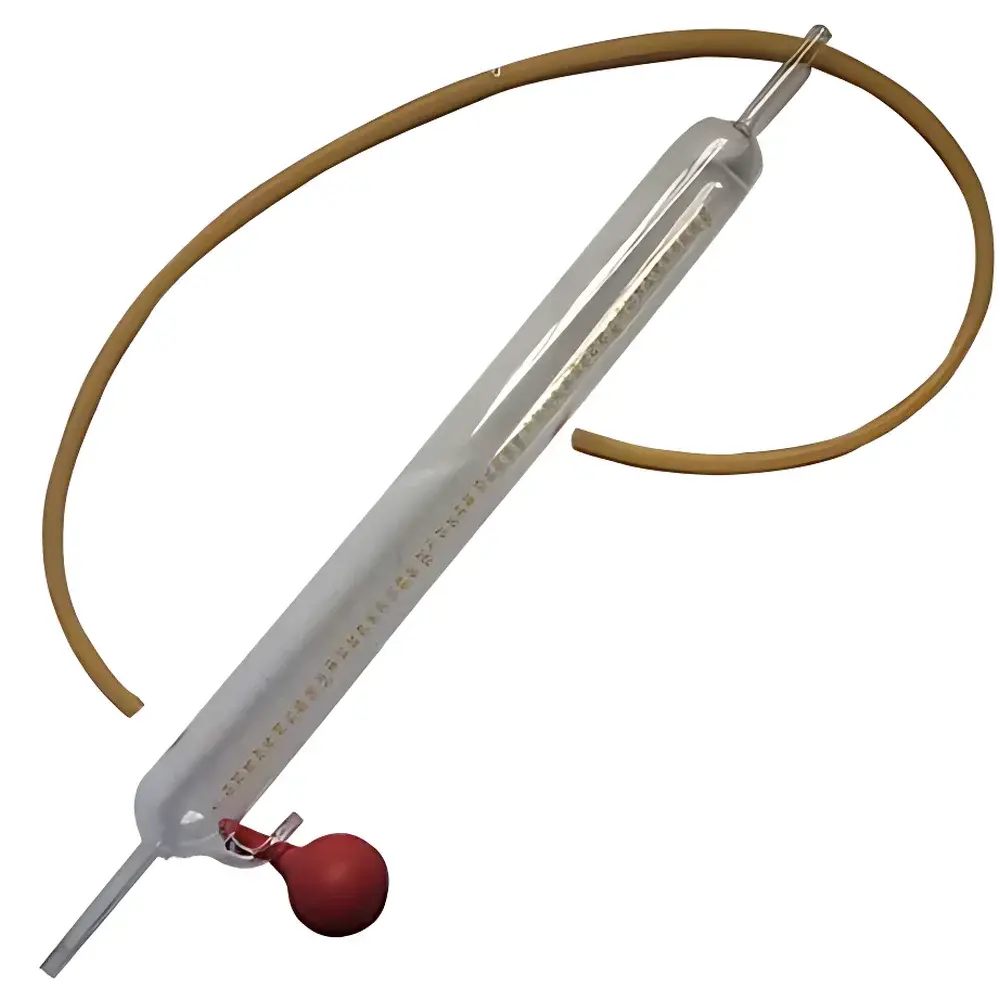
Beifen Sanpu 500 mL Volumetric Glass Soap Film Flowmeter
| Brand | Beifen Sanpu |
|---|---|
| Origin | Hebei, China |
| Manufacturer Type | Manufacturer |
| Origin Category | Domestic (China) |
| Model | 500 mL |
| Product Type | Positive Displacement Flowmeter |
| Price Range | USD 0.15 – 720 (FOB) |
| Volume Calibration | 500 mL ±0.5% (gravimetrically verified) |
| Operating Pressure Range | ≤10 kPa (gauge) |
| Temperature Range | 15–30 °C (ambient, uncorrected) |
| Resolution | 0.1 s (with digital stopwatch) |
| Material | Borosilicate glass (DIN ISO 3585), PTFE-sealed inlet/outlet ports |
| Compliance | ASTM D6196-22 Annex A2 (for low-flow gas calibration), ISO 4064-2:2014 (volumetric flowmeter verification principles), GB/T 28296-2012 (Chinese standard for soap film flowmeters) |
Overview
The Beifen Sanpu 500 mL Volumetric Glass Soap Film Flowmeter is a primary-standard, gravimetrically calibrated instrument designed for high-accuracy measurement of low-rate gas flows in laboratory and calibration environments. It operates on the fundamental principle of positive displacement volumetric timing: a soap film—generated at the inlet via a squeezable glycerol-based surfactant bulb—is propelled upward through a vertically oriented, solvent-etched borosilicate glass tube by differential pressure across the device. The film traverses a precisely engraved scale corresponding to a nominal 500 mL volume; elapsed time between two defined scale marks is measured using a traceable digital stopwatch. Gas volume flow rate (in mL/min or L/min) is calculated as V / t, where V is the calibrated volume interval and t is the measured transit time. When combined with concurrent measurements of gas temperature (via calibrated Pt100 probe) and absolute pressure (via digital barometer), the instrument supports calculation of standardized volumetric flow (e.g., SLPM at 25 °C, 101.325 kPa) and, with known gas composition, mass flow (mg/min) per ISO 6145-2 and ASTM E2654. Its near-zero pressure drop (<0.2 kPa at 500 mL/min N₂), minimal wall adhesion, and negligible film inertia enable reproducible measurements down to 10 mL/min with typical uncertainty ≤±0.8% (k=2), making it suitable for calibrating mass flow controllers (MFCs), validating environmental air samplers, and verifying low-flow gas delivery systems.
Key Features
- High-purity borosilicate glass tube (Schott Duran® equivalent), chemically resistant and thermally stable (−20 °C to +120 °C short-term)
- Optically clear, laser-etched scale with dual calibration marks defining the 500 mL measuring interval; scale certified per ISO/IEC 17025-accredited gravimetric procedure
- Ergonomic PTFE-sealed inlet/outlet ports with 6 mm OD tubing compatibility and leak-tight compression fittings
- Integrated surfactant reservoir with medical-grade silicone bulb for consistent, repeatable film generation without carryover or residue
- No electronics, no power supply required — intrinsically safe for use in explosion-hazardous zones (ATEX Zone 0 compatible when used with non-sparking tools)
- Modular design allows rapid cleaning, sterilization (autoclavable up to 121 °C, 20 min), and field recalibration verification
Sample Compatibility & Compliance
This flowmeter is validated for clean, dry, non-corrosive, non-particulate gases including nitrogen, oxygen, argon, helium, synthetic air, and CO₂ at ambient conditions. It is not recommended for vapors, aerosols, or gases containing condensables, oils, or reactive species (e.g., Cl₂, NH₃, H₂S). All glass components comply with DIN ISO 3585 for laboratory glassware dimensional stability and thermal shock resistance. Calibration traceability is maintained to NIM (National Institute of Metrology, China) standards, with optional UKAS-accredited calibration certificate available upon request. The device satisfies functional requirements outlined in EPA Method TO-11A (air sampling flow verification), ISO 12103-1 (test dust generator calibration), and USP Analytical Instrument Qualification for Class A volumetric reference standards.
Software & Data Management
As a manual, analog primary standard, this flowmeter does not incorporate embedded firmware or data logging. However, it integrates seamlessly into GLP/GMP-compliant workflows via external digital instrumentation: time measurement is performed using NIST-traceable stopwatches (e.g., OHAUS SF400, resolution 0.01 s); temperature and pressure inputs are captured via calibrated sensors interfaced with spreadsheet-based or LIMS-hosted calculation templates. Optional Excel-based correction calculator (provided with purchase) applies ideal gas law corrections and reports expanded uncertainty (k=2) per GUM (JCGM 100:2008). Audit trails, calibration records, and operator logs are maintained manually per 21 CFR Part 11 Annex A guidelines when used in regulated environments.
Applications
- Calibration and verification of low-flow gas meters, MFCs, and environmental air samplers (e.g., SKC, Gilian, Thermo Fisher models)
- Flow validation in gas chromatography carrier gas lines and purge-and-trap systems
- Method development and QC for ASTM D5197, ISO 16000-22, and EN 13670-2 indoor air quality monitoring protocols
- Research-scale gas evolution studies (e.g., microbial respiration, electrochemical gas production)
- Educational demonstration of fluid mechanics principles: laminar flow, surface tension effects, and volumetric vs. mass flow relationships
- Field-deployable reference standard for mobile emission testing laboratories requiring portable primary calibration
FAQ
What is the maximum allowable operating pressure for this flowmeter?
Maximum gauge pressure is 10 kPa. Exceeding this may cause film rupture or inaccurate transit times due to turbulent flow onset.
Can I use distilled water instead of the supplied surfactant solution?
No. Distilled water lacks sufficient surface tension reduction and film stability. Only glycerol–detergent formulations meeting ISO 4064-2 Annex B specifications ensure reproducible film formation and linear ascent.
How often should the flowmeter be recalibrated?
Annual gravimetric recalibration is recommended. More frequent verification (e.g., quarterly) is advised if used daily in critical applications or after mechanical shock or thermal cycling.
Is the 500 mL volume nominal or actual?
The 500 mL interval is actual volume, verified gravimetrically against NIM-certified weights with uncertainty ≤±0.25 mL (k=2) at 20 °C.
Does this model support temperature and pressure compensation out-of-the-box?
No. Compensation requires external measurement of T and P and manual or spreadsheet-based application of the ideal gas law. An optional integrated T&P sensor module is available as a separate accessory (Model: BF-SF500-TP).