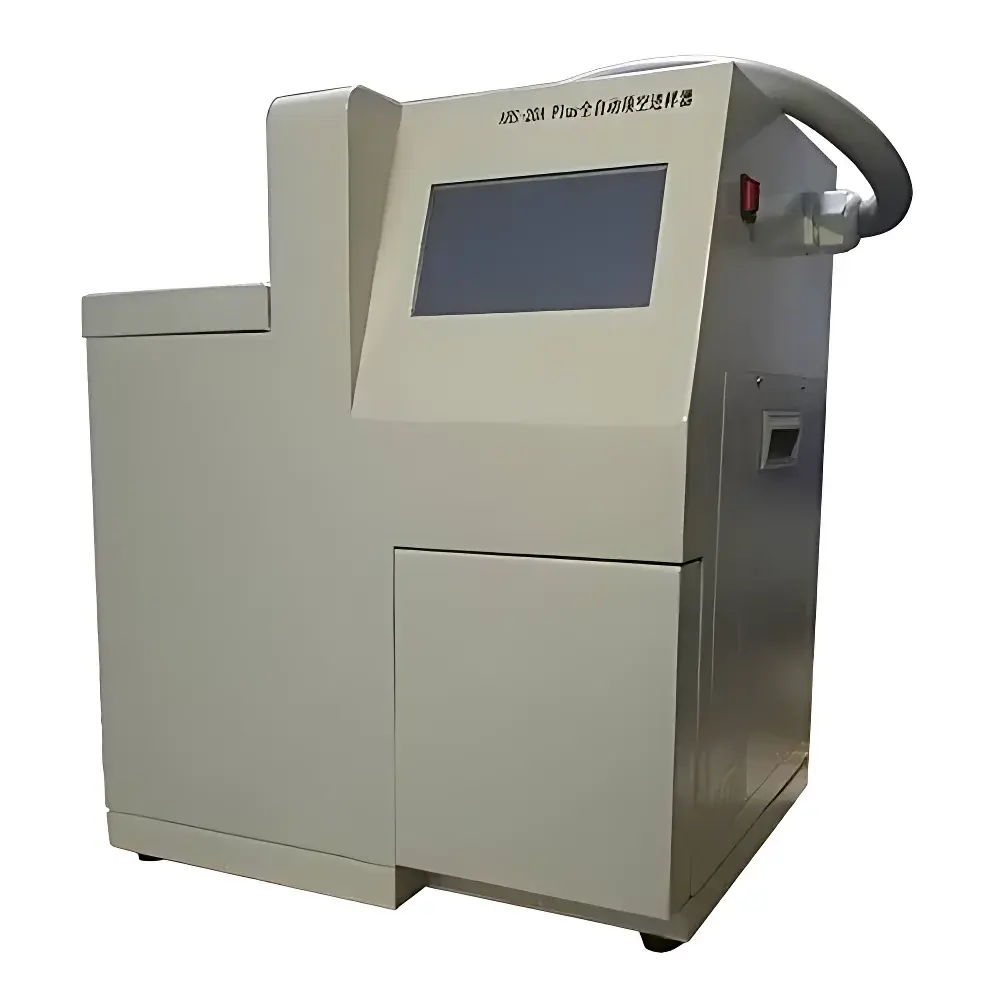
Beifen Sanpu AHSB-20A Plus Fully Automated Headspace Sampler
| [Brand | Beifen Sanpu |
|---|---|
| Origin | Beijing, China |
| Manufacturer Type | Original Equipment Manufacturer (OEM) |
| Product Category | Domestic Instrument |
| Model | AHSB-20A Plus |
| Sample Capacity | 20 positions |
| Vial Size Compatibility | 10 mL or 20 mL (customizable up to 100 mL) |
| Quantitative Loop Volume | 1 mL (optional: 0.5 / 2 / 5 mL) |
| Sample Heating Range | 40–220 °C (expandable to 300 °C) |
| Valve & Transfer Line Heating Range | 40–220 °C (expandable to 300 °C) |
| Temperature Accuracy | ±0.5 °C |
| Temperature Stability | < ±0.5 °C |
| Pressure Control Range | 0–0.25 MPa (continuously adjustable) |
| Pressurization Time | 0–999 s |
| Sampling Time | 0–30 min |
| Injection Time | 0–999 s |
| Bake-out/Clean Time | 0–30 min |
| Minimum Time Resolution | 1 ms |
| Carrier Gas Flow Control | 0–100 mL/min (EPC optional) |
| RSD | < 1.0% (measured on 100 ppm ethanol in water) |
| Interface | USB communication with PC |
| Compliance | Designed for GLP/GMP environments |
Overview
The Beifen Sanpu AHSB-20A Plus Fully Automated Headspace Sampler is an engineered solution for reproducible, high-throughput volatile organic compound (VOC) analysis in gas chromatography (GC) workflows. It operates on the principle of equilibrium headspace sampling—where a sealed sample vial is heated to promote partitioning of analytes from the liquid or solid matrix into the vapor phase above it. Following thermal equilibration, the instrument applies precise positive pressure to transfer a representative portion of the headspace gas through a thermostatted transfer line and quantitative loop into the GC injector. This method eliminates matrix interference, reduces column contamination, and enhances detection sensitivity for trace-level volatiles—including residual solvents, environmental contaminants, flavor compounds, and pharmaceutical impurities.
Key Features
- 20-position autosampler carousel with automatic vial recognition and collision-avoidance logic—ensures robust unattended operation across multi-day sequences.
- Triple-zone independent temperature control: sample incubation oven, six-port valve housing, and transfer line—all maintained within ±0.5 °C stability to prevent condensation and ensure analyte integrity.
- Positive-pressure sampling architecture eliminates reliance on external drive gases (e.g., nitrogen or air), reducing infrastructure requirements and improving lab safety.
- High-inertness fluidic path: de-activated fused-silica capillary tubing and electropolished stainless-steel components minimize adsorption, carryover, and cross-contamination—critical for low-concentration quantitation.
- Optimized flow geometry: low-dead-volume six-port valve coupled with in-oven valve placement eliminates cold spots and preserves volatile fraction fidelity during transfer.
- Real-time system diagnostics: power-on self-test, positional encoder feedback, fault-tolerant motion control, and hardware-level error logging support regulatory compliance and troubleshooting efficiency.
- Flexible operational modes: single-vial repeated injections, single-shot per vial, or multi-vial sequential analysis—all programmable via intuitive 7-inch graphical LCD or PC-based configuration software.
Sample Compatibility & Compliance
The AHSB-20A Plus accommodates standard 10 mL and 20 mL crimp-top headspace vials, with mechanical adaptability for custom formats (e.g., 50 mL or 100 mL). It accepts both liquid and solid matrices—including aqueous solutions, polymers, soils, food homogenates, and pharmaceutical tablets—without derivatization or extraction. Temperature programming supports method development per ASTM D7699 (standard practice for headspace analysis), ISO 11843-2 (detection limits), and USP (residual solvents). When interfaced with 21 CFR Part 11–compliant chromatography data systems (CDS), the device supports electronic signatures, audit trails, and user-access controls required under GLP and GMP frameworks.
Software & Data Management
Instrument parameters—including heating profiles, pressurization duration, sampling volume, loop fill time, and purge cycles—are fully configurable via USB-connected PC software or local touchscreen interface. All settings are timestamped and stored with version metadata. Synchronization signals enable precise triggering of GC oven ramp initiation, detector acquisition start, and CDS data capture—ensuring temporal alignment between sampling event and chromatographic response. Exportable log files include runtime diagnostics, thermal history, and motion-event timestamps—facilitating root-cause analysis during validation or audit preparation.
Applications
- Pharmaceutical quality control: residual solvent testing per ICH Q3C guidelines.
- Environmental monitoring: VOCs in water, soil, and waste leachates per EPA Method 502.2 and 8260D.
- Food & beverage safety: ethanol, acetaldehyde, and off-flavor compounds in wines, dairy, and packaged goods.
- Polymer and packaging analysis: extractables and leachables from medical devices and drug delivery systems.
- Clinical toxicology: blood alcohol quantification and volatile metabolite profiling.
FAQ
What vial sizes does the AHSB-20A Plus support?
Standard configurations accommodate 10 mL and 20 mL headspace vials; custom trays for 50 mL and 100 mL formats are available upon request.
Can the system be integrated with third-party GC instruments?
Yes—it provides TTL-level trigger outputs and accepts external start signals, ensuring seamless interoperability with Agilent, Thermo Fisher, Shimadzu, PerkinElmer, and other major GC platforms.
Is EPC (Electronic Pressure Control) included as standard?
EPC is an optional upgrade; base configuration uses precision mechanical pressure regulators with 0–0.25 MPa continuous adjustment.
How is carryover minimized between samples?
The system performs programmable bake-out cycles using heated transfer lines and inert gas purging at up to 100 mL/min, validated to achieve <0.1% carryover for target analytes like benzene and chloroform.
Does the instrument support audit-trail functionality for regulated labs?
While the sampler itself does not store audit logs internally, its deterministic command protocol and timestamped parameter export enable full traceability when paired with compliant CDS software meeting 21 CFR Part 11 requirements.