
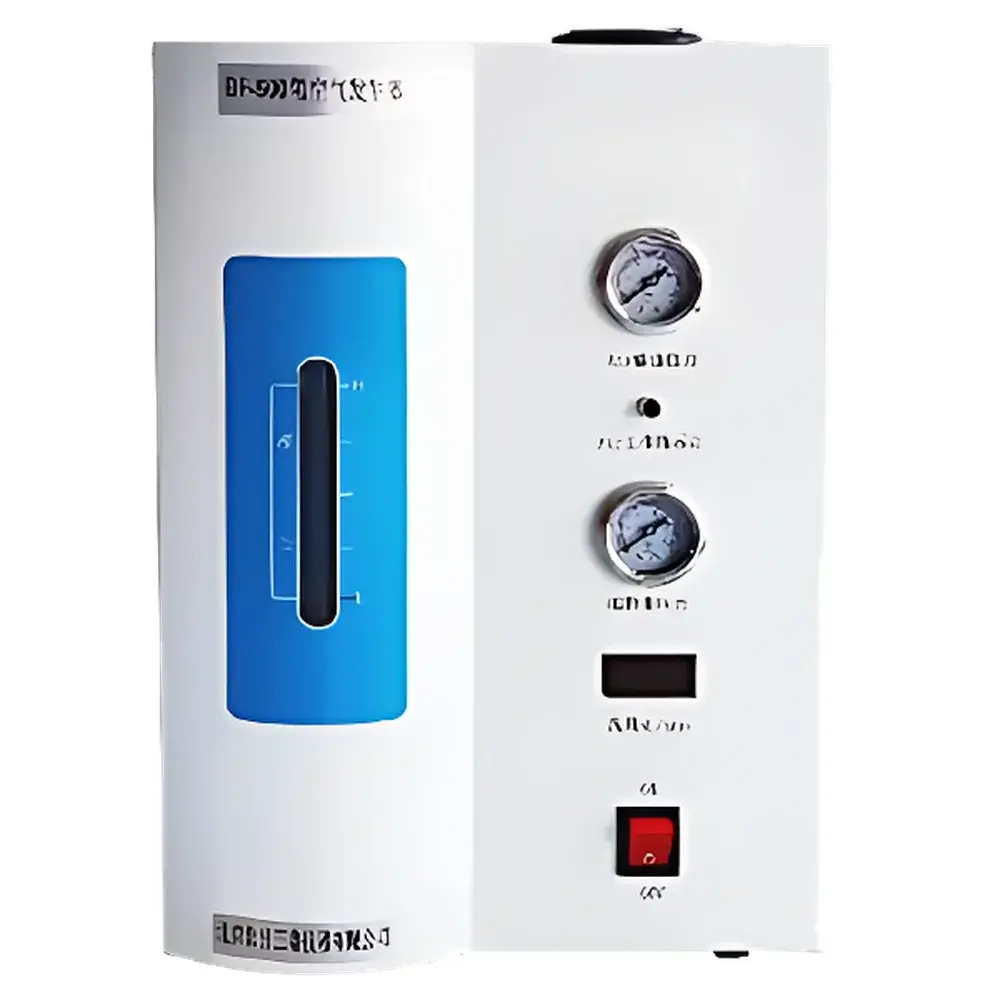
Beifen Sanpu BF-500 Hydrogen & Air Integrated Gas Generator
| Brand | Beifen Sanpu |
|---|---|
| Origin | Beijing, China |
| Manufacturer Type | Direct Manufacturer |
| Model | BF-500 |
| Hydrogen Purity | 99.999% (O₂ < 1 ppm) |
| Hydrogen Flow Range | 0–500 mL/min |
| Hydrogen Working Pressure | 0.4 MPa (adjustable, factory-set) |
| Air Flow Range | 0–5 L/min |
| Air Pressure | 0.4 MPa |
| Air Filtration | Oil-free, 3-stage purification (particulate, hydrocarbon, moisture) |
| Output Stability | ≤ ±0.01 MPa |
| Power Supply | AC 220 V, 50 Hz |
| Power Consumption | 280 W |
| Operating Temperature | 0–40 °C |
| Relative Humidity | <85% RH (non-condensing) |
| Dimensions (L×W×H) | 520 × 280 × 400 mm |
| Net Weight | 42 kg |
| Electrolyte | KOH aqueous solution (160 g in 400 mL distilled water, total reservoir volume 1.6 L) |
| Water Refill Requirement | Distilled water only |
| Safety Features | Non-return liquid trap, over-pressure cutoff, electrolyte level sensor, thermal protection, auto-shutdown on leak or dry-run |
Overview
The Beifen Sanpu BF-500 Hydrogen & Air Integrated Gas Generator is an engineered solution for laboratories requiring reliable, on-demand hydrogen and compressed air supplies for gas chromatography (GC) and related analytical instrumentation. Unlike conventional high-pressure gas cylinders, this dual-output generator produces ultra-high-purity hydrogen (99.999%, O₂ < 1 ppm) via alkaline electrolysis of deionized water and oil-free, multi-stage purified air via a sealed rotary vane compressor and integrated filtration system. Its design conforms to the operational demands of modern GC systems—particularly flame ionization detectors (FID), thermal conductivity detectors (TCD), and nitrogen-phosphorus detectors (NPD)—where consistent flow, stable pressure, and trace-level contaminant control are critical for baseline stability, retention time reproducibility, and method robustness. The BF-500 eliminates cylinder logistics, safety hazards associated with pressurized H₂ storage, and variability introduced by cylinder-to-cylinder purity drift.
Key Features
- Integrated dual-gas architecture: Simultaneous or independent operation of hydrogen and air modules—no cross-contamination or performance compromise.
- High-efficiency alkaline electrolysis cell: Tower-type electrolytic stack with large electrode surface area, low operating temperature (< 60 °C), and integrated oxygen venting ensures long-term H₂ purity stability and minimal maintenance.
- Hydrogen output monitoring: LED digital display indicates real-time electrolysis current-derived flow (±10% indicative accuracy); actual delivered flow remains stable due to internal buffer and pressure-regulated delivery.
- Oil-free air generation: Three-stage purification (pre-filter, activated carbon, desiccant silica gel) removes particulates, hydrocarbons, and moisture; dual-stage pressure regulation maintains precise 0.4 MPa output across variable demand.
- Fail-safe engineering: Non-return liquid traps prevent electrolyte backflow into GC lines; automatic shutdown triggers on low electrolyte level, over-temperature, over-pressure, or open-circuit conditions.
- Low operational burden: Requires only periodic distilled water top-up (no KOH replenishment); full electrolyte replacement recommended every 6–7 months under continuous operation (~1000 h).
- Compact benchtop footprint: 520 × 280 × 400 mm unit fits standard lab workspaces; 42 kg mass enables stable placement without anchoring.
Sample Compatibility & Compliance
The BF-500 is compatible with all major GC platforms—including Agilent, Thermo Fisher Scientific, Shimadzu, PerkinElmer, and国产 OEM systems—that accept 0.4 MPa inlet pressure and standard 1/8″ or 3 mm OD stainless steel or PTFE tubing connections. Its hydrogen output meets ASTM D6300 and ISO 8573-1 Class 1 (for particles) and Class 2 (for water and oil) requirements when operated per manufacturer instructions. Air purity complies with USP specifications for instrument air used in regulated analytical environments. While not intrinsically rated for hazardous locations, the unit incorporates UL/IEC 61010-1 certified electrical isolation, reinforced insulation, and grounding continuity—supporting GLP/GMP-aligned lab infrastructure where documented gas sourcing is required.
Software & Data Management
The BF-500 operates as a standalone hardware device with no embedded firmware, network interface, or data logging capability—consistent with ISO/IEC 17025 Clause 5.5.2 requirements for validated, deterministic gas supply systems. All operational parameters (pressure, flow indication, status LEDs) are locally observable; no software installation, calibration certificates, or audit trails are generated. This design minimizes cybersecurity exposure, avoids version-control dependencies, and simplifies qualification (IQ/OQ/PQ) in regulated settings. Users maintain full traceability via logbook entries recording water refill dates, electrolyte changes, silica gel replacements (indicated by ≥66% color shift), and activated carbon service intervals (every ~1000 h). Documentation includes a factory test report verifying initial pressure stability and purity compliance.
Applications
- Carrier and fuel gas for GC-FID analysis of volatile organic compounds (VOCs), petrochemical fractions, and environmental samples.
- Make-up gas for GC-MS interfaces and electron capture detectors (ECD).
- Combustion support gas in TCD and NPD configurations requiring high thermal conductivity and inertness.
- On-site air supply for pneumatic actuators, sample dilution manifolds, and purge-and-trap systems.
- Research labs transitioning from cylinder-based to sustainable, low-risk gas provisioning without compromising method equivalence.
FAQ
What is the expected service life of the electrolysis cell?
Under normal use (≤8 h/day, distilled water maintained at mid-level), the tower-type cell typically exceeds 5,000 operating hours before measurable efficiency decline. No user-serviceable parts require replacement within the first 3 years.
Can the BF-500 be used with GC systems requiring >0.4 MPa inlet pressure?
No. The unit’s fixed pressure regulation is non-adjustable; it must be paired with GC inlets rated for ≤0.4 MPa. External pressure boosters are not recommended due to risk of destabilizing flow control and voiding safety certifications.
How often must the activated carbon filter be replaced?
Every 1,000 operating hours—or sooner if air output exhibits odor or elevated hydrocarbon baseline in GC-FID—as confirmed by routine system suitability testing.
Is the hydrogen flow reading digitally calibrated?
No. The LED display reflects electrolysis current scaled to approximate flow (mL/min); it serves as a diagnostic aid only. Actual flow is pressure-regulated and verified during PQ using a certified wet-test meter.
What happens if tap water is accidentally added to the electrolyte reservoir?
Immediate shutdown and complete electrolyte replacement are mandatory. Tap water introduces Ca²⁺/Mg²⁺ ions that precipitate as carbonates/hydroxides, causing cell fouling, reduced efficiency, and irreversible damage to the nickel-plated electrodes.



