
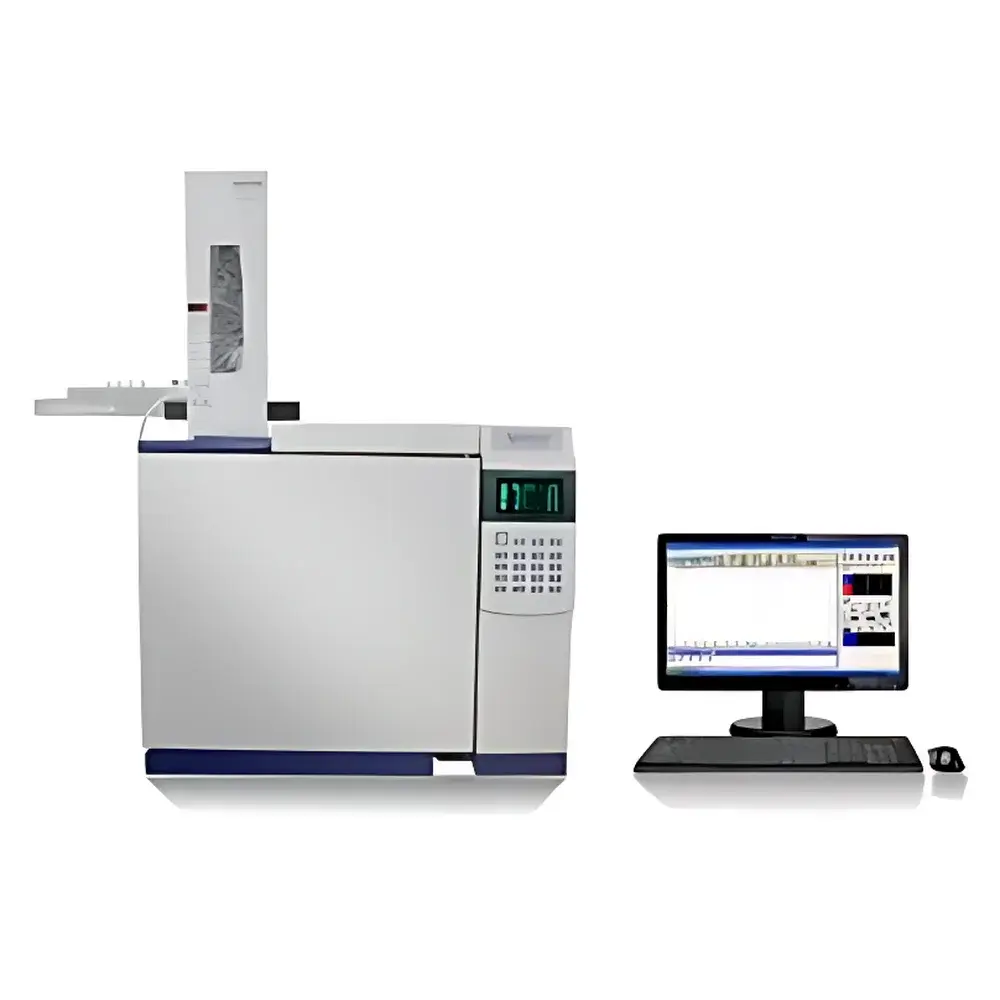
Beifen Sanpu GC-9860-IV-1 Laboratory Gas Chromatograph with ECD for Pentachlorophenol (PCP) and Sodium Pentachlorophenolate Residue Analysis in Aquatic Products
| Brand | Beifen Sanpu |
|---|---|
| Origin | Beijing, China |
| Manufacturer Type | Direct Manufacturer |
| Regional Classification | Domestic (China) |
| Model | GC-9860-IV-1 |
| Instrument Type | Laboratory Gas Chromatograph |
| Application Field | Environmental & Food Safety Testing |
| Oven Temperature Range | 450 °C |
| Maximum Ramp Rate | 80 °C/min |
| Maximum Cooling Rate | 40 °C/min |
| Carrier Gas Flow Range & Control | 0–1200 mL/min |
| Carrier Gas Pressure Range & Control | 0–970 kPa |
| Injector Maximum Temperature | 450 °C |
| Injector Pressure Setting Range | 0–970 kPa |
| Injector Total Flow Setting Range | 0.4–1200 mL/min |
Overview
The Beifen Sanpu GC-9860-IV-1 is a high-stability laboratory gas chromatograph engineered for the quantitative determination of pentachlorophenol (PCP) and its sodium salt residues in aquatic food matrices—such as fish, shrimp, mollusks, and processed seafood products. It operates on the principle of capillary gas chromatography coupled with electron capture detection (GC-ECD), a method widely recognized for its exceptional sensitivity and selectivity toward halogenated organic compounds. PCP—a persistent, bioaccumulative, and toxic (PBT) biocide—has been restricted globally due to its endocrine-disrupting potential, hepatorenal toxicity, and thermal formation of dioxin congeners during incineration. This instrument meets the analytical requirements of SC/T 3030–2006, the Chinese national standard specifying GC-based quantification of PCP and sodium pentachlorophenolate in aquatic products at detection limits ≤0.1 µg/kg (on a matrix-matched calibration basis). Its robust thermal management system, precision pressure/flow control, and ECD-compatible architecture ensure reproducible retention time stability (<0.02 min RSD, n=10) and peak area repeatability (<1.5% RSD) under regulated environmental testing workflows.
Key Features
- Programmable oven with ultra-fast heating (up to 80 °C/min) and active cooling (40 °C/min), enabling rapid method development and high-throughput analysis of complex aquatic tissue extracts.
- Dual independent pressure/flow-controlled inlet system supporting split, splitless, and cold-on-column injection modes—critical for trace-level PCP analysis where sample integrity and solvent focusing are essential.
- High-temperature injector (max 450 °C) and detector (ECD, 300 °C) compatible with derivatized and underivatized PCP analysis, accommodating both direct injection and silylation-based sample preparation protocols.
- Integrated carrier gas (N₂) control module with digital pressure regulation (0–970 kPa) and mass flow sensing (0.4–1200 mL/min), ensuring compliance with ISO/IEC 17025 method validation requirements for gas delivery uncertainty.
- Modular detector bay supporting future upgrades to GC-MS or tandem ECD configurations without hardware replacement.
Sample Compatibility & Compliance
The GC-9860-IV-1 is validated for use with aqueous and lipid-rich aquatic matrices following SC/T 3030–2006 extraction procedures—including acetonitrile partitioning, gel permeation chromatography (GPC) cleanup, and solid-phase extraction (SPE) using C18 or Florisil cartridges. It supports compliance with multiple regulatory frameworks: GB/T 22808–2008 (leather), GB/T 25002–2010 (paper), LY/T 1985–2011 (wood), and SN/T 2204–2008 (food contact materials). Instrument performance adheres to GLP principles, with full audit trail capability for temperature setpoints, flow parameters, and run sequences. Data acquisition software supports 21 CFR Part 11-compliant electronic signatures and user access control when deployed in accredited testing laboratories.
Software & Data Management
The system is operated via Beifen Sanpu’s ChromaVision Pro v3.2 workstation—designed for chromatographic data acquisition, integration, calibration curve generation (linear, quadratic, or weighted), and report export in PDF, CSV, and XML formats. Peak identification is supported by retention time locking (RTL) against certified PCP reference standards (e.g., AccuStandard P-027), and the software includes built-in tools for signal-to-noise ratio calculation, limit of detection (LOD) estimation per ICH Q2(R2), and system suitability assessment (tailing factor, resolution, and plate count). All raw data files are stored in vendor-neutral .cdf format for long-term archival and third-party reprocessing.
Applications
- Quantitative residue monitoring of PCP and sodium pentachlorophenolate in farmed and wild-caught seafood for domestic market compliance and export certification (EU Regulation EC No. 396/2005, US FDA Import Alert 15-05).
- Method transfer and verification studies in contract testing laboratories performing routine surveillance under China’s National Food Safety Risk Monitoring Program.
- Research applications investigating PCP metabolism pathways in aquatic organisms and evaluating degradation kinetics in aquaculture sediments.
- Support for regulatory enforcement testing by provincial CDCs and AQSIQ-accredited inspection agencies conducting border control screening of imported seafood.
FAQ
What detection limit can be achieved for PCP in fish muscle using this system?
Under optimized SC/T 3030–2006 conditions—including 10 g homogenized sample, 50 mL acetonitrile extraction, and 1 µL splitless injection—the typical method detection limit (MDL) is 0.08 µg/kg (ppb) on a wet-weight basis.
Is derivatization required prior to GC-ECD analysis?
Derivatization (e.g., with diazomethane or BSTFA) is optional but recommended for improved peak shape and sensitivity when analyzing highly polar or acidic PCP metabolites; native PCP elutes reliably on 35% phenyl polysiloxane columns without derivatization.
Can this instrument comply with ISO/IEC 17025 accreditation requirements?
Yes—when configured with calibrated temperature sensors, flow meters, and traceable reference standards, the GC-9860-IV-1 supports full uncertainty budgeting and satisfies clause 7.7 (Equipment) and clause 7.8 (Traceability) of ISO/IEC 17025:2017.
What column specifications are recommended for PCP analysis?
A 30 m × 0.25 mm ID × 0.25 µm fused-silica capillary column coated with 35% diphenyl / 65% dimethyl polysiloxane (e.g., DB-17ms or equivalent) is specified in SC/T 3030–2006 and provides optimal resolution of PCP from co-extracted lipids and sterols.
Does the system support automated sample introduction?
The GC-9860-IV-1 is compatible with Beifen Sanpu’s AS-3020 autosampler (optional), enabling unattended analysis of up to 120 samples per sequence with programmable vial agitation and syringe wash cycles.
Related Products




