
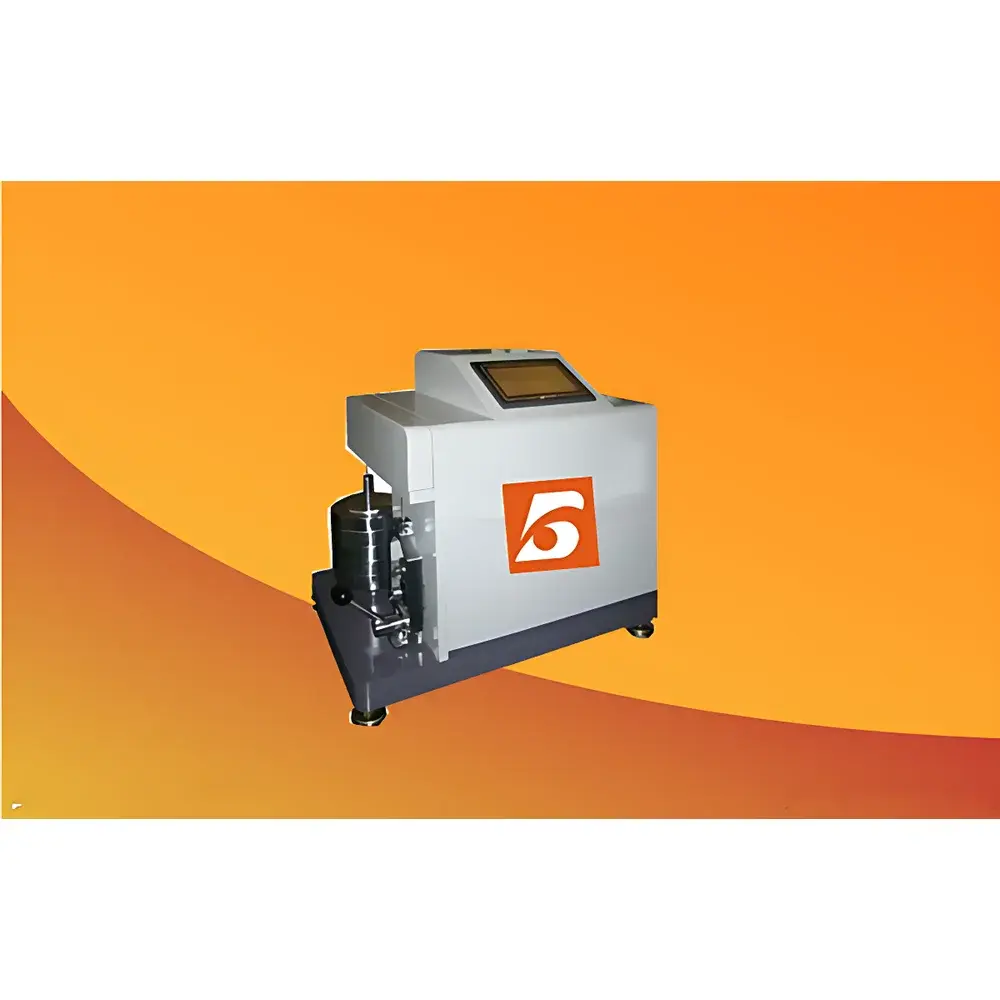
Beiguang Jingyi M-2000 Plastic Wear and Friction Tester
| Brand | Beiguang Jingyi / All Precision Instrument |
|---|---|
| Origin | Beijing, China |
| Manufacturer Type | Direct Manufacturer |
| Country of Origin | China |
| Model | M-2000 |
| Price Range | USD 1,400 – 7,000 (FOB) |
| Specimen Dimensions | 30 mm × 7 mm × 6 mm |
| Rotational Speed | 0–200 rpm (adjustable, ±5% accuracy) |
| Normal Load | 196 N ±0.1% (extendable to 392 N) |
| Counterface Ring | Ø40 mm × 10 mm, 0.5×45° chamfer, concentricity deviation <0.01 mm |
| Ring Material | 45# steel, quenched & tempered, HRC 40–45, surface roughness Ra ≤1.6 µm |
| Friction Torque Range | 0–4 N·m |
| Standard Weights | One 4 kg mass + four 1 kg masses (stackable) |
Overview
The Beiguang Jingyi M-2000 Plastic Wear and Friction Tester is a precision-engineered tribological instrument designed for quantitative evaluation of sliding friction behavior and wear resistance in polymeric materials under controlled load, speed, and environmental conditions. It operates on the principle of pin-on-ring (or block-on-ring) sliding contact geometry, where a rectangular plastic specimen is pressed axially against a rotating hardened steel ring. The system measures real-time friction torque while enabling post-test assessment of mass loss or wear scar geometry—key metrics for predicting service life, evaluating lubricant efficacy, and validating material formulations in packaging, automotive interior, medical device, and consumer goods applications. Compliant with core methodology standards including ASTM D3702, ISO 8295, and GB/T 3960, the M-2000 delivers repeatable, traceable data suitable for R&D validation, QC release testing, and regulatory submission dossiers.
Key Features
- High-stability rotational drive system with digital speed control (0–200 rpm), maintaining speed accuracy within ±5% across full range
- Precision loading mechanism delivering calibrated normal force of 196 N (20 kgf) ±0.1%, extendable to 392 N (40 kgf) via modular weight stack
- Hardened 45# steel counterface ring (Ø40 × 10 mm) with certified hardness (HRC 40–45), surface finish ≤Ra 1.6 µm, and geometric tolerance <0.01 mm concentricity
- Integrated torque transducer with 0–4 N·m range and linear output for direct coefficient of friction (COF) derivation
- Dual-mode wear quantification: gravimetric (mass loss measured on 0.1 mg analytical balance) and geometric (wear track width measurement using calipers with ±0.02 mm resolution)
- Thermostatically regulated test environment (23 ±5 °C, 50 ±10% RH per GB/T 2918) with optional oil-bath thermal management for elevated temperature studies
- Zero-drift compensated sensor architecture requiring dual-point zeroing (initial + 5-min stabilization) to eliminate thermal and mechanical stress artifacts
Sample Compatibility & Compliance
The M-2000 accommodates rigid and semi-crystalline thermoplastics (e.g., PP, PE, PET, PS, ABS, PC) and thermosets used in packaging films, closures, blister trays, and laminated structures. Specimens must be dimensionally stable (30 × 7 × 6 mm), free of voids, delamination, or surface defects, and conditioned per GB/T 2918 (23 ±5 °C / 50 ±10% RH) prior to testing. The instrument supports both static upper specimen and rotating lower ring configurations, ensuring unidirectional sliding kinematics essential for COF reproducibility. Data acquisition complies with GLP documentation requirements: all test parameters—including load setpoint, rotational speed, duration (2 h standard), ambient temperature, and operator ID—are manually logged per run. While not natively 21 CFR Part 11 compliant, raw torque and time data are exportable for integration into validated LIMS or ELN platforms supporting audit trails.
Software & Data Management
The M-2000 operates via dedicated embedded controller with analog signal conditioning and digital display interface—no proprietary software installation required. Real-time friction torque is recorded on chart paper (included) with manual annotation of start/stop times and load application events. Post-test calculations follow standardized equations defined in GB/T 3960: coefficient of friction µ = M / (F × R), where M is stabilized torque (N·m), F is normal load (N), and R is ring radius (0.02 m); volumetric wear rate is derived from mass loss (m₁ − m₂), density (ρ), and contact geometry. All raw measurements (mass, dimensions, torque) are documented in laboratory notebooks meeting ISO/IEC 17025 record retention guidelines. For automated reporting, users may digitize chart traces or integrate external DAQ systems via 0–10 V analog output.
Applications
- Quantifying static and kinetic COF of packaging films (e.g., heat-seal layers, slip additives in PE pouches)
- Evaluating abrasion resistance of polymer-based food contact surfaces (e.g., conveyor belts, filling nozzles)
- Screening anti-wear additives in engineering plastics for pharmaceutical blister packaging
- Comparative wear mapping of biodegradable polymers (PLA, PHA) under simulated shelf-life conditions
- Supporting ASTM F88 seal strength correlation studies where interfacial friction influences peel initiation
- Validating surface modification techniques (plasma treatment, corona discharge) via pre/post-treatment COF shifts
FAQ
What is the maximum allowable wear scar diameter for the counterface ring before replacement?
The ring must be discarded when its outer diameter falls below 36 mm. Arbitration testing requires strict use of Ø40 mm rings per GB/T 3960.
Can the M-2000 perform tests at elevated temperatures?
Yes—when equipped with optional oil bath and PID-controlled heater (not included), it supports testing up to 150 °C, provided operating temperature remains ≥40 °C below the flash point of the thermal medium.
Is calibration certification provided with shipment?
Each unit ships with factory calibration report for load cell and speed encoder, traceable to CNAS-accredited standards. Annual recalibration is recommended per ISO/IEC 17025.
How is compliance with ISO 8295 ensured during operation?
By adhering to specified specimen geometry, surface preparation (solvent cleaning with ethanol/acetone), 2-hour test duration, and environmental conditioning—parameters directly aligned with Clause 6 of ISO 8295:2017.
What maintenance intervals are recommended for long-term accuracy?
Weekly inspection of ring surface integrity and weight calibration; monthly cleaning of guide rods and load train with solvent (no lubricants); quarterly verification of concentricity and torque zero stability.
Related Products





