
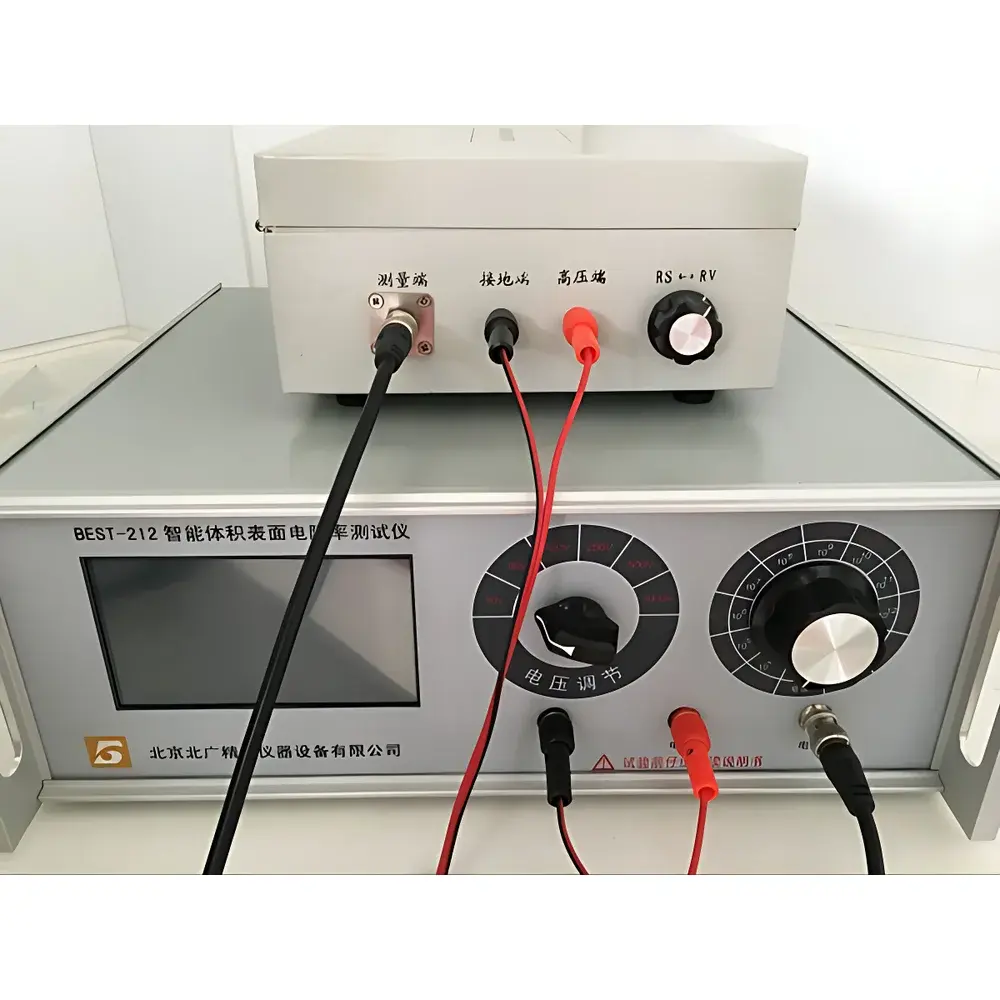
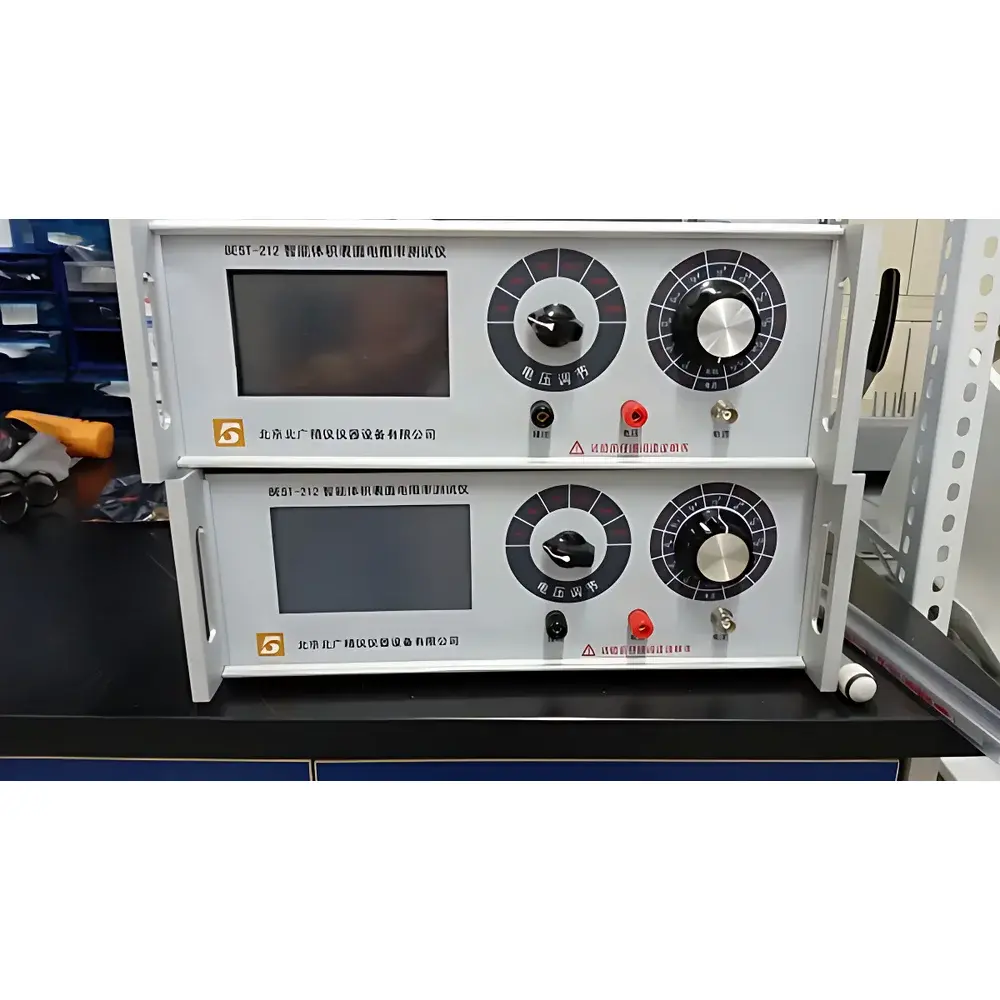
Beiguang Jingyi BGJY-212 High-Resistance Resistivity Tester for Insulating Coatings
| Brand | Beiguang Jingyi (All Precision Instrument) |
|---|---|
| Origin | Beijing, China |
| Manufacturer Type | Direct Manufacturer |
| Product Category | Domestic |
| Model | BGJY-212 |
| Resistance Range | 1×10⁴ Ω to 1×10¹⁸ Ω |
| Current Range | 2×10⁻⁴ A to 1×10⁻¹⁶ A |
| Test Voltages | DC 10 V, 50 V, 100 V, 250 V, 500 V, 1000 V |
| Accuracy | ±10% (for R ≤ 1×10¹² Ω), ±20% (for R > 1×10¹² Ω) |
| Compliance | GB/T 1410-2006, ASTM D257-99, GB/T 10581-2006, GB/T 1692-2008, GB/T 2439-2001, GB/T 12703.4-2010, GB/T 10064-2006 |
Overview
The Beiguang Jingyi BGJY-212 High-Resistance Resistivity Tester is a precision instrument engineered for the quantitative evaluation of volume and surface resistivity in solid and liquid insulating materials—including insulating varnishes, coatings, elastomers, plastics, rubbers, and thin-film dielectrics. It operates on the principle of direct-current (DC) high-resistance measurement using guarded three-electrode configuration, enabling accurate separation of bulk conduction from surface leakage paths. The system applies calibrated DC test voltages across standardized electrode geometries and measures resulting current with femtoampere-level sensitivity, allowing calculation of resistivity (ρ, in Ω·m) per ISO/IEC 60093 and ASTM D257 methodologies. Designed for laboratory-based quality control and R&D applications, the BGJY-212 supports traceable, repeatable measurements under controlled environmental conditions (23 ± 2 °C, 60–70 % RH), aligning with GLP-compliant testing workflows.
Key Features
- Large-format color touchscreen interface with dual digital display: simultaneous real-time readout of resistance (Ω) and current (A)
- Seven selectable resistance ranges (10²–10⁹ Ω full-scale), each optimized for ±10% or ±20% accuracy per IEC 60093 tolerance classes
- Programmable DC test voltage selection (10 V, 50 V, 100 V, 250 V, 500 V, 1000 V) to accommodate material-specific polarization and breakdown thresholds
- Integrated guard circuitry to minimize surface leakage errors—critical for high-resistivity (>10¹² Ω) samples
- Compact benchtop form factor (W × D × H: 320 × 280 × 150 mm), lightweight (<4.5 kg), and ESD-safe enclosure
- No manual scaling required: all readings displayed directly in Ω or Ω·m after electrode geometry and sample thickness input
- Stable zero-drift performance (<4% full-scale/hour), validated per GB/T 10064-2006 calibration requirements
Sample Compatibility & Compliance
The BGJY-212 is validated for use with rigid solids (e.g., cured insulating films, laminates, ceramics), flexible polymers (e.g., silicone rubber sheets, PVC tapes), and low-viscosity liquids (e.g., plasticizers, solvent-borne varnishes). Electrode configurations include concentric ring electrodes (diameter 120 mm, guard gap 2 mm, outer electrode 146 mm) per GB/T 1410-2006 and ASTM D257-99 specifications. All measurements comply with international standards governing electrical insulation characterization, including ISO 3915 (resistivity of conductive plastics), IEC 62631-3-1 (dielectric properties), and USP (electrical resistance of pharmaceutical packaging materials). For regulatory submissions, the instrument supports manual audit trails; optional firmware upgrade enables 21 CFR Part 11-compliant electronic signatures and data integrity features.
Software & Data Management
While the BGJY-212 operates as a standalone unit with embedded firmware, it includes RS-232 and USB-B interfaces for ASCII-formatted data export to external PCs. Measurement logs contain timestamp, test voltage, range setting, raw resistance/current values, calculated resistivity, operator ID, and environmental metadata (if connected to optional温湿度 sensor). Exported CSV files are compatible with Excel, MATLAB, and LIMS platforms. Firmware updates preserve calibration coefficients and support user-defined electrode geometry presets. All internal memory retains ≥1,000 test records with overwrite protection. For laboratories requiring full traceability, third-party software integration (e.g., LabWare LIMS, Thermo Fisher SampleManager) is supported via HL7 or ASTM E1384 messaging protocols.
Applications
- Quality assurance of insulating varnishes used in motor windings, transformer coils, and printed circuit board conformal coatings
- Evaluation of antistatic additives in polymeric packaging films and cleanroom flooring materials (per GB/T 12703.4-2010)
- Research into charge transport mechanisms in novel dielectric composites and nanofilled elastomers
- Validation of high-purity solvent systems for semiconductor wafer cleaning processes
- Measurement of volume resistivity in liquid plasticizers per GB/T 10581-2006 and ASTM D257 Annex A3
- Baseline characterization of reference materials for interlaboratory proficiency testing programs
FAQ
What electrode configuration is required for volume resistivity testing of insulating varnish films?
Standardized three-terminal electrodes per GB/T 1410-2006 must be used: a 120 mm diameter guarded measuring electrode, 8 mm guard ring width, and 2 mm gap between measuring and high-voltage electrodes. Film thickness must be uniform and measured independently (e.g., micrometer).
Does the BGJY-212 meet FDA requirements for pharmaceutical packaging validation?
Yes—the instrument’s measurement uncertainty, calibration traceability to NIM (National Institute of Metrology, China), and documented SOP compliance enable use in USP and ISO 11607-1 testing. Full 21 CFR Part 11 functionality requires optional software license.
Can this instrument measure surface resistivity of non-planar samples?
Surface resistivity measurements require flat, parallel surfaces for defined electrode contact area. Curved or irregular geometries necessitate custom electrode fixtures; contact resistance artifacts must be evaluated per ASTM D257 Section 7.3.
How often does the instrument require recalibration?
Annual calibration against certified high-resistance standards (e.g., IET Labs SR1012 series) is recommended. Internal zero-check and gain verification should be performed before each test session per GB/T 10064-2006 Section 4.1f.
Is temperature compensation available for resistivity calculations?
No built-in temperature sensor is included; however, the firmware allows manual entry of ambient temperature (°C) and relative humidity (%) to annotate reports. For temperature-dependent studies, external climate chamber integration is advised.



