
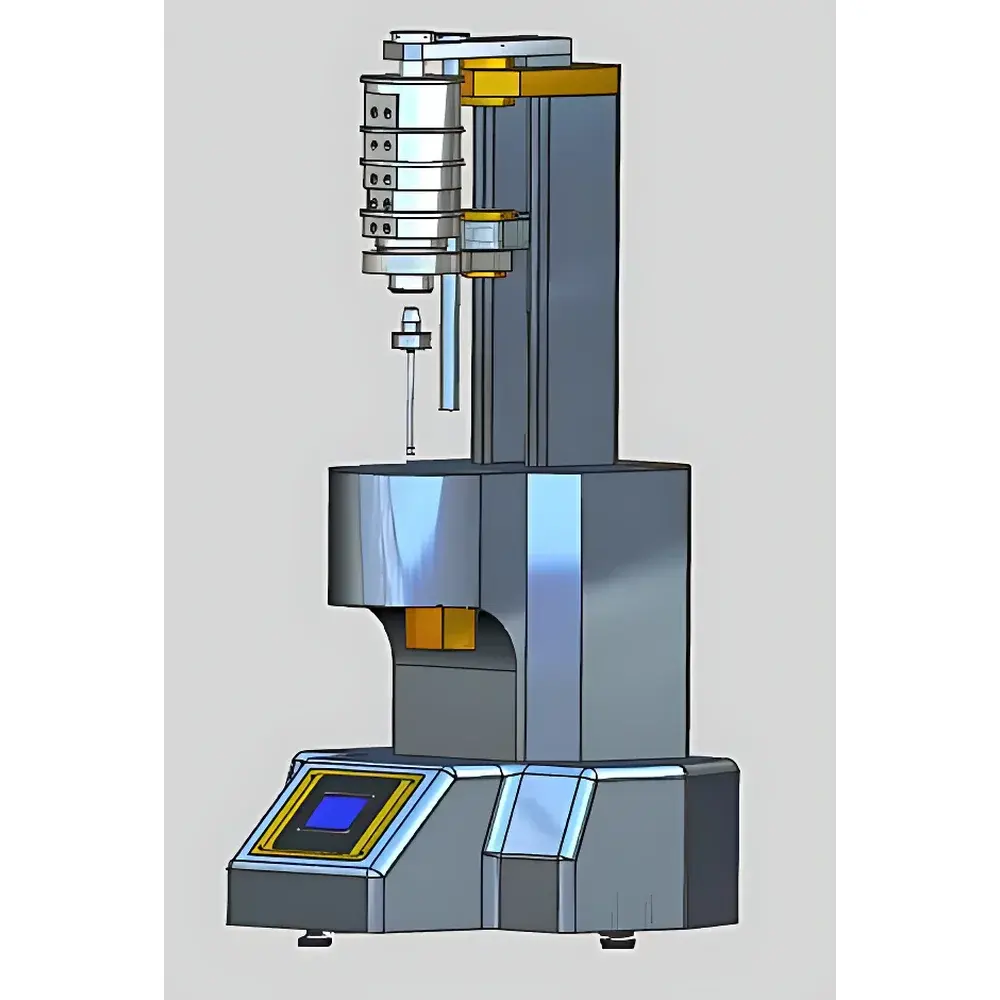
Beiguang Jingyi BMT-3001 Automatic Blaine Specific Surface Area Analyzer
| Brand | Beiguang Jingyi / All Precision Instrument |
|---|---|
| Origin | Beijing, China |
| Manufacturer Type | Direct Manufacturer |
| Product Origin | Domestic (China) |
| Model | BMT-3001 |
| Price | USD 1,700 (FOB Beijing) |
| Power Supply | 220 V AC, 50 Hz |
| Timing Range | 0.1–999.9 s |
| Timing Accuracy | < 0.2 s |
| Measurement Accuracy | ≤ 0.1% (relative error) |
| Temperature Range | 8–34 °C |
| Measurable Surface Area | 0.1–9999.9 cm²/g |
| Permeability Cell Diameter | 12.7 ± 0.05 mm |
| Bed Height | 15 ± 0.5 mm |
| Perforated Plate | 35 holes, Ø1.0 mm, thickness 1.0 ± 0.1 mm |
| Weight | ~6 kg |
| Dimensions (W×D×H) | 320 × 100 × 460 mm |
Overview
The Beiguang Jingyi BMT-3001 Automatic Blaine Specific Surface Area Analyzer is a precision instrument engineered for the quantitative determination of specific surface area (SSA) of fine powders using the air permeability principle—specifically, the Blaine method as standardized in GB/T 8074–2008 (equivalent to ISO 9277 and ASTM C204). It operates on the fundamental relationship between the resistance to airflow through a compacted powder bed and the specific surface area of the material. By measuring the time required for a fixed volume of air to pass through a standardized bed of known porosity, thickness, and geometry under constant pressure differential, the instrument calculates SSA via the Blaine equation. This gravimetric–pneumatic approach delivers high reproducibility for routine quality control in cement, ceramics, metallurgical powders, coal, pharmaceutical excipients, and food-grade particulates. The system integrates digital temperature compensation, automated timing, real-time water-level monitoring, and self-calibrating pneumatic actuation—eliminating manual stopwatch dependency and operator-induced variability.
Key Features
- Fully automated measurement cycle: automatic pump activation, electromagnetic valve control, dual-photoelectric liquid-level detection, and integrated thermal compensation.
- Dual-mode operation: supports both standard Blaine calibration (using GSB14-1511 certified reference material) and user-defined K-value input for material-specific calibration.
- High-precision pneumatic architecture: 12.7 mm internal-diameter permeability cell with 35 precisely drilled Ø1.0 mm orifices in a 1.0 mm thick stainless steel perforated plate ensures consistent flow geometry and minimal edge effects.
- Real-time environmental monitoring: built-in temperature sensor (8–34 °C operational range) dynamically corrects viscosity and density inputs per ISO 9277 Annex A.
- Robust mechanical design: compact footprint (320 × 100 × 460 mm), lightweight aluminum housing (~6 kg), and sealed electromagnetic pump (<15 VA power draw) ensure lab stability and low energy consumption.
- Intuitive keypad interface with LED display: dedicated [K Value], [S Value], [Reset/Measure], and [Check] functions enable rapid parameter configuration, multi-trial validation, and outlier rejection per ASTM C204 Section 7.3.
Sample Compatibility & Compliance
The BMT-3001 is validated for use with dry, non-cohesive, free-flowing powders exhibiting particle sizes predominantly below 100 µm—ideal for Portland cement clinker, fly ash, silica fume, alumina abrasives, activated carbon, and metal atomized powders. Sample preparation follows strict Blaine protocol: controlled compaction to achieve uniform void fraction (ε ≈ 0.500 ± 0.005), precise bed height (15 ± 0.5 mm), and moisture-free conditioning. The instrument complies with national and international regulatory frameworks including GB/T 8074–2008, ISO 9277:2010 (Gas adsorption and gas permeation methods), ASTM C204–22 (Standard Test Methods for Fineness of Hydraulic Cement by Air-Permeability Apparatus), and EN 196-6:2018. Its deterministic pneumatic measurement principle supports GLP-compliant documentation when paired with external lab notebooks; while not natively 21 CFR Part 11 compliant, audit trails can be maintained via timestamped manual logs aligned with instrument output sequences.
Software & Data Management
The BMT-3001 operates via embedded firmware without external PC dependency—ensuring reliability in environments with limited IT infrastructure. All measurements are stored in volatile memory with immediate on-screen display of elapsed time, ambient temperature, and calculated SSA (cm²/g). Up to three sequential trials are retained for statistical evaluation; discrepancies exceeding ±1.0 s between replicate runs trigger manual retest prompts. Data export is performed manually via visual transcription or optional RS-232 interface (available upon request) for integration into LIMS or Excel-based QA databases. Calibration records—including K-value verification using GSB14-1511 reference material—must be archived per ISO/IEC 17025 Clause 7.7 to support traceability and inter-laboratory comparability.
Applications
- Cement manufacturing: QC of fineness in OPC, slag cement, and blended cements per ASTM C150 and EN 197-1.
- Mineral processing: surface area assessment of ground limestone, talc, and barite for rheology and reactivity prediction.
- Advanced materials R&D: correlation of SSA with sintering behavior in ceramic green bodies and additive manufacturing feedstocks.
- Environmental testing: quantification of reactive surface in fly ash and bottom ash for leaching potential modeling.
- Pharmaceutical preformulation: screening of micronized APIs where dissolution rate is surface-area-limited (per USP ).
FAQ
What standards does the BMT-3001 comply with?
It conforms to GB/T 8074–2008, ISO 9277:2010, ASTM C204–22, and EN 196-6:2018 for air-permeability-based specific surface area measurement.
Can it measure materials other than cement?
Yes—provided the sample is dry, non-fibrous, and forms a stable, uniformly porous bed (e.g., coal, ceramics, metals, food powders); validation against reference materials is recommended for non-cement applications.
How is calibration performed?
Using certified GSB14-1511 standard reference material; the instrument guides users through K-value determination and stores the result for subsequent S-value calculations.
Is temperature compensation automatic?
Yes—the integrated sensor measures ambient temperature in real time and applies corrections to air viscosity and density per ISO 9277 Annex A.
What maintenance is required?
Routine cleaning of the permeability cell and perforated plate with dry compressed air; annual verification of photoelectric switch alignment and pump performance is advised.
Related Products





