
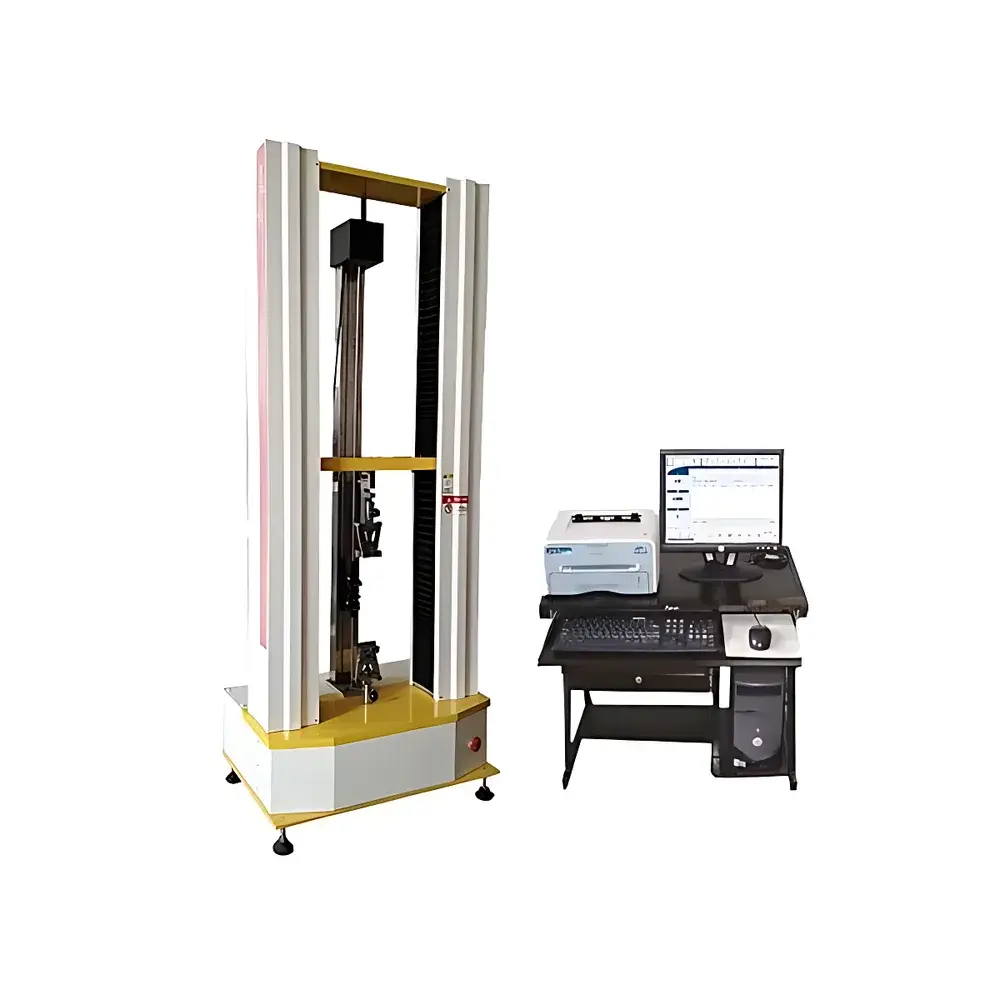
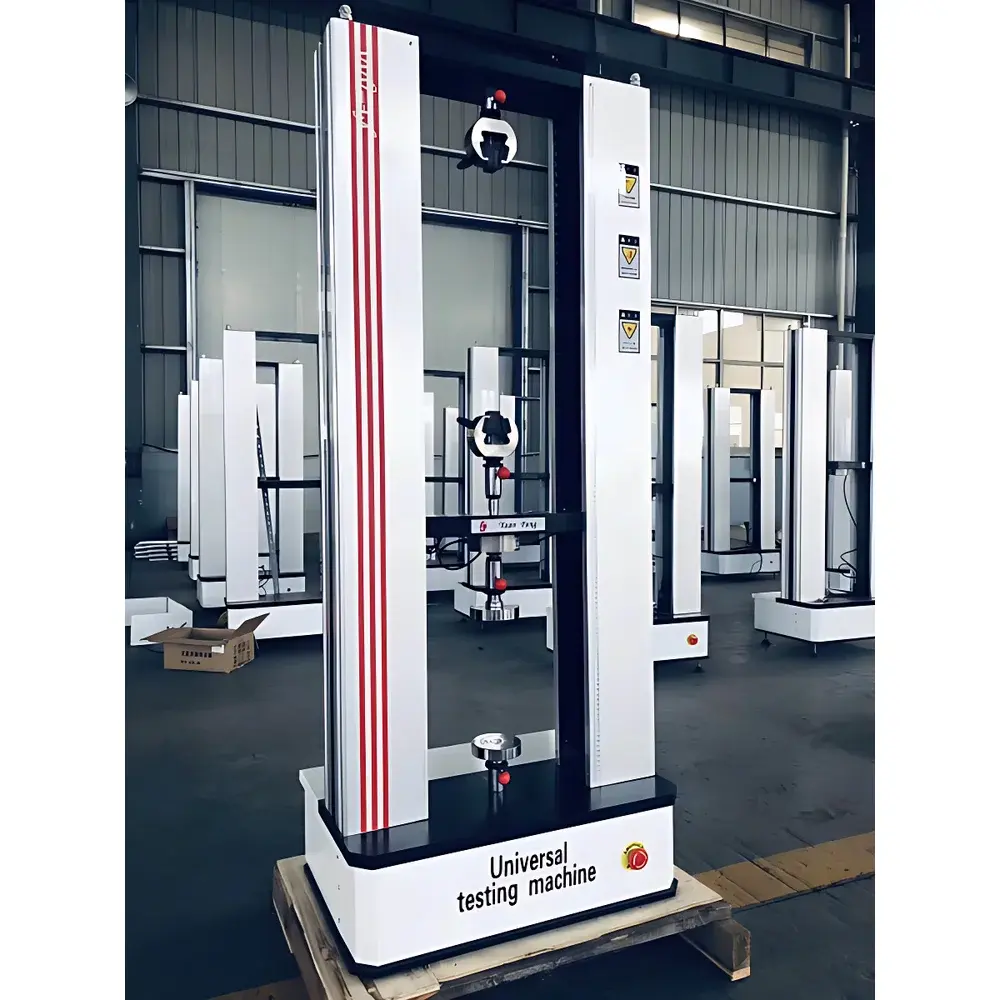
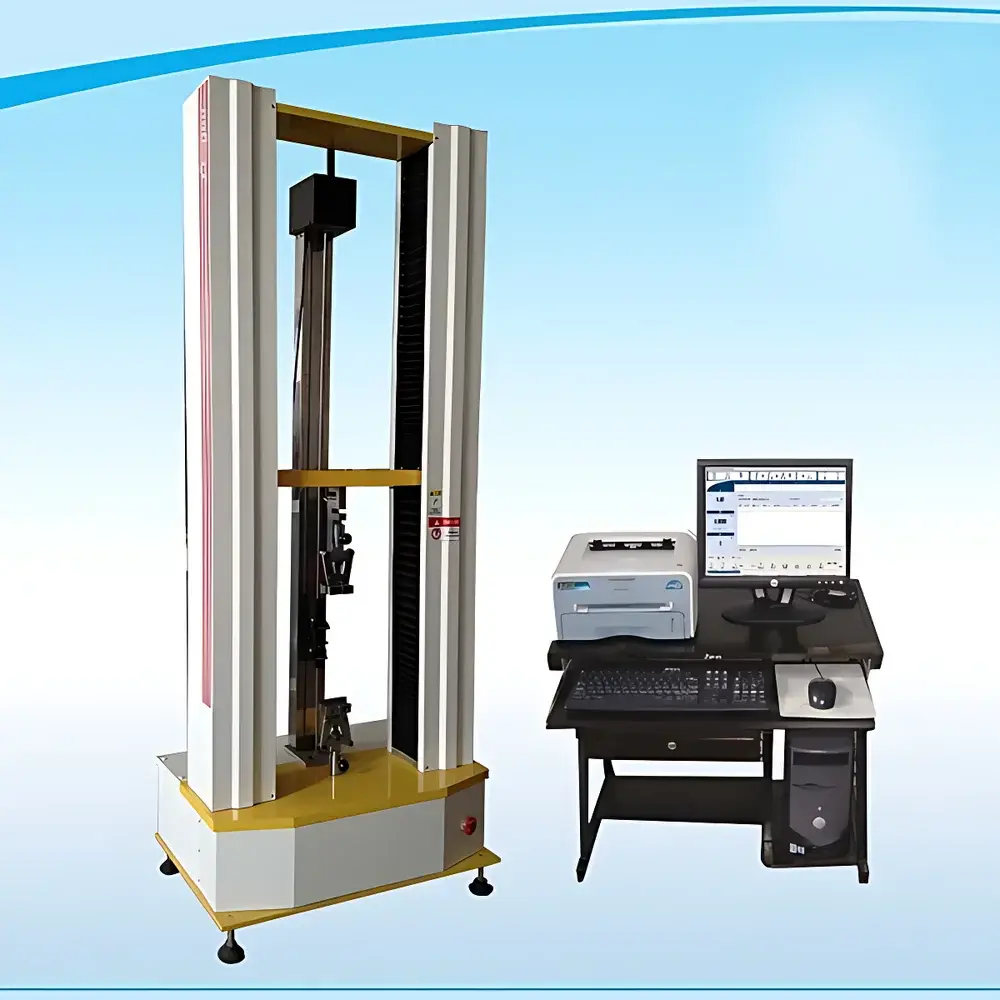
Beiguang Jingyi BWN Series Microcomputer-Controlled Electronic Tensile Testing Machine for Filament and Fine-Wire Materials
| Brand | Beiguang Jingyi / All Precision Instrument |
|---|---|
| Origin | Beijing, China |
| Manufacturer Type | Direct Manufacturer |
| Instrument Type | Electronic Tensile Testing Machine |
| Maximum Test Load | 600 kN |
| Load Measurement Range | Full Scale (FS) |
| Load Accuracy | ±1% of reading |
| Displacement Resolution | 0.01 mm |
| Displacement Measurement Accuracy | ±0.5% |
| Travel Range | 0–1000 mm (excluding fixtures) |
| Speed Range | 0.05–500 mm/min (infinitely variable) |
| Compliance Standards | ASTM D638, ISO 527, GB/T 1040, JIS K7113, DIN 53455 |
Overview
The Beiguang Jingyi BWN Series Microcomputer-Controlled Electronic Tensile Testing Machine is a precision-engineered system designed specifically for the mechanical characterization of fine-diameter linear materials—including synthetic filaments, monofilaments, textile yarns, medical sutures, fishing lines, and specialty metallic wires. It operates on the fundamental principle of uniaxial tensile loading, where controlled axial force is applied to a specimen at a defined strain rate while simultaneously measuring load, displacement, and extension. The machine employs a high-rigidity dual-column or single-arm structural frame, coupled with a precision-ground ball-screw actuation system and a closed-loop digital servo control architecture. This ensures stable force application, minimal compliance error, and high reproducibility across repeated tests—critical for quality assurance in R&D, production QA/QC, and third-party certification laboratories.
Key Features
- Full-range load measurement without manual range switching, maintaining constant resolution across 2–100% of full scale
- Digital servo motor control with real-time speed regulation (0.05–500 mm/min), enabling precise strain-rate-dependent testing per ISO 527-1 and ASTM D638
- High-accuracy load cell calibrated traceably to national standards; verification points at 20%, 40%, 60%, 80%, and 100% of rated capacity using Class III standard force transducers
- Optical encoder-based displacement measurement with 0.01 mm resolution and ±0.5% accuracy, independently verifiable using certified height gauges
- Integrated dual-stage protection: programmable software limits + mechanical overload stop (3–5% over full scale)
- Auto-return function to pre-test position post-fracture, minimizing operator intervention and improving throughput
- Real-time dynamic display of multiple synchronized curves: Load vs. Displacement, Load vs. Time, Stress vs. Strain, and Extension vs. Time
- Multi-sample batch testing with stored parameter templates, supporting standardized workflows for GLP-compliant environments
Sample Compatibility & Compliance
The BWN series accommodates a broad spectrum of filamentous and thin-section specimens through interchangeable grips—including pneumatic, wedge, and custom-designed clamp fixtures optimized for low-slippage engagement of smooth or coated surfaces. It supports standardized test geometries per ISO 20753 (plastics), ASTM D2256 (yarn tensile), and ISO 13934-1 (textile fabrics). All hardware and firmware are engineered to meet electromagnetic compatibility (EMC) requirements per IEC 61326-1 and safety standards per IEC 61010-1. Mechanical validation procedures align with ISO/IEC 17025 calibration guidelines, and software audit trails support FDA 21 CFR Part 11 readiness when deployed in regulated manufacturing settings.
Software & Data Management
The Windows-based testing software provides a fully interactive GUI compatible with Windows XP through Windows 10 (32/64-bit). It enables automatic calculation of key mechanical parameters—including tensile strength, elongation at break, modulus of elasticity, yield point, and secant modulus—according to user-selected test methods. Raw data and processed results are saved in native binary format with embedded metadata (operator ID, timestamp, environmental conditions, calibration status). Export options include CSV, Excel (.xlsx), and Word (.docx) reports with customizable templates. Curve overlay functionality allows comparative analysis of up to eight specimens within a single plot. All data acquisition, processing steps, and user actions are logged in an immutable audit trail—essential for GMP/GLP audits and ISO 9001 documentation requirements.
Applications
This instrument serves as a primary evaluation tool across diverse industrial and academic domains: polymer fiber development labs assessing melt-spinning process consistency; medical device manufacturers validating suture tensile integrity per USP and ISO 10993-1; aerospace suppliers verifying high-strength aramid or carbon tow performance; cable producers certifying conductor insulation adhesion and jacket tensile resilience; and packaging R&D teams evaluating seal strength and film puncture resistance. Its versatility extends to rubber compounds, elastomeric films, nonwovens, and composite prepregs—where controlled low-force, high-resolution displacement tracking is essential.
FAQ
What calibration standards does the system support?
The system supports traceable calibration per ISO 7500-1 (static force calibration) and ISO 9513 (extensometer calibration), using certified reference standards from national metrology institutes.
Can the software generate compliant audit trails for regulated environments?
Yes—the software records all user actions, parameter changes, test executions, and data exports in a tamper-evident log file, meeting baseline requirements for FDA 21 CFR Part 11 and EU Annex 11 compliance.
Is mechanical overload protection hardware-based or software-only?
Dual-layer protection is implemented: programmable electronic limit switches in the control loop, plus physical end-stop mechanisms integrated into the crosshead assembly.
How is displacement verified independently of the encoder system?
Displacement accuracy is validated using NIST-traceable digital height gauges during routine metrological verification, following procedures outlined in ISO 9513 Section 7.2.
Does the system support ASTM D3822 for single-filament tensile testing?
Yes—the grip geometry, speed control fidelity, and data sampling rate (≥100 Hz) fully satisfy the instrumentation requirements specified in ASTM D3822-22 for microfilament characterization.



