
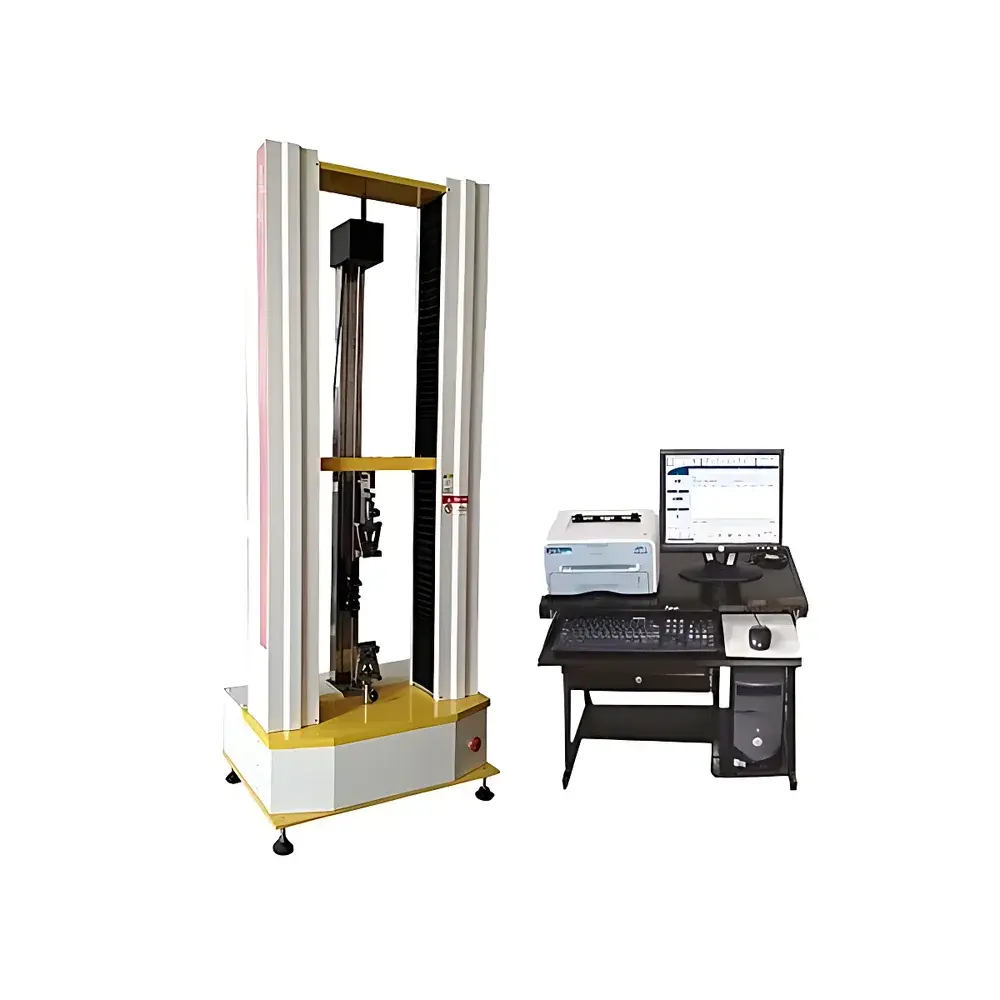
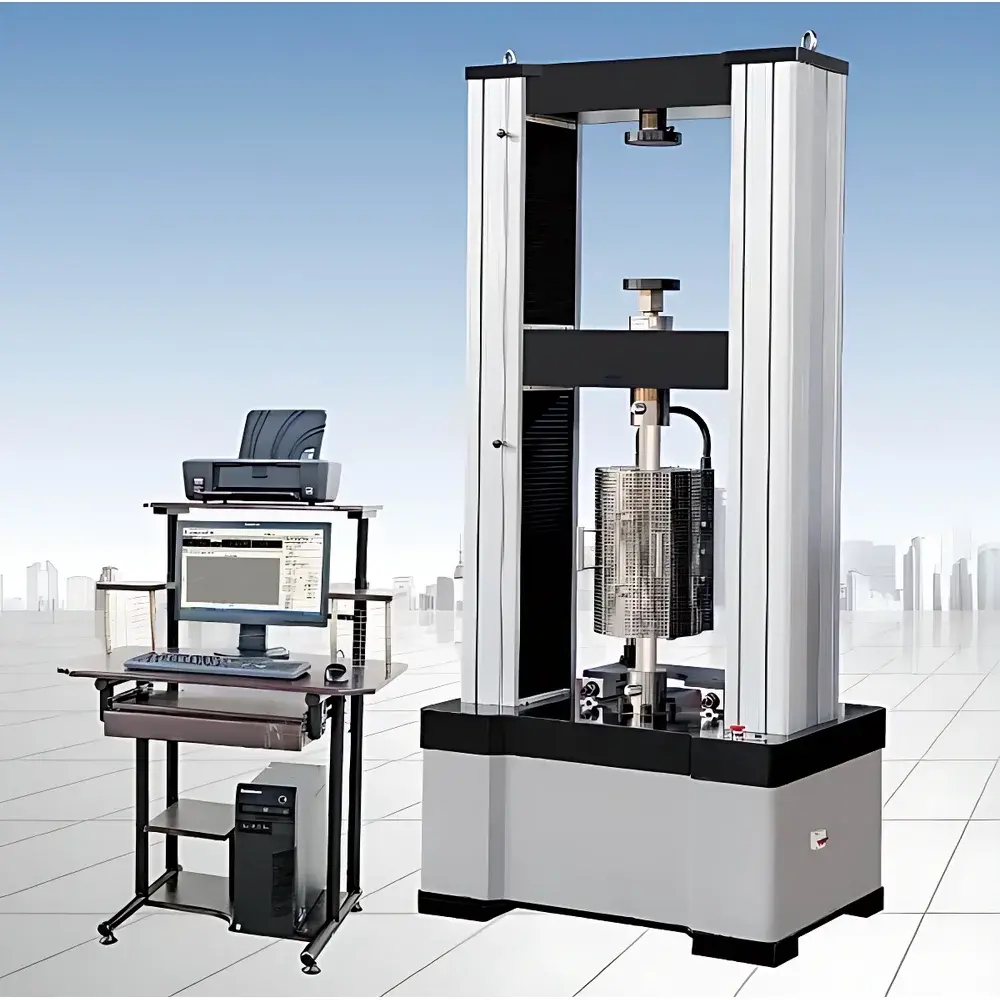
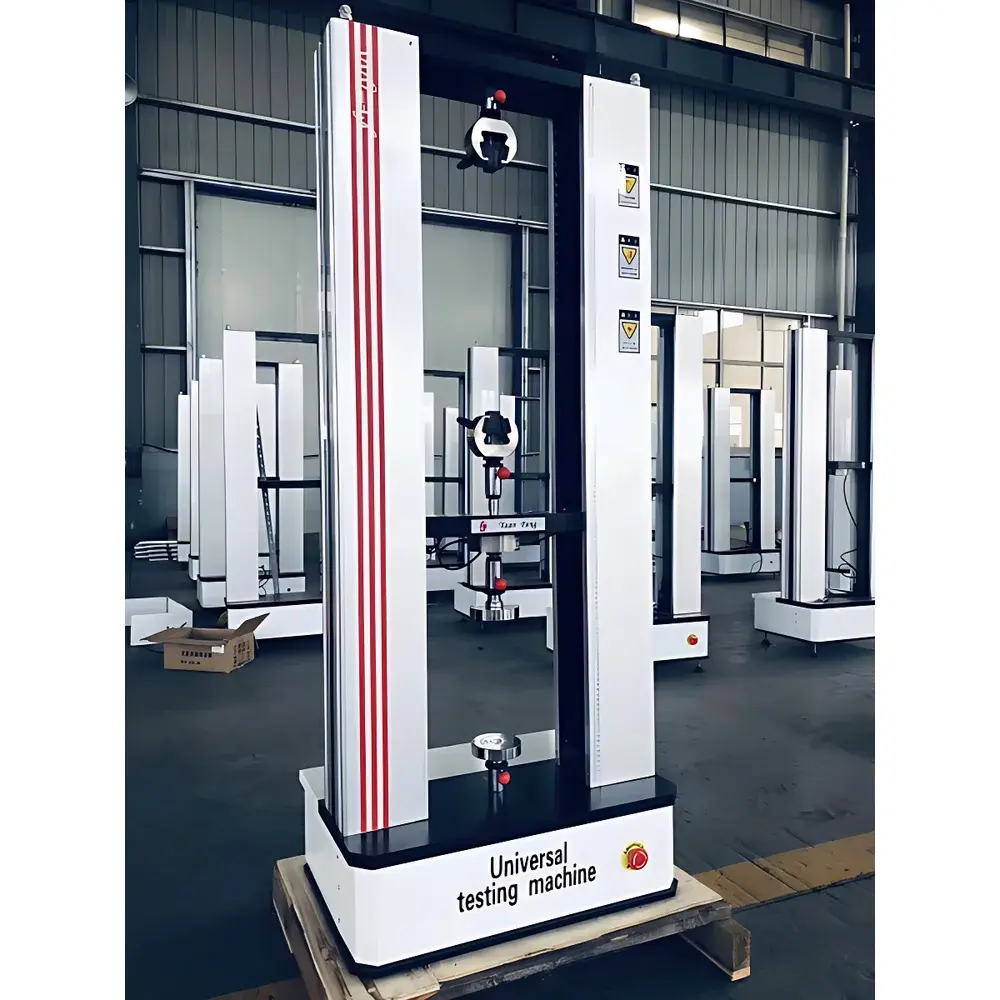
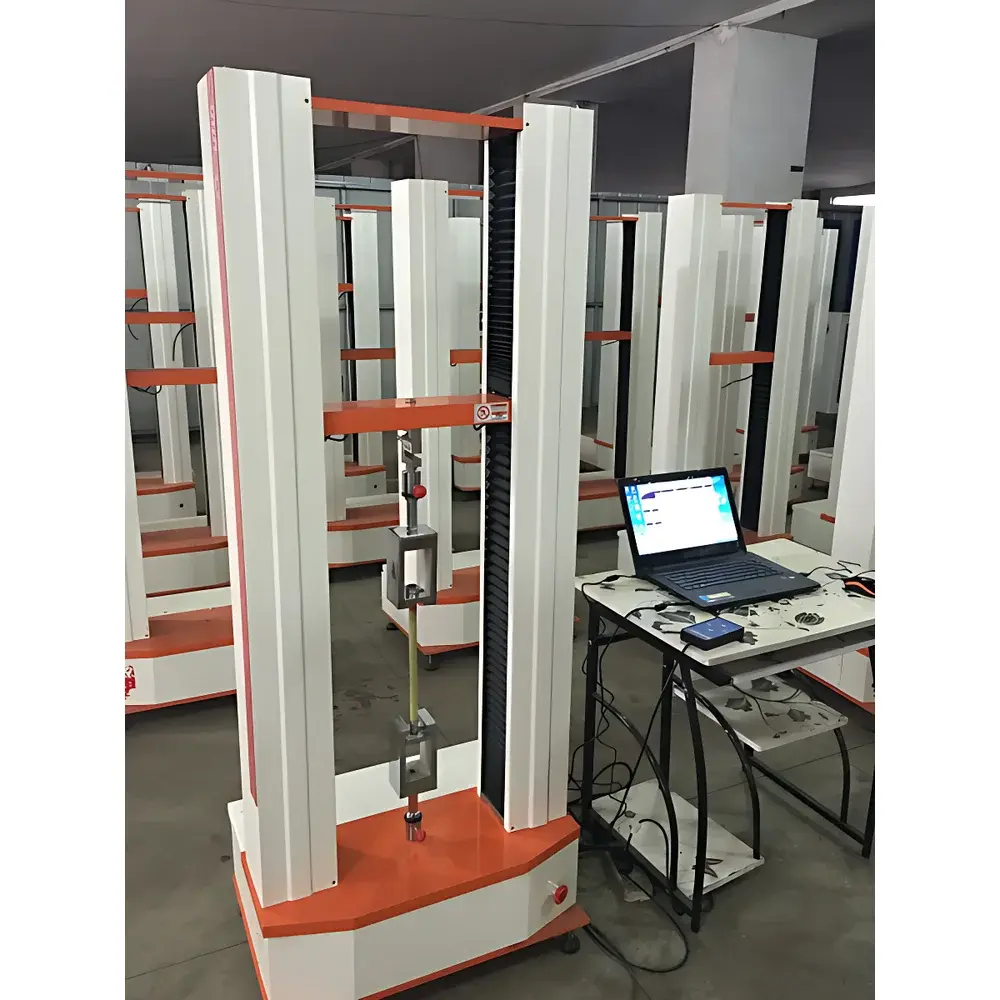
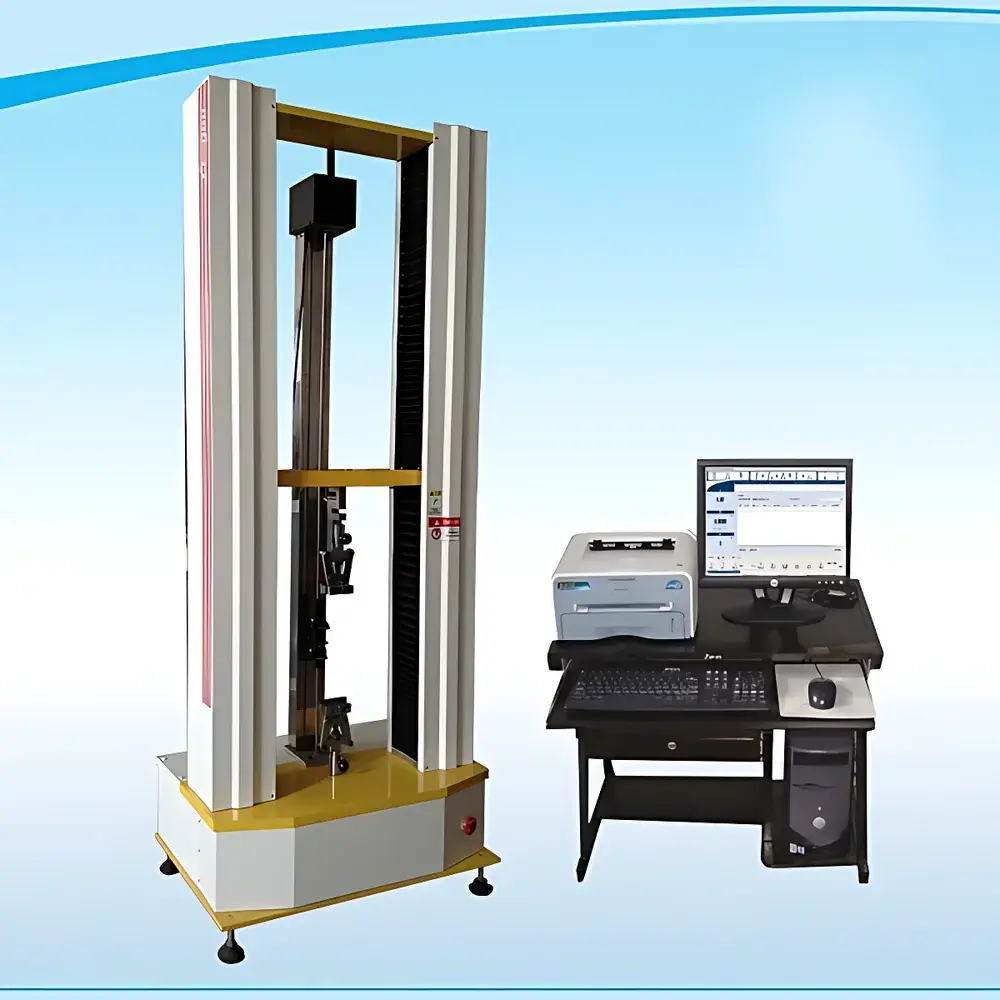
Beiguang Jingyi BWN Series Universal Testing Machine for Ballistic Rope Tensile Strength Evaluation
| Brand | Beiguang Jingyi / All Precision Instrument |
|---|---|
| Origin | Beijing, China |
| Manufacturer Type | OEM Manufacturer |
| Instrument Type | Electromechanical Universal Testing Machine |
| Model | BWN Series |
| Force Sensor Range | 0–1 kN (±0.5% accuracy) |
| Speed Range | 0.01–500 mm/min |
| Test Width | 350 mm |
| Crosshead Travel | 950 mm (excluding fixtures) |
| Displacement Resolution | 0.001 mm |
| Data Acquisition | 24-bit A/D, 200 Hz sampling |
| Compliance | GB/T 16491, ASTM D412, ISO 37, ISO 1421, EN 12995, DIN 53507-A |
| Software | UTM107 + Windows-based test suite with multi-standard module support (GB, ASTM, ISO, DIN, JIS, BS), real-time curve plotting, Excel/Word report export, audit-ready data logging |
Overview
The Beiguang Jingyi BWN Series Universal Testing Machine is an electromechanical tensile testing system engineered for high-reproducibility mechanical property evaluation of high-strength fibrous and composite materials—specifically designed to meet the stringent demands of ballistic rope qualification, safety-critical tethering systems, and defense-grade textile performance validation. Operating on the principle of controlled uniaxial force application via precision ball-screw actuation and closed-loop servo control, the system delivers traceable, repeatable load-displacement data across a wide dynamic range (0.01–500 mm/min). Its architecture complies with fundamental metrological requirements defined in ISO/IEC 17025 for testing laboratories and supports full alignment with mechanical testing protocols referenced in MIL-STD-461, NATO AEP-97, and STANAG 4298 for kinetic energy absorption and failure mode analysis of tactical restraint systems.
Key Features
- High-fidelity load measurement using a calibrated 0–1 kN load cell (±0.5% full-scale accuracy), featuring seven auto-ranging segments (×1 to ×100) and 1/100,000 internal resolution.
- Robust mechanical frame with rigid dual-column construction and precision-ground ball screws, ensuring minimal deflection (<0.2/1000 horizontal deviation) under peak loads.
- Real-time dual-mode control: strain-rate-controlled and load-rate-controlled modes, plus programmable hold steps for creep and stress-relaxation profiling.
- Integrated safety subsystems including overload emergency stop, upper/lower travel limit switches, leakage current protection, and automatic breakpoint halt with position memory.
- Modular fixture interface compatible with wedge-action, pneumatic, and custom-designed grips for ropes up to 40 mm diameter and braided or twisted architectures.
- 24-bit analog-to-digital conversion at 200 Hz sampling rate ensures fidelity in capturing transient rupture events and hysteresis loops during cyclic loading.
Sample Compatibility & Compliance
The BWN Series accommodates a broad spectrum of high-performance materials relevant to personal protective equipment (PPE), aerospace tethers, naval mooring lines, and military-grade fastening systems. Validated sample forms include aramid (e.g., Kevlar®, Twaron®), ultra-high-molecular-weight polyethylene (UHMWPE), Dyneema®, PBO fibers, hybrid braids, and coated synthetic cables. The system fully supports standardized test methods per ASTM D412 (tensile properties of vulcanized rubber), ISO 37 (rubber—determination of tensile strength and elongation at break), ISO 1421 (rubber- or plastics-coated fabrics—determination of tensile strength and elongation at break), and EN 12995 (ropes—determination of breaking force). It also facilitates non-standard protocol execution—including dynamic impact preloading, sequential tension-hold-release cycles, and multi-point modulus interpolation—required for ballistic rope certification under NIJ Standard-0101.06 Annex A and ISO 20471 Annex C.
Software & Data Management
The UTM107 software platform operates natively on Windows OS and provides full GLP/GMP-aligned data governance. It includes configurable audit trails compliant with FDA 21 CFR Part 11 (electronic signatures, user access tiers, immutable raw data archiving), automated metadata tagging (operator ID, calibration certificate ID, environmental log), and timestamped event history for every test cycle. Users may define custom calculation formulas, assign material-specific constants (e.g., cross-sectional correction factors for non-uniform rope geometry), and generate multi-parameter reports in Excel or Word formats—with embedded stress-strain curves, statistical summaries (mean, SD, CV%), and pass/fail flags against predefined specification limits. All raw data files are stored in open binary format (.utd) with ASCII export capability, enabling third-party analysis in MATLAB, Python (NumPy/Pandas), or LabVIEW environments. Backup is supported across local drives, network shares, or NAS endpoints without proprietary lock-in.
Applications
This system serves as a primary verification tool in R&D labs, quality assurance departments, and accredited third-party testing facilities performing mechanical qualification of: ballistic-resistant cords and slings; parachute suspension lines; UAV tether cables; marine salvage ropes; explosion containment netting; and medical-grade suture anchor tendons. It enables determination of ultimate tensile strength (UTS), breaking tenacity (cN/tex), elongation at break (%), modulus at 1%, 5%, and 10% strain, energy-to-break (J), work-of-fracture (N·mm), and post-yield deformation behavior. Additional capabilities include peel adhesion testing (per ASTM D903), shear resistance of spliced terminations, and cyclic fatigue life assessment under variable amplitude loading profiles. Its modularity allows integration with environmental chambers (–40°C to +85°C) and humidity control units for climate-conditioned performance mapping.
FAQ
What standards does this machine support for ballistic rope testing?
It natively implements ASTM D412, ISO 37, ISO 1421, EN 12995, and DIN 53507-A. Custom test sequences can be configured to align with NIJ 0101.06, STANAG 4298, and ISO 20471 requirements.
Can it accommodate ropes with diameters exceeding 25 mm?
Yes—standard wedge grips support up to 40 mm diameter; optional heavy-duty hydraulic clamps extend capacity to 60 mm with uniform pressure distribution.
Is the software validated for regulated industries?
Yes—the UTM107 suite includes 21 CFR Part 11-compliant electronic signature workflows, role-based access control, and immutable audit logs suitable for FDA, EMA, and ISO 13485-regulated environments.
How is calibration traceability maintained?
Each load cell ships with NIST-traceable calibration certificate (ISO/IEC 17025 accredited); onboard dual-point linearization and seven-range auto-correction ensure long-term stability between external recalibrations.
Does the system support real-time data streaming to SCADA or MES platforms?
Yes—via RS232 serial output or optional Ethernet TCP/IP interface using Modbus RTU or custom ASCII protocol; raw data packets include timestamp, load (N), displacement (mm), and status flags.



