
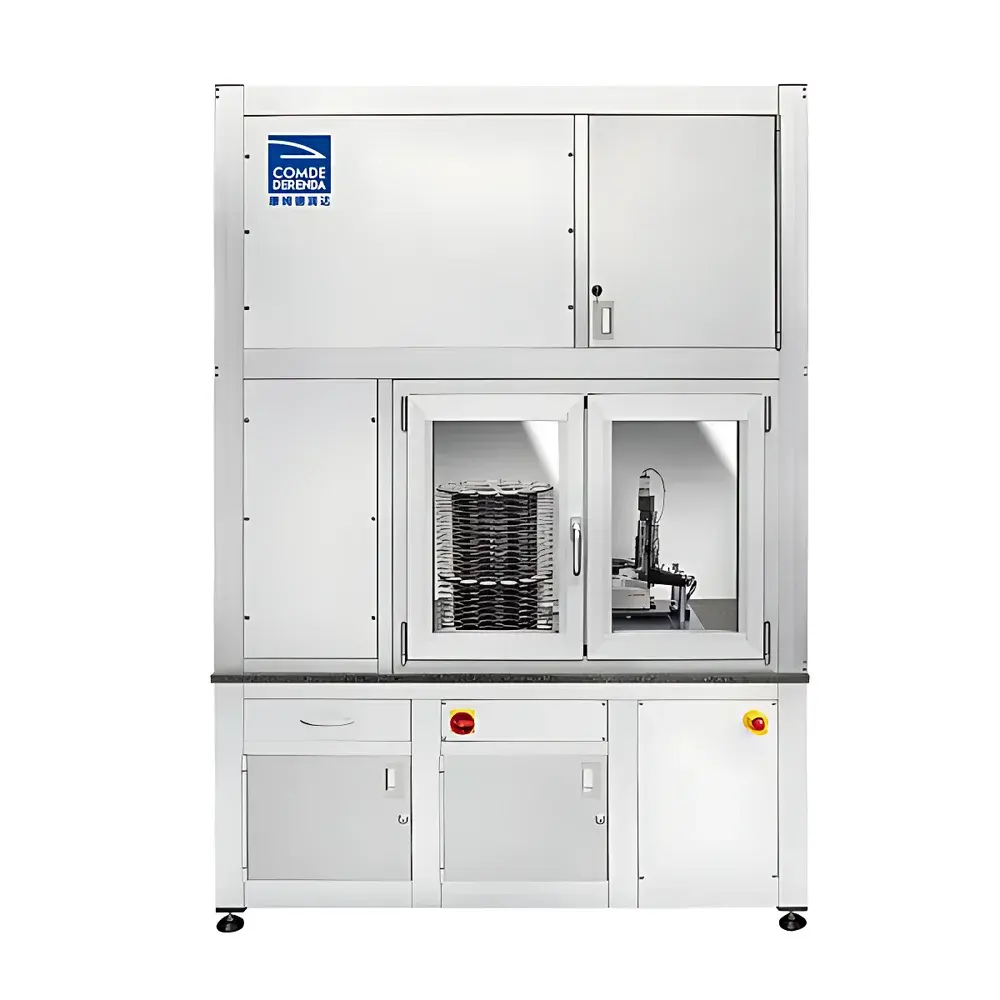
Derenda AWS Fully Automated Constant Temperature & Humidity Weighing System
| Brand | Derenda |
|---|---|
| Origin | Germany |
| Model | AWS |
| Category | Automated Filter Weighing Platform for Ambient Particulate Matter Analysis |
| Compliance | HJ 656-2013, EN 12341:2014, EN 14907:2005, US EPA QA Document 2.12, ISO 14644 Class 6 Cleanroom |
| Sample Capacity | ≥750 × 47 mm filters / batch, ≥350 × 90 mm filters / cycle, ≥90 low-concentration samplers or No.3 impingers / cycle |
| Temperature Control | 15–30 °C, stability ±0.1 °C, uniformity ±0.5 °C, accuracy ±0.5 °C |
| Relative Humidity Control | 45–55 %RH, stability ±1 %RH, uniformity ±2 %RH, accuracy ±2 %RH |
| Weighing Resolution | 0.001 mg (1 µg), repeatability < ±0.003 mg, linearity deviation < 0.02 mg, stabilization time ≤5 s |
| Electrostatic Dissipation | ≥92 %, real-time charge monitoring optional |
| Weighing Time per Filter | ≤20 s |
| Vibration Isolation | Four-stage active/passive decoupling |
| Cleanroom Class | ISO 14644-1 Class 6 (1,000 particles ≥0.5 µm/ft³) |
| RFID Encoding | Automatic filter identification via embedded chip in filter holder |
| Data Management | Cloud-integrated QA/QC matching, automatic mass concentration calculation (PM₁, PM₂.₅, PM₁₀, TSP), full audit trail compliant with GLP/GMP principles |
| Power Requirement | 1400 W (integrated HVAC module), operating ambient: 5–45 °C |
| Dimensions | 1620 × 900 × 2325 mm (L×W×H) |
| Weight | <800 kg |
Overview
The Derenda AWS Fully Automated Constant Temperature & Humidity Weighing System is an ISO 14644 Class 6 cleanroom-grade analytical platform engineered for gravimetric quantification of airborne particulate matter collected on filter media. It implements a rigorously controlled microclimate—maintaining temperature within ±0.1 °C and relative humidity within ±1 %RH—to satisfy the stringent preconditioning requirements defined in HJ 656-2013, EN 12341:2014, US EPA QA Document 2.12, and other internationally harmonized ambient air quality standards. Unlike conventional manual or semi-automated balance chambers, the AWS integrates a closed-loop environmental control system, a 3D robotic sample handling mechanism, and high-resolution microgram-level mass measurement into a single validated architecture. Its operational principle relies on thermodynamic equilibrium stabilization of filter substrates prior to gravimetric analysis, eliminating hygroscopic drift and electrostatic artifacts that compromise measurement fidelity. The system is purpose-built for regulatory-compliant PM₁, PM₂.₅, PM₁₀, and TSP monitoring programs, supporting both routine network operations and high-throughput research laboratories.
Key Features
- Four-stage vibration isolation architecture: Independent weighing island decoupled from structural frame via elastomeric mounts and inertial mass (~80 kg), ensuring sub-microgram stability even in non-dedicated laboratory spaces.
- RFID-enabled smart filter management: Each filter holder contains an embedded transponder enabling automated tracking across preconditioning, identification, weighing, and data linkage—eliminating manual coding errors and enabling full traceability.
- Integrated electrostatic neutralization: High-efficiency ionizing system achieves ≥92% static charge removal; optional real-time surface charge monitoring provides quantitative validation per filter during weighing.
- Dual-mode environmental control: Precise PID-regulated temperature (15–30 °C, ±0.1 °C stability) and humidity (45–55 %RH, ±1 %RH stability) modules operate independently from external HVAC infrastructure—no dedicated climate-controlled room required.
- High-throughput robotic handling: 3D Cartesian manipulator accesses up to 750 positions for 47 mm filters or 350 positions for 90 mm filters without mechanical interference, minimizing cycle time and cross-contamination risk.
- Modular pre-conditioning chamber: Dedicated side compartment maintains identical environmental conditions as the weighing chamber, allowing parallel equilibration of incoming samples while active weighing proceeds uninterrupted.
- Compliance-ready data architecture: All weighings generate timestamped, operator-agnostic records with digital signatures; metadata includes environmental logs, balance diagnostics, RFID IDs, and QC flags—fully compatible with 21 CFR Part 11 audit trail requirements.
Sample Compatibility & Compliance
The AWS accommodates standardized environmental sampling media including glass fiber, quartz, and PTFE filters (47 mm and 90 mm diameters), low-concentration PM samplers (e.g., EPA Method 201A), and ASTM D3222-compliant No.3 impingers. Its physical design conforms to ISO 14644-1 Class 6 cleanroom specifications (≤1,000 particles ≥0.5 µm per cubic foot), ensuring minimal airborne contamination during handling. Regulatory alignment spans multiple jurisdictions: it fulfills the gravimetric preconditioning mandates of China’s HJ 656-2013, the European EN 12341:2014 and EN 14907:2005 protocols, US EPA Quality Assurance Guidance Document 2.12 for ambient air monitoring, Japan’s JIS K 0127 and JCO8H methodologies, India’s CPCB Bharat Stage IV guidelines, and Brazil’s PROCONVE L4–L5 emission testing frameworks. All firmware and software modules are validated per GLP principles, with configurable user access levels and immutable audit logs.
Software & Data Management
The AWS operates via dual-control interface: embedded touchscreen HMI and remote PC-based client software supporting Windows/Linux environments. The system embeds a relational database (SQLite with ACID compliance) storing raw mass values, environmental sensor readings, RFID events, balance diagnostics, and operator actions. Data export supports CSV, PDF, and XML formats—including direct integration with national air quality databases (e.g., CNEMC, EEA AQ e-Reporting, US EPA AirNow). Cloud synchronization enables centralized QA/QC review: blank filters, field blanks, spiked controls, and field samples are auto-matched to corresponding sampling event metadata, enabling automatic calculation of net particulate mass concentrations with uncertainty propagation. All data modifications are logged with ISO/IEC 17025-compliant audit trails—including timestamps, user credentials, IP addresses (for remote sessions), and reason-for-change annotations.
Applications
- Ambient air quality monitoring networks requiring daily processing of hundreds of PM filters under standardized gravimetric protocols.
- National reference laboratories performing method validation, inter-laboratory comparisons, and proficiency testing under ISO/IEC 17025 accreditation.
- Research institutions studying aerosol hygroscopic growth, filter substrate interactions, or long-term stability of reference materials.
- Industrial hygiene programs quantifying workplace respirable dust fractions (e.g., coal, silica, metal fumes) using NIOSH/OSHA-compliant filter sets.
- Environmental consultancies managing multi-site compliance reporting where chain-of-custody integrity and audit readiness are contractual obligations.
FAQ
Does the AWS meet US EPA equivalency requirements for FRM/FEM filter weighing?
Yes—the system satisfies all technical criteria outlined in EPA QA Document 2.12, including temperature/humidity control tolerances, static elimination efficiency, balance resolution (≤1 µg), and environmental stability metrics required for Federal Reference Method (FRM) and Federal Equivalent Method (FEM) particulate monitoring.
Can the AWS be integrated into an existing LIMS environment?
Yes—via RESTful API and ODBC-compliant database connectors, enabling bidirectional synchronization of sample IDs, weighing results, and QC flags with major LIMS platforms (e.g., LabWare, STARLIMS, Thermo Fisher SampleManager).
Is calibration of the internal balance traceable to NIST or PTB standards?
All factory-installed balances include full calibration certificates issued by accredited metrology laboratories (DAkkS or UKAS), with traceability to PTB (Physikalisch-Technische Bundesanstalt) for German-supplied units and NIST for North American deployments.
What maintenance intervals are recommended for the HVAC and robotic subsystems?
Scheduled preventive maintenance is advised every 6 months, covering HEPA filter replacement, humidity sensor recalibration, robotic arm lubrication, and balance performance verification using certified weights—documentation aligns with ISO 17025 clause 6.4.6.
How does the system handle filter edge effects or non-uniform deposition during weighing?
The AWS employs center-positioning algorithms and adaptive load-cell compensation routines that correct for minor eccentric loading; however, users must adhere to standardized filter mounting procedures (e.g., EN 12341 Annex B) to ensure consistent geometry and avoid systematic bias.



