
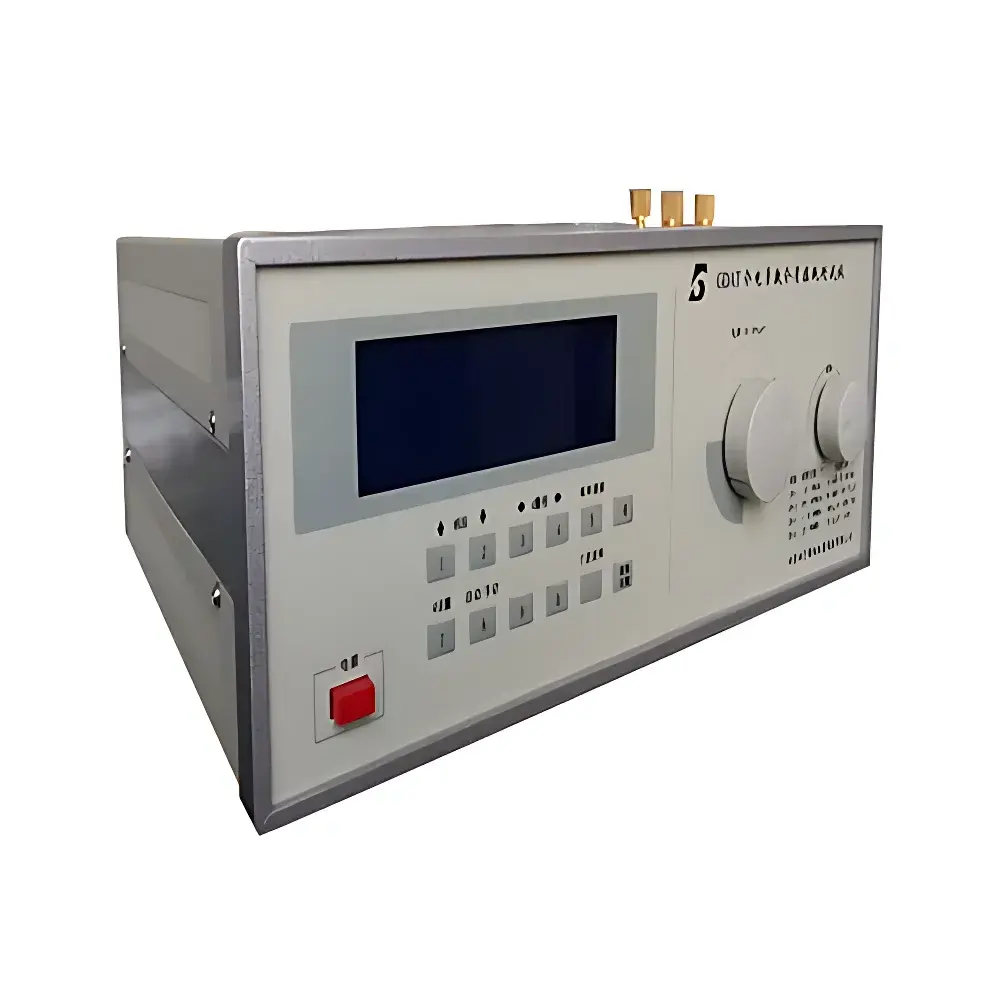
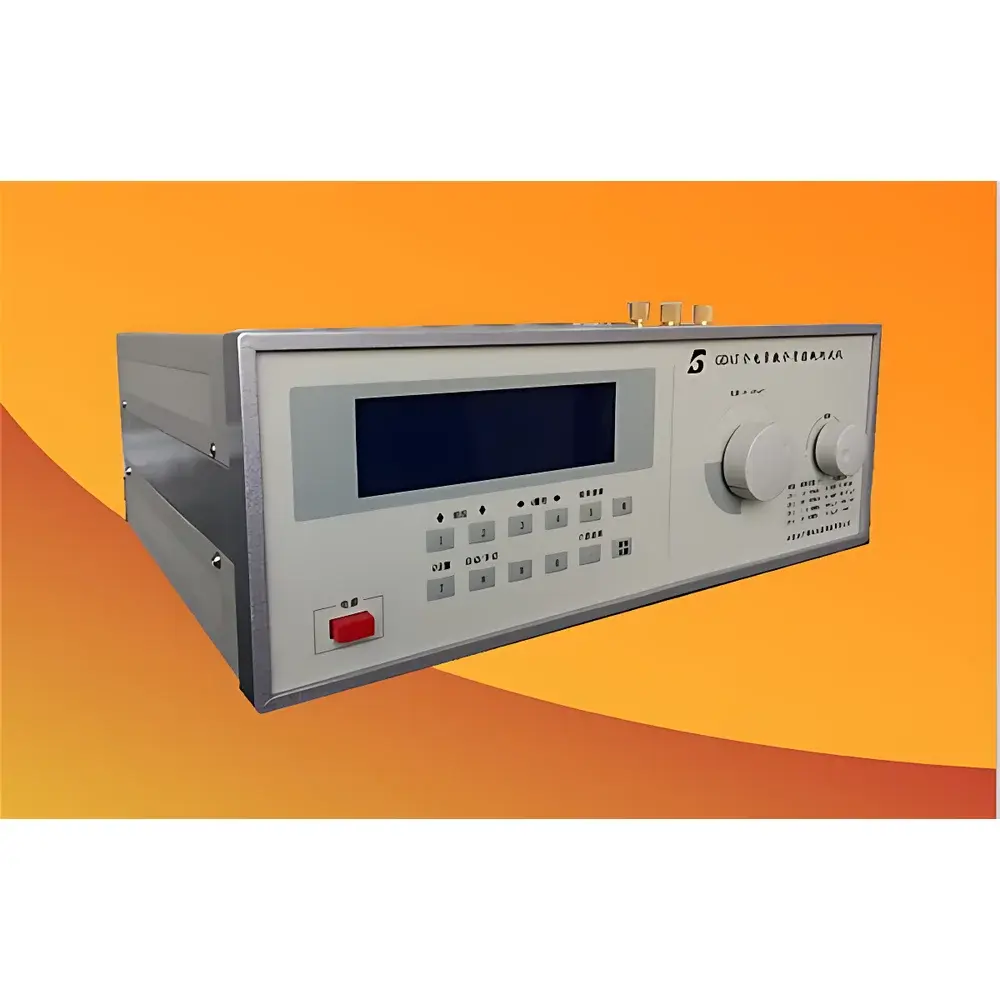
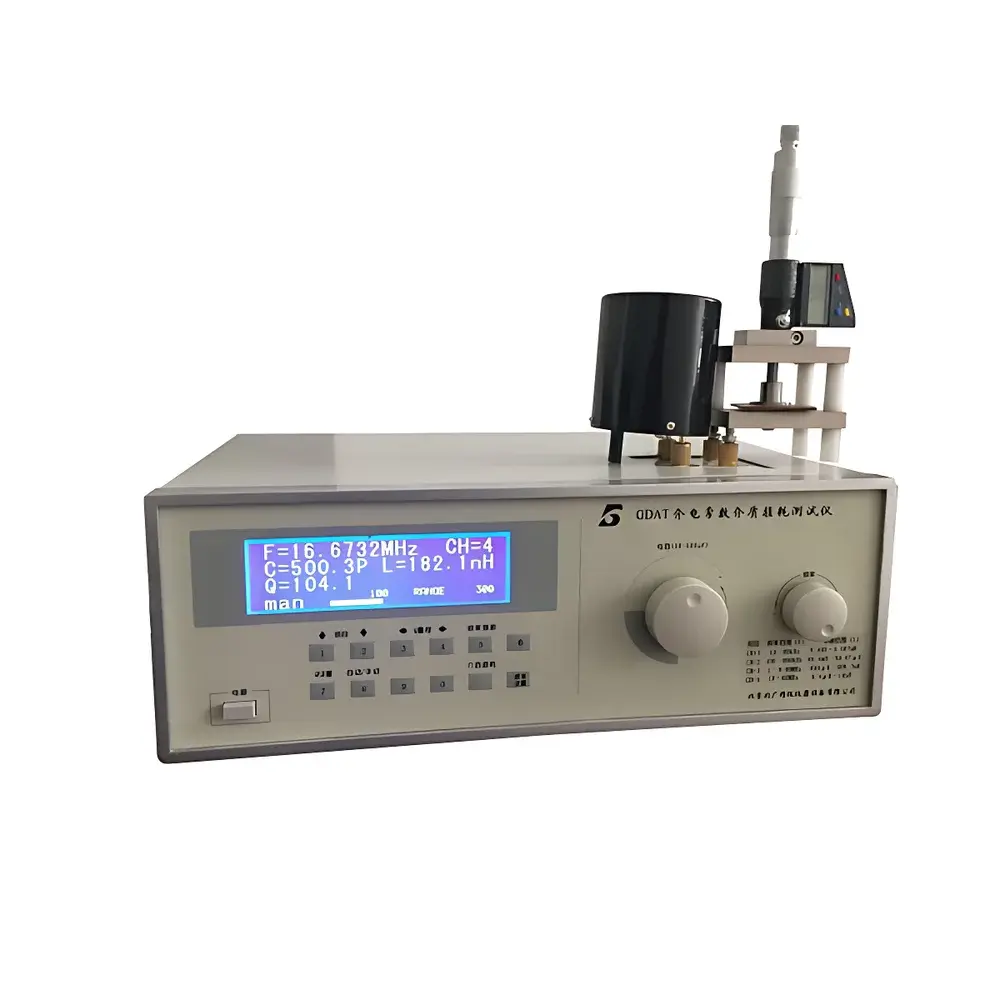
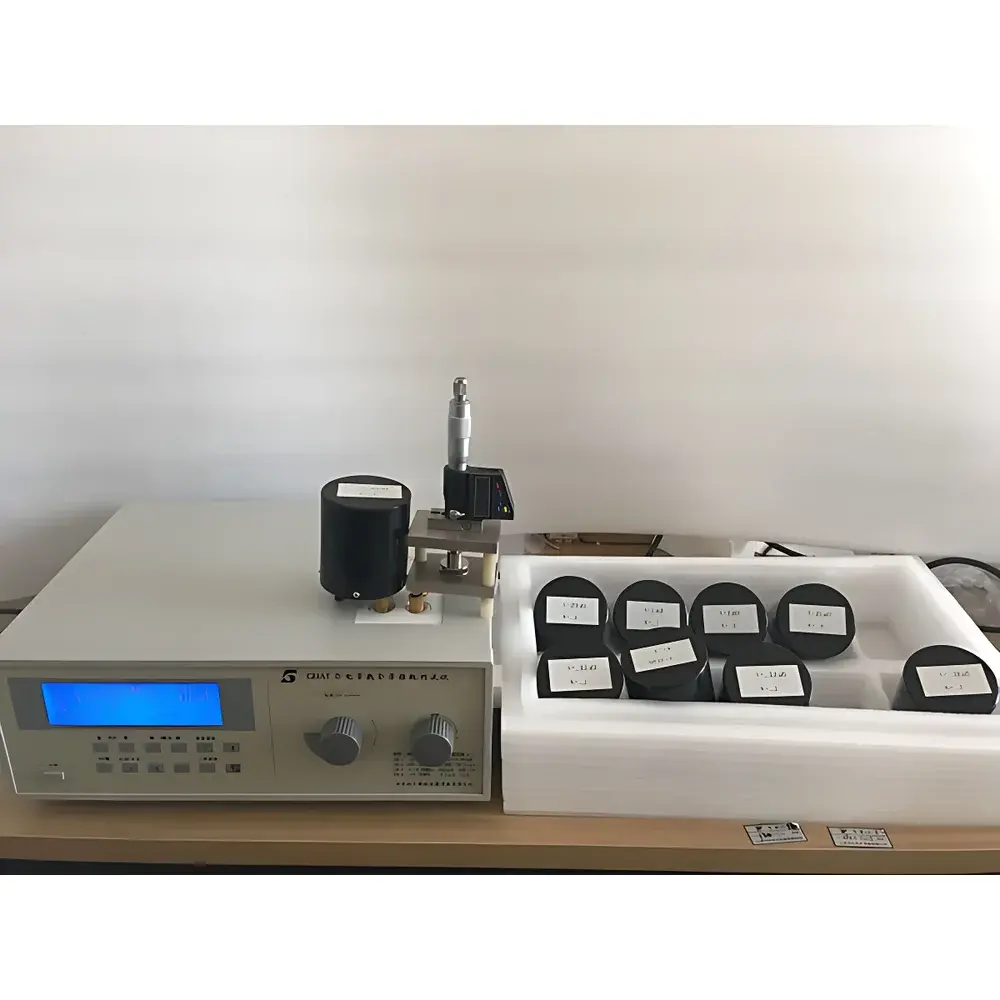
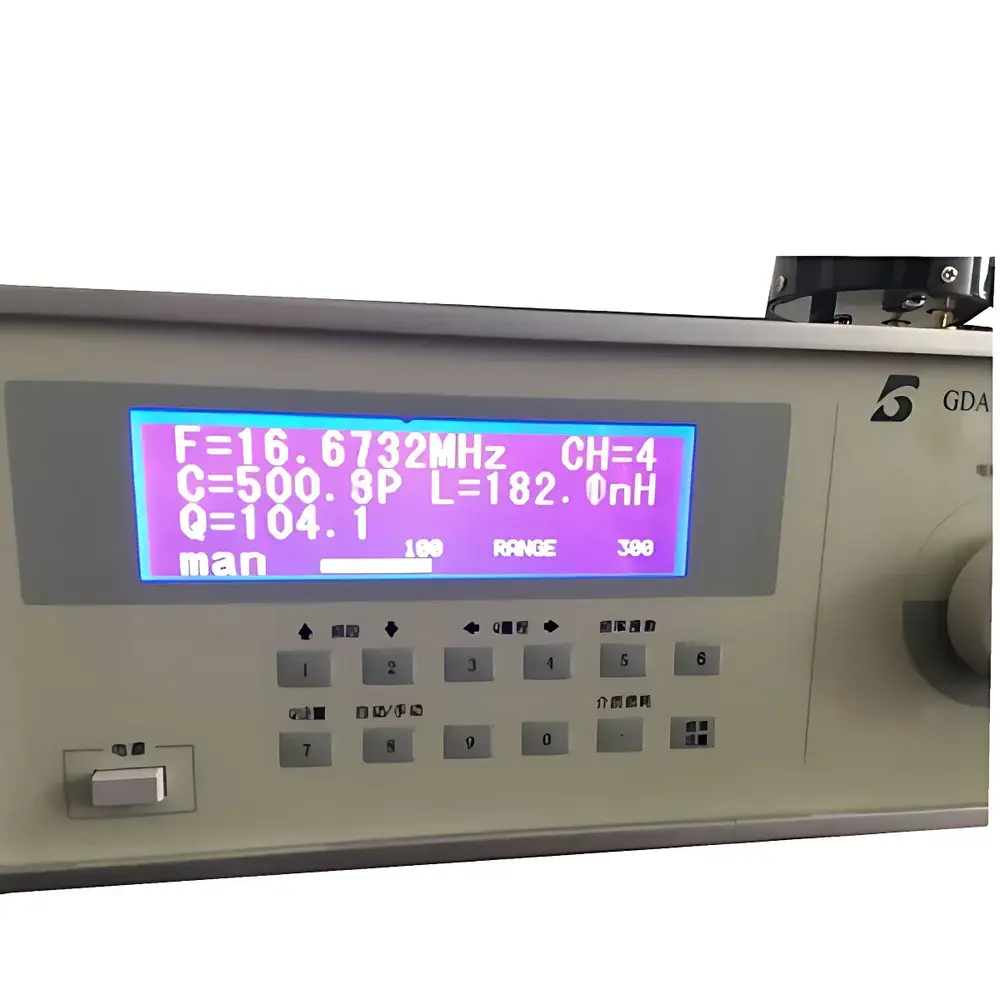
Beiguang Jingyi GDAT-70MHz High-Frequency Dielectric Constant Analyzer
| Brand | Beiguang Jingyi / All Precision Instrument |
|---|---|
| Origin | Beijing, China |
| Manufacturer Type | Manufacturer |
| Product Origin | Domestic (China) |
| Model | GDAT-70MHz |
| Price | USD 1,850 (approx.) |
Overview
The Beiguang Jingyi GDAT-70MHz High-Frequency Dielectric Constant Analyzer is a precision impedance measurement instrument engineered for accurate determination of complex permittivity (ε* = ε′ − jε″), dielectric loss tangent (tan δ), and quality factor (Q) of solid and liquid dielectric materials in the RF to lower microwave frequency range. It operates on the principle of resonant cavity perturbation and series/parallel resonance methods using a calibrated high-Q LC oscillator circuit. The system functions as a high-stability Q-meter with direct readout of Q, capacitance, inductance, and distributed parameters—enabling quantitative characterization of polarization mechanisms, conduction losses, and relaxation behavior in insulating materials under alternating electric fields. Designed for laboratory-based R&D and QC environments, it supports standardized evaluation of dielectrics used in printed circuit board (PCB) substrates, capacitor films, polymer composites, ceramic insulators, and aerospace-grade laminates.
Key Features
- Frequency coverage from 10 kHz to 60 MHz (with extended calibration up to 160 MHz across four selectable channels)
- Dual-mode operation: automatic resonance search and manual fine-tuning with digital capacitance adjustment (main tuning capacitor with sub-pF resolution)
- High-resolution frequency display with ±1 digit accuracy and base error ≤ 3 × 10⁻⁵
- Low-residual-impedance test fixture architecture minimizing stray inductance and parasitic capacitance
- Integrated DC bias capability (±12 V) for evaluating field-dependent permittivity and loss behavior
- Direct analog output (0–12 V RMS) compatible with external data acquisition systems and oscilloscopes
- Input impedance > 1012 Ω and output impedance < 0.6 Ω ensure minimal loading effects during high-impedance measurements
Sample Compatibility & Compliance
The GDAT-70MHz accommodates standard parallel-plate, coaxial, and solenoid coil configurations for bulk solids, thin films, powders, and low-conductivity liquids. Sample holders are constructed from low-loss polytetrafluoroethylene (PTFE) or polystyrene to minimize dielectric interference. Measurement protocols align with ASTM D150 (Standard Test Methods for Dielectric and Resistivity Properties of Solid Electrical Insulating Materials), IEC 60250 (Determination of the Dielectric Constant and Dissipation Factor of Electrical Insulating Materials at Power, Audio and Radio Frequencies), and ISO 257 (Plastics — Determination of the Dielectric Constant and Dissipation Factor). The instrument supports GLP-compliant documentation when paired with validated external logging software; while not natively 21 CFR Part 11 compliant, audit trails and user access control can be implemented via third-party DAQ platforms.
Software & Data Management
The GDAT-70MHz operates as a hardware-centric instrument without embedded firmware-based software. It delivers analog and digital outputs suitable for integration with industry-standard data acquisition systems (e.g., National Instruments DAQmx, Keysight PathWave, or MATLAB Data Acquisition Toolbox). Users may implement custom scripts for automated frequency sweeps, Q-factor mapping, Cole-Cole plot generation, and Arrhenius/TSDC analysis. Calibration certificates include traceable NIST-traceable reference standards for capacitance (±0.05%) and frequency (±10 ppm). All raw voltage-phase and resonance parameter outputs are time-stamped and exportable in CSV or TDMS format for post-processing in Python (SciPy), OriginLab, or JMP.
Applications
- Quality control of high-frequency PCB laminates (e.g., Rogers RO4000®, Taconic RF-35) for ε′ stability and tan δ consistency across 1–50 MHz bands
- Development of low-loss polymer dielectrics for 5G antenna substrates and millimeter-wave packaging
- Characterization of ferroelectric thin films (e.g., BaTiO3, PZT) for tunable capacitor applications
- Moisture content assessment in hygroscopic insulators via frequency-dependent tan δ shifts
- Evaluation of aging effects in epoxy resins and silicone encapsulants under thermal cycling
- Validation of electromagnetic simulation models (CST, HFSS) with experimentally derived ε*(f) datasets
FAQ
What is the recommended warm-up time before performing calibrated measurements?
A minimum 30-minute warm-up period is required to stabilize internal oscillator temperature and reference voltage rails, ensuring measurement repeatability within ±0.5% Q and ±1.2% tan δ.
Can the GDAT-70MHz measure samples with conductive fillers or high-loss ceramics?
Yes—within its operational Q-range (typically Q ≥ 10). For highly conductive or lossy materials (tan δ > 0.1), use the low-inductance coil configuration (e.g., CH1 or CH2) and apply series-resonance correction algorithms to mitigate skin-effect errors.
Is external shielding mandatory for reliable measurements?
Shielding is strongly recommended for frequencies above 1 MHz. The instrument includes a grounded low-impedance shield terminal; users must connect the sample enclosure or Faraday cage to this point to suppress EMI-induced phase drift.
How is residual capacitance compensated during high-precision permittivity calculation?
The manual provides step-by-step open-circuit/short-circuit compensation procedures. Users perform two-point calibration (empty fixture and reference standard) to derive C0 and L0 offsets, which are then subtracted from raw resonance data prior to ε′/tan δ derivation using standard cavity perturbation equations.
Does the instrument support automated frequency sweeps?
No native sweep function is embedded; however, full remote control is enabled via analog voltage input (0–10 V = 10 kHz–60 MHz) and TTL-triggered Q-readout, enabling seamless integration with programmable signal generators and GPIB/LAN-enabled DAQ systems.
Related Products



