
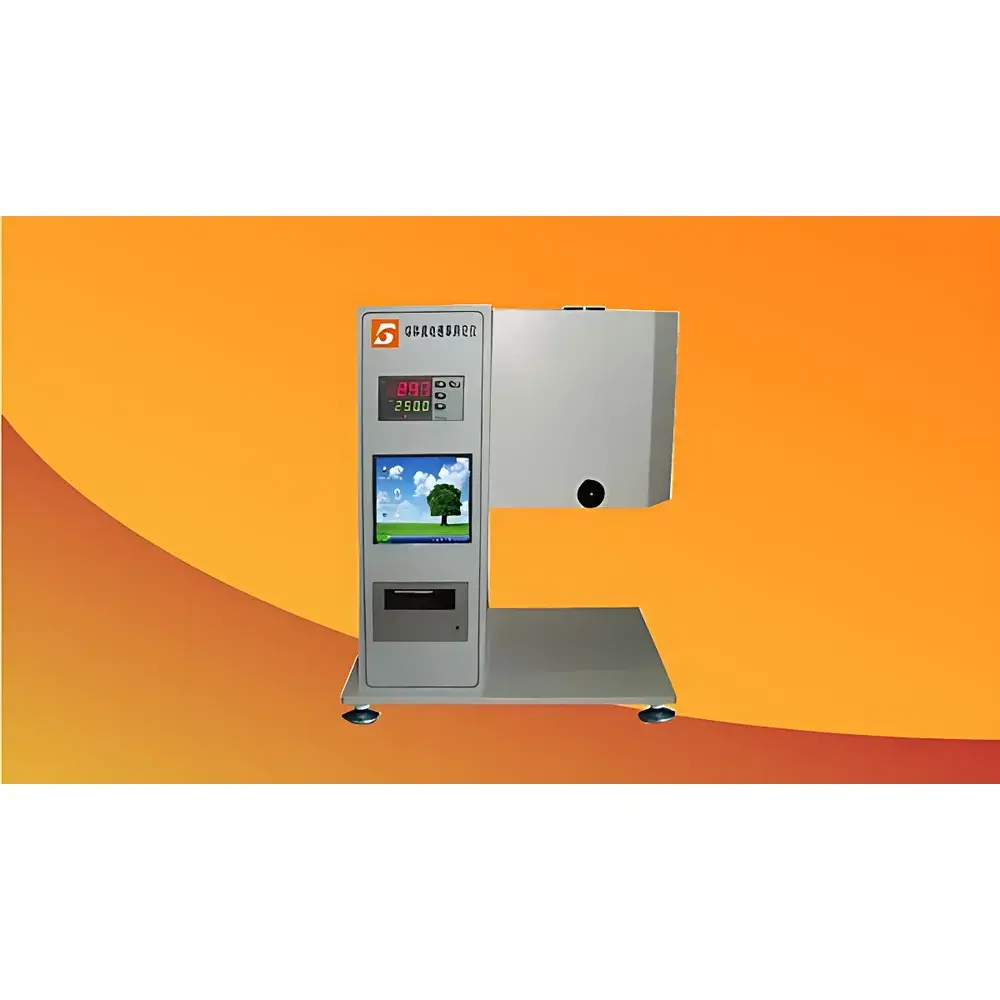
Beiguang Jingyi HRZ-400B Melt Flow Indexer
| Brand | Beiguang Jingyi / All Precision Instrument |
|---|---|
| Origin | Beijing, China |
| Manufacturer Type | Direct Manufacturer |
| Country of Origin | China |
| Model | HRZ-400B |
| Price | USD 1,350 (FOB Beijing) |
| Temperature Control Range | Ambient to 450 °C |
| Temperature Accuracy | ±0.2 °C |
| Temperature Resolution | 0.1 °C |
| Max Power Consumption | ≤500 W |
| Temperature Recovery Time | ≤4 min |
| MFR Range | 0.03–450 g/10 min |
| Piston Displacement Accuracy | ±0.1 mm |
| Standard Barrel ID | 9.55 ±0.025 mm |
| Piston Head Diameter | 9.475 ±0.015 mm |
| Die Orifice Options | 2.095 ±0.005 mm & 1.18 ±0.01 mm |
| Standard Weights | 0.325 kg, 0.875 kg, 0.960 kg, 1.200 kg, 1.640 kg (±0.5% tolerance) |
Overview
The Beiguang Jingyi HRZ-400B Melt Flow Indexer is a precision-engineered instrument designed for the standardized determination of melt mass flow rate (MFR) and melt volume flow rate (MVR) of thermoplastic polymers under defined load and temperature conditions. Based on the fundamental principle of extrusion rheometry—where molten polymer is forced through a standardized capillary die under controlled gravitational or applied load—the HRZ-400B delivers repeatable, traceable results compliant with major international test standards including ISO 1133-1:2011, ASTM D1238-22, and GB/T 3682.2–2018. Its robust thermal architecture, high-stability PID-controlled heating system, and dual-mode measurement capability (mass-based A method and volume-based B method) make it suitable for routine QC in compounding plants, R&D laboratories, and third-party certification bodies requiring GLP-aligned data integrity.
Key Features
- Microprocessor-based control system with fully programmable test sequences aligned to ISO/ASTM procedural requirements
- High-efficiency heating block fabricated from nickel-chromium alloy casting—resistant to thermal degradation up to 450 °C, eliminating failure modes associated with conventional resistance wire elements
- True-color 65,535-color TFT touchscreen interface with multilingual support (English firmware optional), providing real-time graphical feedback of piston displacement, temperature stability, and elapsed test time
- Automatic cutting mechanism capable of severing high-viscosity or semi-crystalline melts—including rigid polyolefins and engineering thermoplastics—without operator intervention
- Dual-sensor temperature monitoring using imported dual-display digital controllers ensures spatial uniformity across the barrel zone (±0.2 °C accuracy at setpoint)
- Integrated optical encoder for MVR mode enables precise piston displacement tracking over a 30 mm reference distance (±0.1 mm resolution)
- Onboard thermal recovery algorithm achieves ≤4-minute return to target temperature after material loading—critical for high-throughput batch testing
- Embedded thermal calibration routine supports user-performed verification per ISO 1133 Annex C and ASTM D1238 Section 8.2
Sample Compatibility & Compliance
The HRZ-400B accommodates a broad spectrum of thermoplastic resins, including but not limited to polyethylene (PE), polypropylene (PP), polystyrene (PS), ABS, polyamide (PA6/PA66), polyacetal (POM), fluoropolymers (e.g., PTFE, PVDF), and polycarbonate (PC). It supports both standard and extended-range test conditions—such as elevated temperatures (up to 450 °C) and variable loads (0.325–1.640 kg)—to meet classification requirements for specialty grades (e.g., ultra-high-MFR PP for fiber spinning or low-MFR PC for structural applications). All mechanical dimensions—including barrel bore (9.55 ±0.025 mm), piston head (9.475 ±0.015 mm), and die orifices (2.095 ±0.005 mm and 1.18 ±0.01 mm)—are manufactured and verified to ISO 1133 Annex A tolerances. The instrument’s metrological traceability path aligns with national standards maintained by CNAS-accredited calibration labs in China, and its operational documentation supports audit readiness for ISO/IEC 17025 and IATF 16949 environments.
Software & Data Management
The embedded operating system logs all critical test parameters—including actual temperature profile, piston displacement curve, cut timing, ambient humidity (via optional sensor input), and operator ID—with timestamped records stored internally (≥1,000 test histories). Data export is supported via USB flash drive in CSV format, preserving raw values, calculated MFR/MVR, and statistical metadata (e.g., mean, SD, n-value). An optional PC communication interface (RS-232 or USB-CDC) enables remote operation and integration with LIMS platforms using ASCII-based command protocols. Audit trail functionality complies with FDA 21 CFR Part 11 requirements when paired with validated software packages—supporting electronic signatures, user access levels, and immutable record retention for regulated pharmaceutical packaging or medical device polymer qualification.
Applications
- Quality control of incoming polymer granules in automotive plastic component manufacturing
- Batch-to-batch consistency verification for flame-retardant ABS used in consumer electronics housings
- Process optimization of polyolefin extrusion lines—correlating MFR shifts with catalyst deactivation or thermal history
- Regulatory submission support for ISO 10993-compliant polymer formulations in medical tubing applications
- Research-grade characterization of nanocomposite melts where shear-thinning behavior influences MFR interpretation
- Technical service support for compounders validating new stabilizer packages against oxidative degradation thresholds
FAQ
Does the HRZ-400B support both MFR and MVR measurement modes?
Yes—it implements ASTM D1238 Method A (gravimetric) and Method B (volumetric) via integrated load cell and optical displacement sensing.
Can the instrument be calibrated to NIST-traceable standards?
While the unit itself is factory-calibrated against CNAS-certified references, users may perform in-house verification using certified reference materials (e.g., NIST SRM 3002) and documented SOPs aligned with ISO/IEC 17025 Clause 6.6.
Is English-language firmware and documentation available?
Yes—English UI firmware, operation manual, and calibration certificate templates are provided upon request at no additional cost.
What maintenance intervals are recommended for long-term reliability?
We recommend quarterly inspection of die orifice geometry, annual verification of temperature uniformity across the barrel zone, and biannual replacement of O-rings and thermal insulation sleeves—per maintenance logbook included with shipment.
How does the HRZ-400B handle high-temperature testing above 350 °C?
The nickel-chromium alloy heating block and ceramic-fiber insulation package ensure stable operation at 450 °C with <0.5 °C axial gradient—validated per ISO 1133 Annex B temperature mapping protocol.
Related Products






