
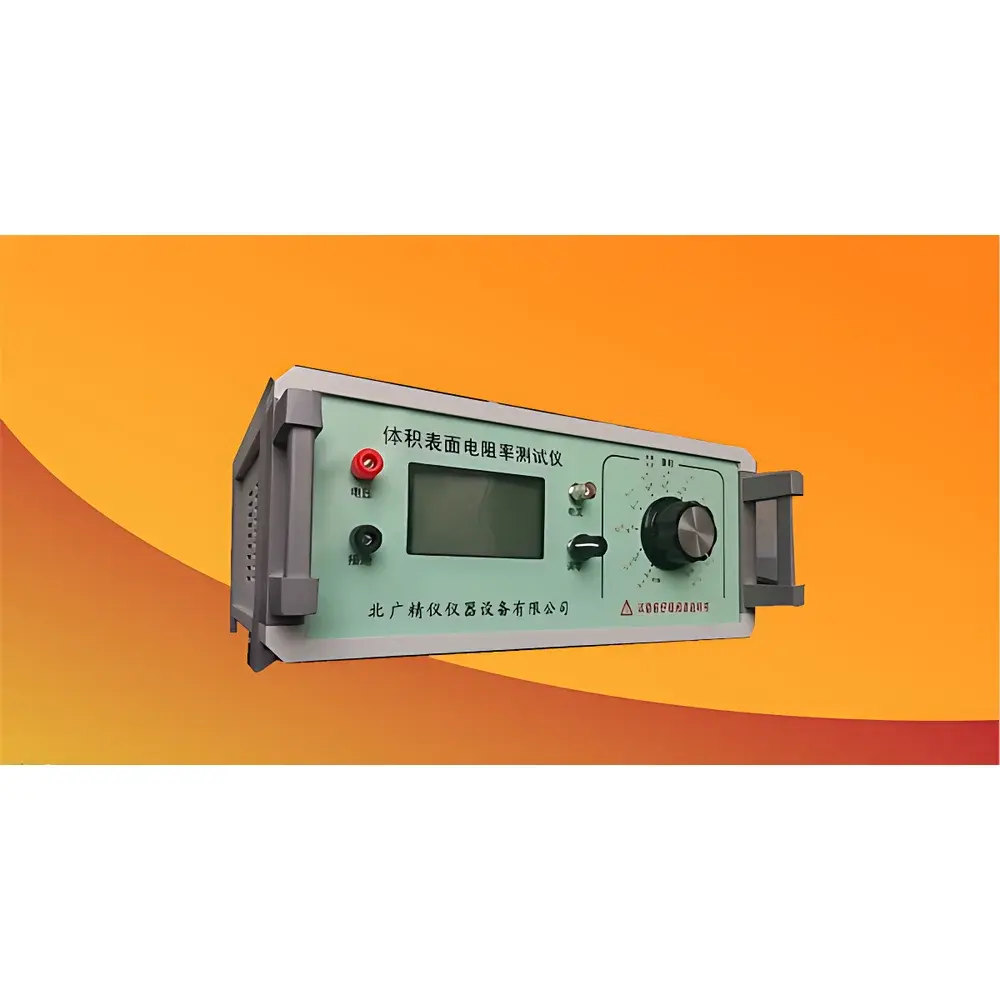
Beiguang Jingyi B-E ST- Volume Resistivity Tester for Rubber & Plastic Industry
| Brand | Beiguang Jingyi / All Precision Instrument |
|---|---|
| Origin | Beijing, China |
| Manufacturer Type | Direct Manufacturer |
| Country of Origin | China |
| Model | B-E ST- |
| Price | USD 1,200 (FOB Beijing) |
| Resistance Range | 1.0 × 10⁴ Ω to 1.0 × 10¹⁶ Ω |
| Volume Resistivity Range | 1.0 × 10⁴ Ω·m to 2.0 × 10¹⁶ Ω·m |
| Test Voltage | 10–1000 V DC, selectable in 6 fixed steps (10/50/100/250/500/1000 V) |
| Accuracy | ±1% of reading (for R ≤ 10¹² Ω) |
| Electrode Configuration | Tri-terminal guarded electrode system per GB/T 1410–2006 and ASTM D257 |
| Operating Environment | 0–40 °C, RH < 80% |
| Compliance Standards | GB/T 1410–2006, GB/T 2439–2001, GB/T 1692–2008, GB/T 10581–2006, ASTM D257, IEC 93:1980 |
Overview
The Beiguang Jingyi B-E ST- Volume Resistivity Tester is a precision-engineered instrument designed specifically for evaluating the bulk electrical insulation performance of elastomers, thermoplastics, plasticizers, and related functional additives used in the rubber and plastics industry. It operates on the principle of direct-current (DC) resistive measurement using a guarded three-electrode configuration—comprising high-voltage, measuring, and guard electrodes—to isolate volume conduction from surface leakage paths. This architecture ensures compliance with standardized test geometries defined in GB/T 1410–2006 (equivalent to IEC 60093:1980) and ASTM D257, enabling accurate determination of volume resistivity (ρv, unit: Ω·m) according to the fundamental relationship ρv = Rv × (S/d), where Rv is measured resistance, S is effective electrode area, and d is sample thickness. The system supports both manual and auto-ranging measurement modes and delivers traceable results under controlled environmental conditions (23 ± 2 °C, 60–70% RH), as required by GB 1672–1988 for liquid plasticizer testing.
Key Features
- Tri-terminal guarded electrode assembly fabricated from brass or stainless steel, conforming to dimensional specifications per GB/T 1410: inner high-voltage electrode diameter 146 mm, measuring electrode outer diameter 120 mm, guard ring width 8 mm, inter-electrode gap 2 mm, and surface roughness ≤ 1.6 µm.
- High-stability digital resistance measurement circuit with input impedance >1017 Ω and shielding integrity verified per IEC 61000-4-3 for electromagnetic immunity.
- Adjustable DC test voltage output (10 V to 1000 V) with six preset levels—10, 50, 100, 250, 500, and 1000 V—enabling application-specific stress profiling per material class and standard requirements.
- Integrated LCD display showing real-time resistance, volume resistivity, surface resistivity, sheet resistance, applied voltage, ambient temperature, and calculated geometric parameters (e.g., cylindrical or rectangular sample dimensions).
- Modular electrode compatibility supporting solids (slabs, sheets), powders (via compression cell), and liquids (using dedicated cup-type electrode)—all referenced to standardized test methods including GB/T 2439–2001 (vulcanized rubber), GB/T 12703.4–2010 (textiles), and SJ/T 10694–2006 (ESD control materials).
- Low power consumption (<5 W), compact benchtop footprint (320 × 280 × 120 mm), and CE-marked safety compliance for laboratory integration.
Sample Compatibility & Compliance
The B-E ST- accommodates diverse sample forms critical to polymer R&D and QC workflows: liquid plasticizers (per GB 1672–1988, 40 mL volume, bubble-free, conditioned 2 h at 23 ± 2 °C/60–70% RH), solid elastomer slabs (thickness 1–10 mm), granular fillers, conductive masterbatches, antistatic coatings, and ESD-safe components (e.g., flooring, footwear, packaging). Its measurement methodology satisfies regulatory and quality system requirements for ISO/IEC 17025-accredited laboratories, including documented calibration traceability to national standards (NIM, China), routine verification per ASTM E1169, and full alignment with GMP-relevant documentation practices. While not FDA 21 CFR Part 11–certified out-of-the-box, audit-ready data logs (when used with optional PC software) support GLP/GMP-compliant record retention when paired with timestamped operator ID entry and electronic signature protocols.
Software & Data Management
An optional Windows-based PC software package (sold separately) provides USB 2.0 connectivity for real-time data streaming, automated calculation of ρv and σ (conductivity), batch report generation (PDF/CSV), and long-term trend analysis across multiple lots or formulations. The software enforces data integrity via automatic metadata capture—including test date/time, operator ID, electrode type, voltage setting, environmental readings, and sample ID—and supports configurable pass/fail thresholds aligned with internal specifications or customer-facing standards (e.g., EN 1149-1 for protective clothing). All raw and processed datasets are stored with SHA-256 checksums to prevent tampering, fulfilling baseline requirements for audit readiness under ISO 9001:2015 Clause 7.5 and IATF 16949 Section 8.5.2.
Applications
This instrument serves core characterization needs across polymer formulation, compounding, and end-product validation: quantifying charge dissipation behavior in carbon-black-filled EPDM compounds; verifying resistivity stability of halogen-free flame-retardant TPEs after thermal aging (per GB/T 10581–2006); screening ionic liquid plasticizers for low-temperature flexibility without compromising dielectric integrity; validating antistatic additive dispersion homogeneity in polyolefin films; and certifying ESD-safe conveyor belt materials per SJ/T 10694–2006. It is routinely deployed in R&D labs at tier-1 automotive suppliers, wire & cable manufacturers, medical device compounders, and contract testing facilities serving ISO 13485–certified production environments.
FAQ
What standards does this instrument directly support?
GB/T 1410–2006, GB/T 2439–2001, GB/T 1692–2008, GB 1672–1988, ASTM D257, IEC 60093, EN 1149-1, and SJ/T 10694–2006.
Can it measure both volume and surface resistivity?
Yes—via interchangeable electrode fixtures: concentric ring electrodes for surface resistivity (ρs) and guarded parallel-plate electrodes for volume resistivity (ρv).
Is calibration certification included?
A factory calibration certificate (traceable to NIM) is supplied with each unit; annual recalibration is recommended per ISO/IEC 17025 Clause 6.6.
Does it require external shielding or grounding?
The integrated shielded test enclosure and grounded chassis eliminate need for external Faraday cages; however, use of dedicated earth ground (≤5 Ω resistance) is mandatory for measurement stability.
What sample preparation is required for liquid plasticizers?
40 mL volume, degassed, conditioned 2+ hours at 23 ± 2 °C and 60–70% RH prior to filling the high-voltage electrode cup to the measurement plane.





